
Visit MARIN
Brave wind and water!
Despite a serious 'storm day' in the Netherlands, most of the KIVI members and their introductions who had registered to visit the MARIN (Maritime Research Institute Netherlands) managed to find their way to Wageningen. Especially nice was the relatively large number of participants who are not (yet) members of the DV department and had registered based on the mention in KIVI's general newsletter.
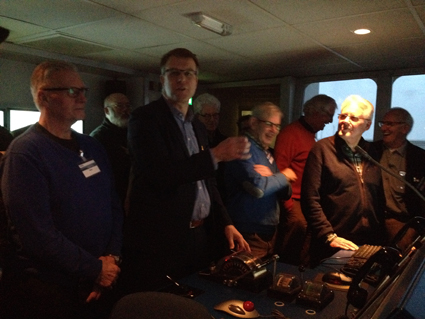
At 4pm, the official part started with an animated and interesting presentation by director Bas Buchner on 'the Naval Ship of the Future'. It became clear from his presentation, among other things, that MARIN offers support in the entire process of developing a ship. Preferably, the applied research institute is already involved in the concept phase to think along and prevent design errors at an early stage. But much more is happening here.
"We are in the digital age," Buchner indicated. "And we can do something with that." By this he was referring, among other things, to the various simulation facilities available at MARIN. On the one hand, these are the simulation programmes with which various properties of ships under different conditions can be simulated. These allow designs to be tested without measuring 'real' ship models fitted with sensors in one of the building's large water tanks.
Simulators
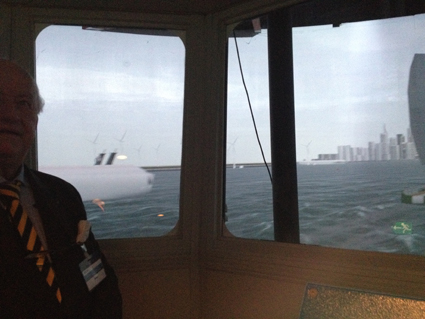
MARIN also has a number of beautiful, high-tech simulators in which people can train a variety of operations. The simulator for the larger ships is stationary on its own, but because of the images shown on a large screen (behind the windows on the bridge), the feeling is 'lifelike'. "During training sessions, people stand with drops of sweat on their foreheads when a 'near collision' has been simulated with another vehicle," Buchner recalls. "They are great tools to train with; simply because in a simulator you are allowed to make mistakes. It also allows you to conjure up a particular scenario a la minute. With regard to the weather - fog, rain, storm - but also with regard to other shipping traffic. Moreover, the main port areas are available digitally, allowing you to practice almost in the real world."
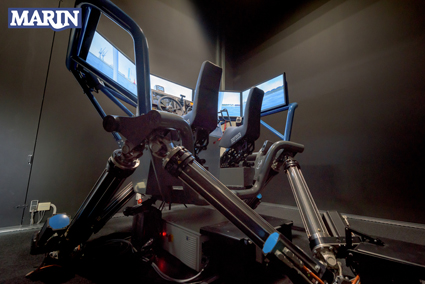
The simulators for smaller vessels are placed on a hexapod that is electrically powered and offers the driver and navigator an 'almost real' experience. 'Almost' because the accelerations in this simulator should not exceed 2G, simply so as not to overload the body of the person concerned.
Basins
After one of the participants had manoeuvred a Frisc quite accurately inside the Zr. Ms Rotterdam, some of the seven basins were quickly visited. Each basin is used to carry out specific investigations on models. Among other things, they simulate currents, wind and waves and study their influence on ship models, submarines but also (offshore) wind turbines. On the wall in the oldest room where the first basin from 1932 is still in use, all propellers developed from 1932 to the present day are displayed. "So can't we do it now?" asks Buchner? The answer is that focal points shift through time. "Whereas in the past the efficiency of the ship's propeller was most important, today's focus includes minimising noise and preventing cavitation that damages propellers."
The visit ended with a heartfelt THANK YOU to tour guides Bas Buchner, Timo Verwoest and Noël Bovens, a snack and a drink. In 2019, we will keep our diaries clear again; that year sees the opening of a new test centre in Ede: the Seven Ocean Simulator Centre (SOS). "Very welcome," informs Buchner.


Description
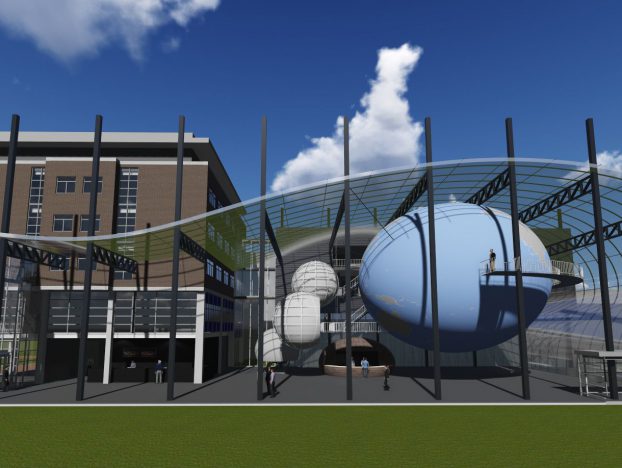
MARIN, the Maritime Research Institute of the Netherlands conducts extensive research and model tests for the development and construction of ships and submarines for the Royal Netherlands Navy.
MARIN is one of the world's largest institutes for research into hydrodynamics and maritime technology through simulations, model tests, true-size measurements and training. MARIN focuses on shipbuilding, shipping, offshore industry and governments. Its main clients are shipyards and shipowners, design and classification agencies, producers in the oil and LNG industry and navies.
MARIN has the status of Large Technological Institute in the Netherlands. Over 85% of turnover is generated by commercial projects for the international maritime industry. The remaining 15% comes from scientific research.
MARIN was founded in 1929 as the Nederlandsch Scheepsbouwkundig Proefstation (NSP) Foundation. After the towing tank was completed in 1932, testing of ship models began. MARIN now has the following seven test facilities: inland tank, deep-water tank, high-speed tank, offshore basin, seagoing and manoeuvring basin, vacuum tank and cavitation tunnel. For training maritime personnel, such as pilots, ship officers, tugboat captains and offshore personnel, there are three simulators: the big bridge, small bridge and traffic service simulator.
(text Wikipedia)
Location
Haagsteeg 2, 6708 PM Wageningen
Organiser
Defence and Security
MARIN
Name and contact details for information
KTZ bd Jan Wind, chairman of Defence and Safety