

2-day unique Fokker trip

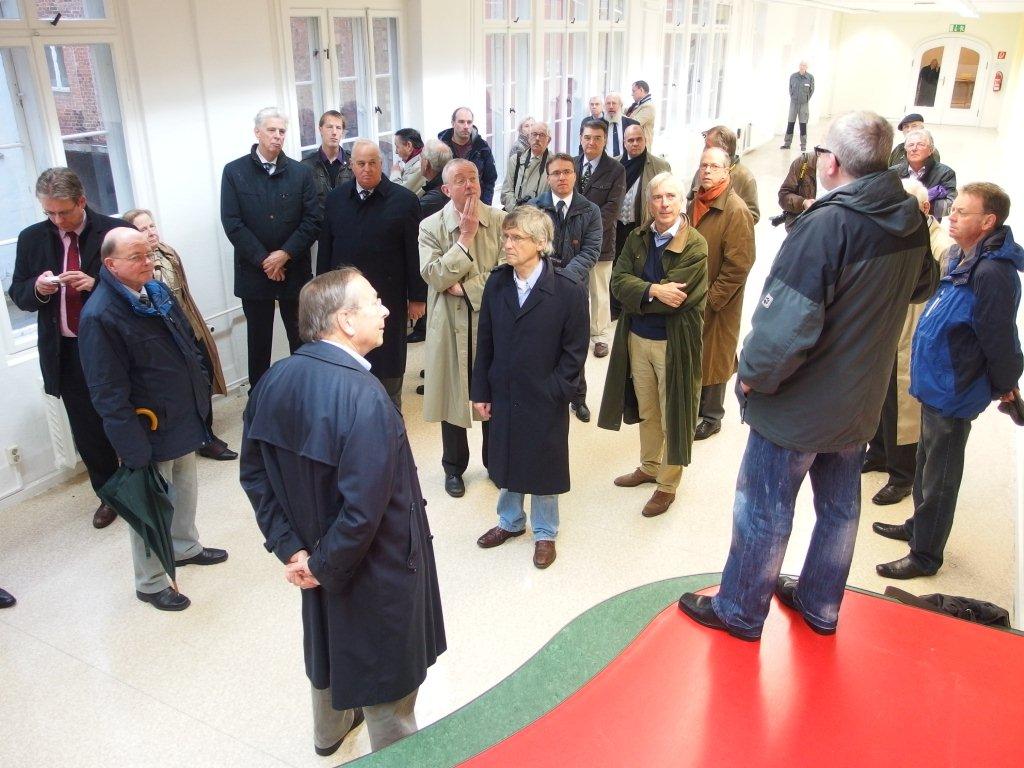
Report by Marc Dierikx of the visit by a Dutch delegation of Fokker-interested people to Schwerin and Wismar, 1-2 November 2013
Finally, after more than a year of preparation, a group of Dutch travellers gathered at Amersfoort railway station on Friday morning 1 November around organiser Hisco Baas. It was a motley crew of 28 people, ranging from people from aviation industry and science to a few with a personal connection or interest in the wonderful history of this Dutch aircraft manufacturer. The occasion was to commemorate 100 years since Anthony Fokker started manufacturing aircraft in Schwerin in October.
That it would be quite an undertaking was immediately apparent on departure. The reserved 1st class carriage of the train towards Germany, turned out to be left in Amsterdam. ersatz' quickly became a catchphrase in the company, which finally reached its destination around five o'clock, with an hour's delay.
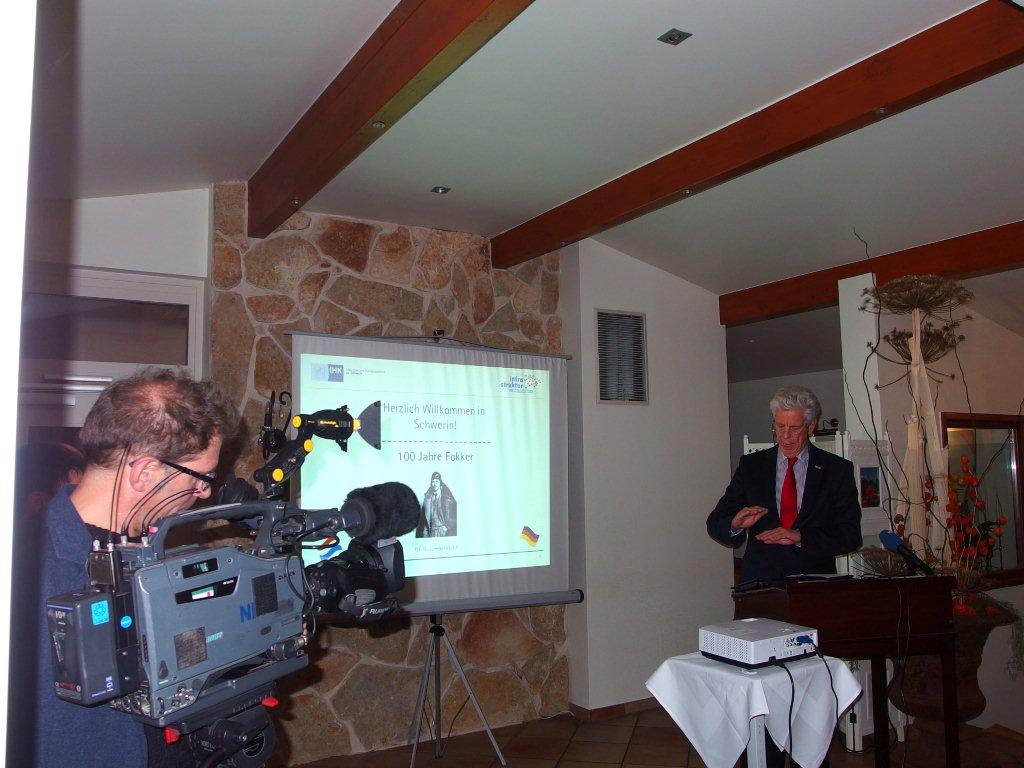
That evening, an elaborate reception was planned in the hotel Niederländischer Hof, organised in cooperation with the Industrie- und Handelskammer zu Schwerin, on whose behalf vice-president Steffen Timm welcomed the company. It formed the prelude to six shorter and longer speeches.
Schwerin's deputy mayor Wolfram Friedersdorff referred to the remarkable history of Fokker in Schwerin between 1913 and '1919' and indicated that the municipality has since decided to have the former company hall 2 preserved.
Fred Abbink, former NLR director and now President of the Dutch Society for Aeronautical Engineering, touched on the relations between the Netherlands and Germany in aeronautical research. Kees de Bruin, Mayor of Papendrecht, explained how his municipality is linked to aviation.
Jan van Ingen elaborated on this historic visit from his position as Emeritus Professor and former Dean of TU Delft, Aerospace Engineering.
Marc Dierikx then once again emphatically drew attention to the historical value of the Fokker halls as the oldest aircraft factory in the world.
Dirk Starink, former commander-in-chief of the Netherlands Air Force, spoke as Chairman of the Board of the Netherlands Aerospace Group, among other things.
Next, Kathrin Möller of the Phantechnikum (Technisches Landesmuseum Mecklenburg-Vorpommern) gave another introduction with visual material about Fokker. Afterwards, the group (as far as the number of seats went) was able to sit down to a very enjoyable meal.
Thus strengthened and rested, the next morning the actual programme of the trip could begin: a visit to the various places in the Mecklenburg capital where echoes of Fokker's life and work could still be observed. This began with a visit 'around the corner' to the former Perzina piano factory, where Fokker also had his own grand pianos built from 1916 onwards - an imposing building that exuded a sense of aesthetics and refinement. It was with some difficulty - and only at the back of the building - that a picture of industrial production of hundreds of aircraft wings in overcrowded workshops could be secured thanks to the enthusiastic and expert explanations by local historian and Fokker expert Michael Schmidt.
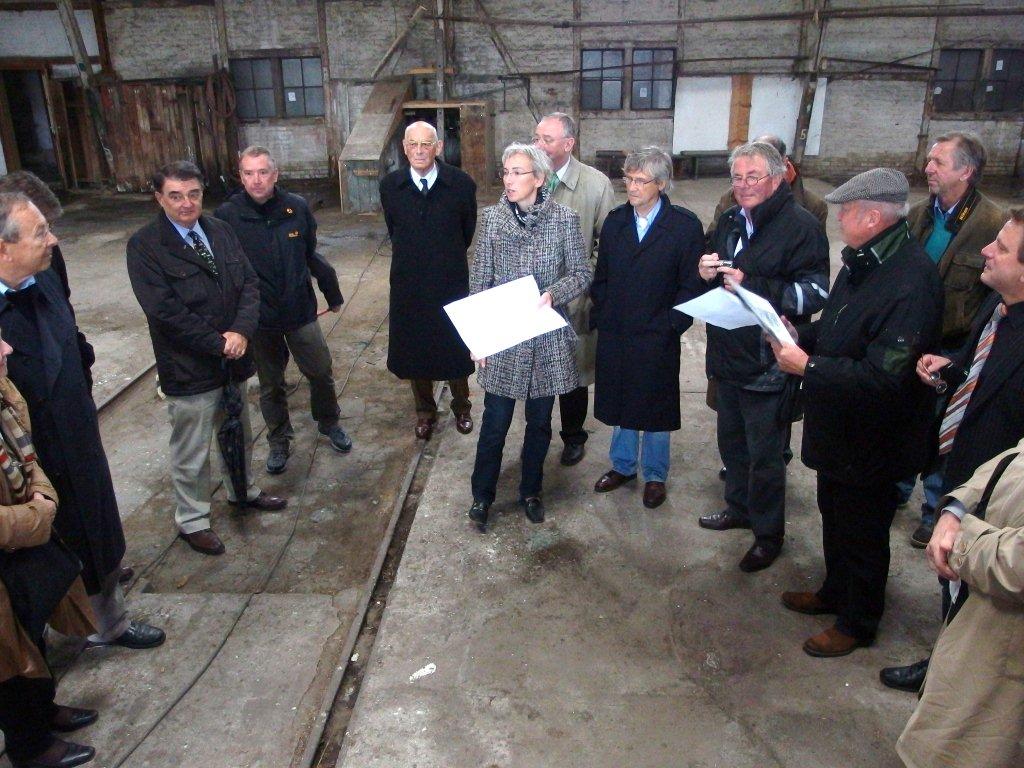
Next, the bus and company made stops at Fokker's two former residences, neatly maintained rather nondescript city buildings that proved to be still in use even a hundred years later. The main destination of the trip, however, was Fokker's two remaining factory buildings: the oldest aircraft factory in the world. On behalf of the municipality, Mr Stefan Schlick welcomed the group to the city's only recently designated industrial monument. Frau Dr Möller gave a detailed explanation, filmed by a crew from the NDR, which made a report on the Dutch visit. Halle 2 - the original nameplate from 1913 turned out to have been 'rescued' earlier by guide Michael Schmidt when it still looked like the building would be demolished - impressed mainly because of its derelict and empty state. The time of year, the weather and the grey light of a rainy day, added elements. Several authentic items appeared to have truly defied time: the winch with which Fokker pulled its seaplanes into the building, the rails that had been laid for this purpose in 1913, the numbered wardrobes for the 55 staff of the time, the abandoned offices in the low, dark annex of the production hall. It did form a contrast with Hall 6, the other production hall that had remained standing, now in use by the local fishing club. There, a well-kept canteen served hearty coffee and cakes. Messrs Pankratz and Egbert Schauer , the latter appropriately dressed in a 'Fokker aviator outfit', gave an introduction that also shed light on the history of the site since Fokker's departure from Schwerin. The party was then given the opportunity to look around the reasonably preserved hall behind it, also designed at the time for the construction of seaplanes.
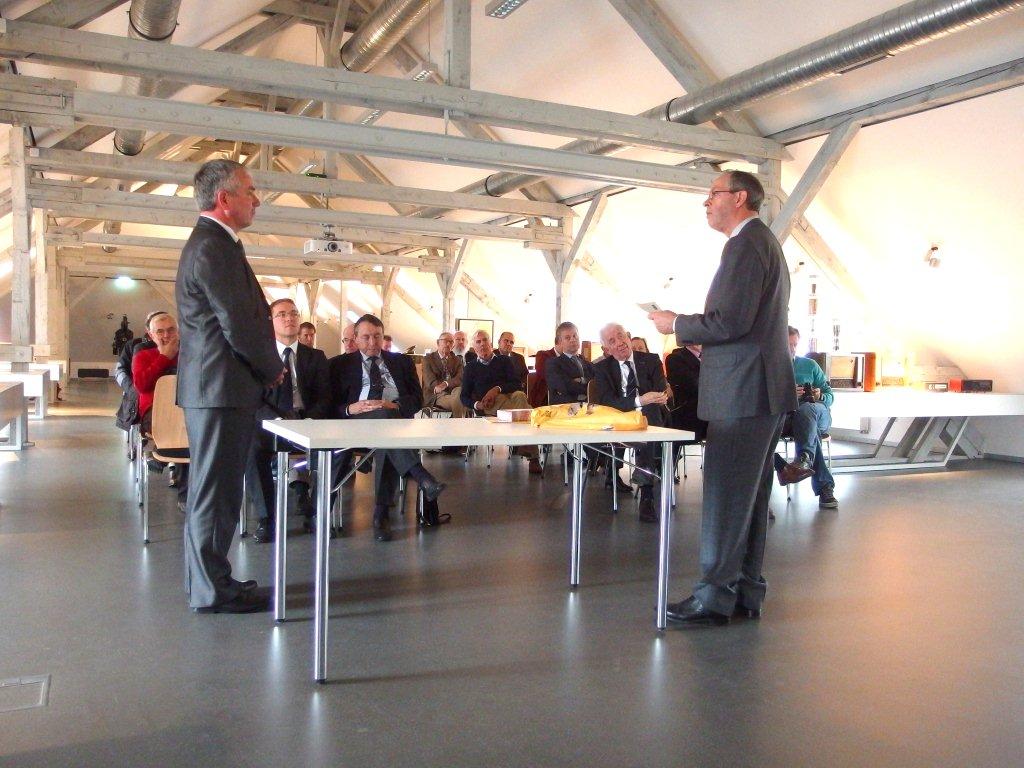
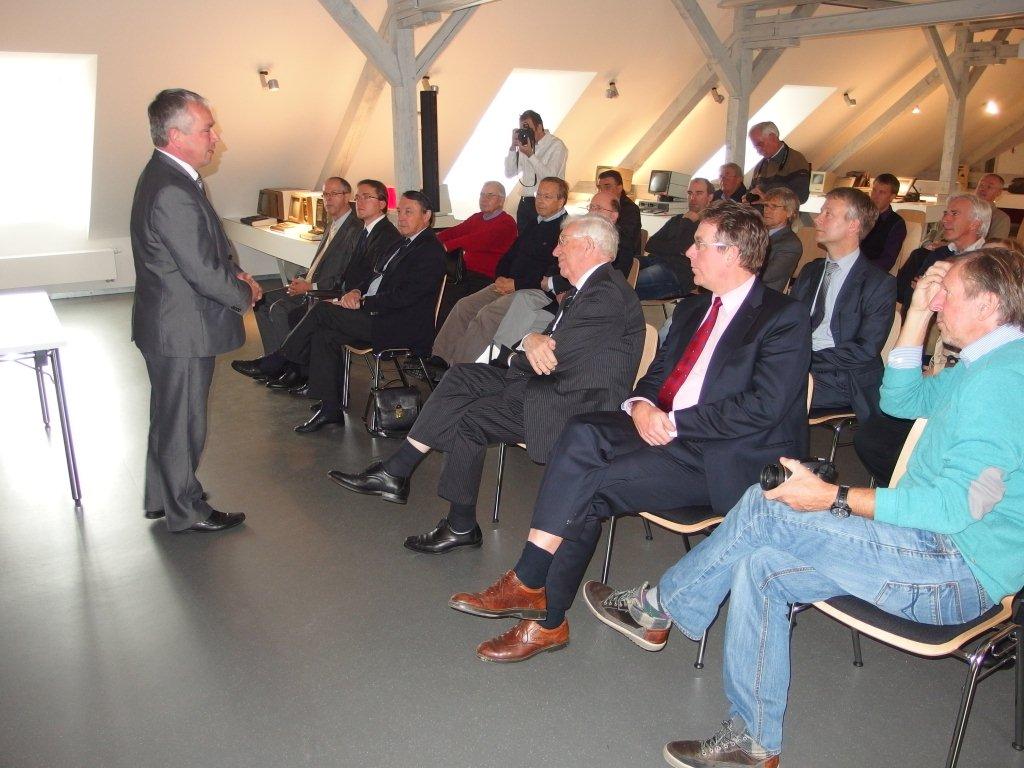
With lunch discussed and planned in Wismar, 35 km away, no time was left to visit the remains of the former Görries airfield (where, apart from long since disused rails, no Fokker tracks are to be seen, incidentally). Hence, after a brief photo stop at the Grand Ducal Palace, the bus set course for Wismar, where Oberbürgermeister Thomas Beyer was already ready to welcome the company to the top floor of the Phantechnikum. Kathrin Möller had not only arranged for an excellent lunch, but also provided an expert tour of the museum, during which she naturally paid special attention to the various objects from the sphere of flying and aeronautical research in Mecklenburg-Western Pomerania. Finally, thanks to Hisco's sharp eye on the clock, the group was back on the bus in time to catch the 16.05 (stop) train to Hamburg. The end of a short, intensive, but successful visit that will have left several participants wanting more
P.S.
Without the exceptionally interested 27 fellow travellers, this trip would not have been possible. The ladies and gentlemen are listed in alphabetical order:
Fred Abbink, Kees de Bruin, Frank van Dalen, Marc Dierikx, Johannes van Doorn, Boudewijn van der Drift, Jan van Ingen, Henk van Leeuwen, Ton de Liefde, Carin Meerburg, Jos Meijer, Bob Mulder, Harm Peters, Adri Pijnappels, Daniël Polak, Jaap Polak, Arthur Roskott, Marc Smeulers, Philip Smeulers, Willem Snieder, Robert Soek, Prudent Staal, Dick Starink, Faris Ustamujic, Jan de Vries, Jan Hendrik de Jonge and Rolf de Winter.
Many thanks are due to Marc Dierikx, the inexhaustible Anthony Fokker source of information.
And not forgetting the Royal Institute of Engineers in The Hague for their administrative support and the opportunity they provided to make a well-attended Marc Dierikx lecture possible in their building on 3 September. This lecture was crucial for the trip preparations to Schwerin and Wismar and was organised in close consultation with Jos Meijer, enthusiastic board member of the KIVI - Afd. Aerospace.
Last but not least, I would like to thank Jan Hendrik de Jonge, the Fokker Hallen "promoter", who two years ago came up with this "enervating and at times almost impossible" travel proposal.
Hisco Baas, Rotterdam d.d. 13 November 2013
Description
As a follow-up to the interesting lecture 'Fokker in Schwerin, Dld. from 1 October 1913 to ....' by Marc Dierikx, aviation historian, the Aerospace Engineering Department is organising a unique two-day Fokker trip to the "historic beginning as of 1 October 1913" of Anthony Fokker's career as a world-renowned aircraft manufacturer
Travel programme:
*Departure CS Station Amersfoort 1 November at 09:37 by IC, 1st Class to Schwerin Hbf, arrival 16:12. Return by IC 1st Class 2 November at 16:05 Schwerin Hbf, arrival Amersfoort CS 22:24. Outward and return group booking (max 36 P).
*Check in Hotel InterCity then visit two Fokker Halls (Heritage Status) from 1913, and the abandoned Görries airfield. (17:00-18:30) In attendance officials Municipality of Schwerin, "Fokker Historians " & local Publicity Media.
*In the early evening reception IHK, Industrie- und Handelskammer zu Schwerin in the beautiful new Ludwig-Bölkow-Haus or in Hotel Niederländischer Hof (by arrangement). In addition to a number of industry representatives, possibly present will be the President of the IHK Mr Hans Thon and the Mayor of Schwerin Ms Angelika Gramkow.
*Dinner at the Hotel Niederländischer Hof (at the time granted the predicate Royal by Queen Wilhelmina and Prince Hendrik) in their "Wintergarten", Friday evening, from 20.30 ( a.o. short lecture by Mr Arnstadt from Schwerin on PARCHIM Airport via participant Prof Polak ).
Speaker(s)
*Saturday morning tour (led by local Fokker Historian Michael Schmidt) through Schwerin past a number of interesting "Fokker points" including the famous Perzina Piano Factory (now the City Library), at the time bought by Anthony Fokker to build wooden aircraft wings. Short visit Schloss Schwerin.
*Early Saturday afternoon: Lunch in Wismar at the Technisches Landesmuseum Mecklenburg-Vorpommern. Reception by the Mayor of Wismar, Mr Thomas Beyer and Ms Dr Kathrin Möller (Landesmuseum) followed by a Museum tour to see some "Anthony Fokker" related items. Present the local Publicity Media. Direction Schwerin Hbf. 15.00 am
Location
Organiser
Business Administration
Aerospace Engineering
Name and contact details for information
Hisco Baas, tel. 010-2151149, m. 06-50524528 or via the e-mail address below