

Interview CAREL WEEBER SPEAKS ...
Click here for the film of the interview with Carel Weeber.
On the initiative of the Royal Institute of Engineers (KIVI) and in cooperation with Het Delftsch Bouwkundig Studenten Gezelschap "Stylos" and designers' association Delft Design, three interviews with three 'éminences grises' in architecture are being organised. These lectures run parallel to a series of lectures in which young up-and-coming designers, with the theme 'Future Makers', give their views on the built environment. Forty years ago, these speakers were the 'Future Makers' of their time.
On 21 February, we start with an interview with the high-profile ex-architect Carel Weeber. The venue is Delft University of Technology, Department of Architecture, the Oranjezaal on the ground floor.
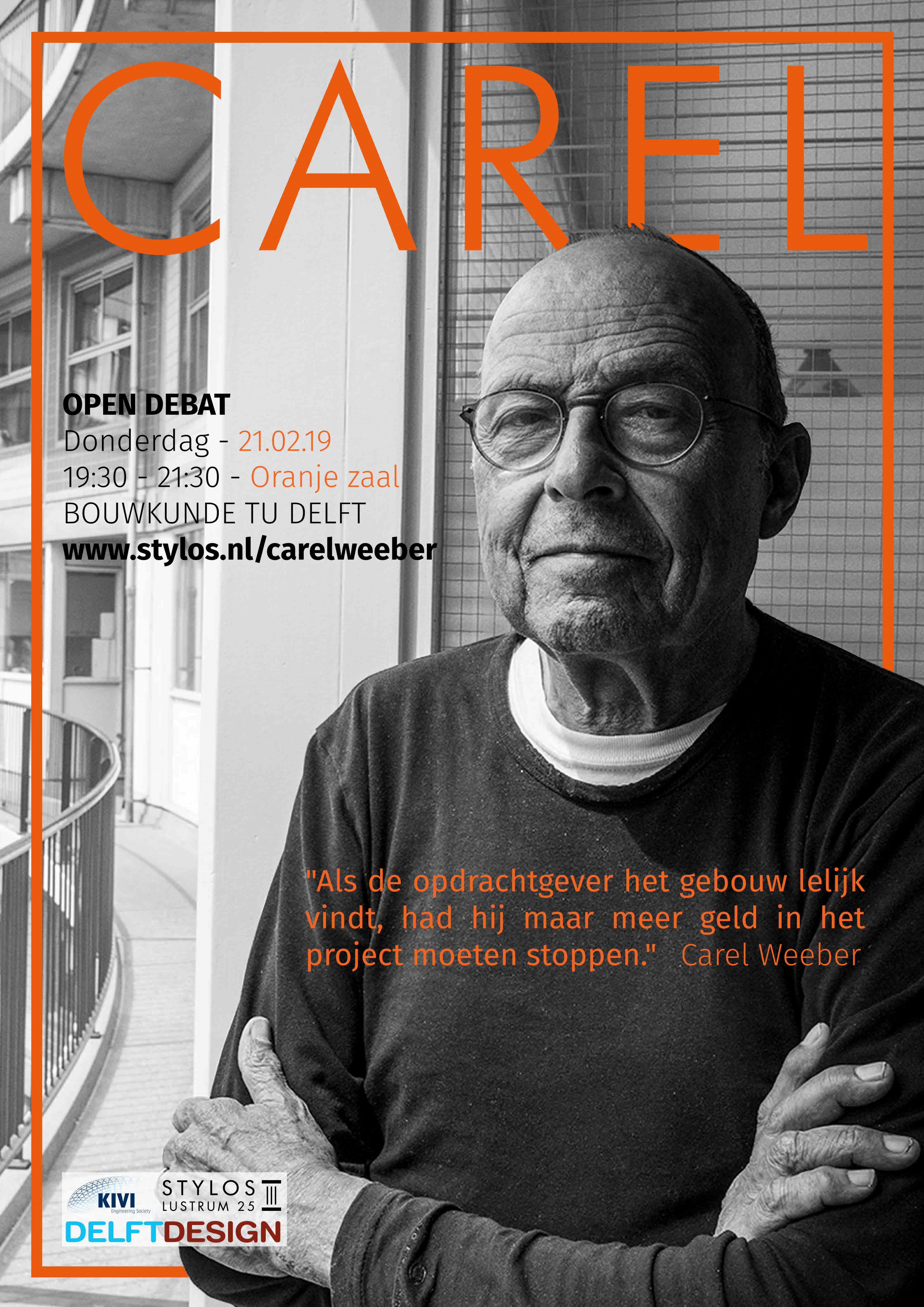
Fifty years after he came to the Netherlands by boat from Curaçao In 2005, ex-architect Carel (Carlos) Weeber left by parcel boat for Curaçao, never to return to the Netherlands (by his own admission). In 2006, after leaving, he was awarded the Maaskant Prize for his entire oeuvre. In a two-hour interview, he looks back on his work and his life. The ex-architect with his outspoken opinions and with surprising but also controversial ideas. Carel will comment on his life and work in retrospect.
Carel Weeber worked in education, from professor and dean to graduation mentor. But also as a publicist on topics such as Het Wilde Wonen and the Petrified Tent Camp. And of course as a well-known Dutchman on TV (preferably in long fur coat and sunglasses) and on the radio. He was also co-founder of the Berlage Institute, Stichting Hoogbouw, chairman of the BNA (Association of Dutch Architects) and a fighter against Truttigheid in the Netherlands. His work starts with the Prix de Rome plan for CS Amsterdam and the Osaka pavilion in Japan (world exhibition) in collaboration with Bakema. Other well-known projects include: the Black Madonna, the Peperklip, the Vensterpolder, prison de Schie, student complex de Struyck, underground stations in Spijkenisse and dozens of other projects. In various compositions, he starts offices with colleagues. His projects are high-profile but often reviled by the general public. Examples include the Black Madonna (now demolished) in The Hague and the Peperklip, and the Schiegevangenis both in Rotterdam.
This evening promises to be memorable with the Netherlands' most outspoken architect of the last century.
Moderator: Ton Voets (chairman KIVI Construction Section) and Sem van der Eijnde (architecture student).
Other interviews:
- 3 April 2019 Riek Bakker at the Prinsenkwartier in Delft
- 8 May 2019 Cees Dam, TUD Department of Architecture, Oranjezaal
Website: https://www.stylos.nl/nl/evenementen.
Information:
Ton Voets, phone 06-54312363 or by e-mail info@tonvoets.nl.