Circular and Sustainable Pavilion Circl
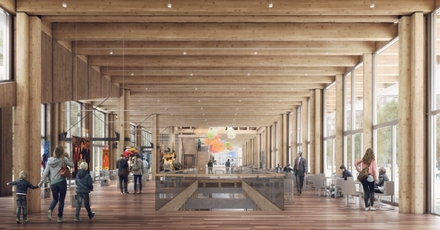
The Pavilion "Circl" stands on a large square with green spaces and is enclosed by the towering buildings of ABN-AMRO. After entering the Pavilion "Circl", the space and pleasant atmosphere, immediately stands out and immediately the reused furnishing materials and attention is drawn to sombre finishes, which are original, such as the reused wooden floors and downstairs in the basement, where the concrete floor, which has only been levelled and polished. Here are many meeting rooms, where we were shown the presentations.
The first speaker Ir. Rutger Sypkens Manager commercial affairs plan development at BAM Bouw en Techniek sketched a good picture with background on how the decision-making came about in each phase of the project. The basic arguments were to achieve a unique performance that fits in with the circular economy and sustainability. Thereby, the form of cooperation and responding to the rapid developments in the circular economy remained a challenge, because the availability of reusable materials was only partly available and briefly known (on the internet). A great example are the windows in the partition walls of the meeting rooms and the passage, which came from a building to be demolished in Hilversum.
The electrical installation is also unique. It is largely on direct current (DC) with only specific parts (such as the sprinkler pump) on alternating current (AC). Harry outlined the principle, the differences in DC and AC and then elaborated on the project phases in development of the DC - Power system. A main distribution system at 350 volts (VDC) for DC voltage with main busbar, descending fields, groups and associated protections, was developed, built and delivered on time entirely by his team (with ABB). Besides the PV solar cells on the roof, there is storage of electrical energy in batteries to cover brief ( 5 min) dark periods with clouds. A grid connection has been made for the period when there is no sunlight. The alternating current AC is converted into direct current (DC) for this purpose.
The building installation is special. The wall sockets, as we know them, have been replaced by a junction box with USB connections and a special DC connector. For the various user devices, the level of DC voltage / DC current must be made suitable for that specific device. Specific transition cables with built-in inverters have been made for this purpose. An existing Scandinavian lighting system was used for the LED lighting. This was designed for 250 VDC. A transition inverter was also made for this. In the future, this will be dropped and the lighting will be connected directly to the 350 VDC groups.
The construction and installation of the unique electro-technical DC installation of the Circl pavilion, was put together by Ing. Marius Boon, former Installation Advisor at BAM Bouw en Techniek. The challenges were when there were bottlenecks yet to always choose the new approach and overcome them. The only escape was to install a conventional electrical installation in the final months of the project, but fortunately that proved unnecessary.
The tour of the building was well done and the explanations were clear. The questions about "how and why" were answered with the criteria, which led to the choice of materials used and which installation applications were arrived at. The effect of the (temporary) failure of the heat pump was noticeable, but did not cause a major temperature fluctuation, this due to the well-insulated building.
A supplementary article from "Installation Journal" with publication by Marjolein Eilander on 12 Nov 2018 and Last update: 13 Nov 2018 reads:
With DC, grid reinforcement is probably no longer needed in the Netherlands!
The first building with a DC grid is on the Zuidas. Circl opened its doors in September 2017. More than a year later, what are the findings? Harry Stokman of Direct Current explains.

Circl is a pavilion owned by ABN AMRO. It is a circular building. This means that the material used has been used before or is reusable. It is the first building in the world with a DC grid. "We have achieved something very big here," said director Harry Stokman of consultancy, development and manufacturing company Direct Current. "We can be proud of that as the Netherlands."
Solar panels & direct current
The entire Circl building is connected to a direct voltage grid with a 350V DC distribution system and DC components developed by Direct Current. There are more than 500 solar panels on the roof and against the eaves of the pavilion. These are connected directly to the DC grid via microconverters. Normally, all energy still has to be converted to alternating current first. This involves conversion losses. At Circl, the solar panels therefore supply energy directly to consumers in the building, such as laptops, mobile phones and LED lighting, via the DC grid. There is no intervention from the regular AC grid. Air management is also connected to the DC grid.
BAM & Engie
Stokman: "When Circl opened, we weren't sure it would work. Of course you assume it will, but you can't be sure. But that's also the strength of the installations in this building. That you gradually invent and adapt things." BAM provided the installations in Circl. Engie is currently responsible for their maintenance.
Reading tip: How do you design a DC grid?
No grid aggravation
"We demonstrate with our DC components that strengthening the Dutch electricity grid is not necessarily necessary," Stokman said. "The system can naturally manage congestion. It optimises the power available automatically. Overbooking is not necessary. This is very important in the context of energy transition. Often the message anyway is that our power grid is not designed to cope with the many decentralised power generators. And that you cannot escape grid reinforcement as a result. Circl is also a very nice showcase in that respect." Direct Current aims to minimise grid consumption in Circl even further.
Metering
With the current DC installation, metering is more complex because you don't have a standard gross production meter as with alternating current. Generation is disconnected from use and people are only charged based on production. "Because of the 'own energy first principle' and because consumption and generation are mixed, a different principle of metering is necessary. We are now in the process of delineating it properly financially, making sure it is settled properly fiscally," Stokman says.
Reading tip: First DC house out of the starting blocks
Optimising the energy balance
Based on the Current/OS operating system, also a Direct Current innovation, it is possible to further optimise the energy balance. For instance, Current Routers control the security and control of the DC grid in Circl, which is located in the distribution panel that forms the heart of the DC grid. "The effect that our Current/OS system has on the power has been demonstrated very nicely at Circl. The software of the AC-DC converter was off once. Then the pavilion operated in island mode for a few hours without a battery system. We showed that the system can fully maintain the balance between production and use."
No ict
The conversion management system is not ict-based. Stokman: "At first, people also thought that this would not be feasible. But it is. It takes a vulnerability out of your installation. Remote control makes installations hackable. And there has been a lot of talk about that recently. Of course, you don't want a 12-year-old boy turning off all the installations just for fun."
USB-C wall sockets
100W USB-C wall sockets have been installed throughout the building. These are powered directly from the DC grid. The socket was developed in cooperation with ABB, which makes the USB-C housing. Because USB-C allows both power transport and data communication through the same cable, the USB-C plug will become the standard connection of laptops, desktop computers, monitors, phones, tablets, LED lighting and media devices. Devices that do not support USB-C can use locally 'produced' 230V AC at Circl. AC is an option.
Battery implementation
When Circl was completed, the DC installation was suitable for the later implementation of batteries. A combination of energy storage in batteries with solar panels makes it possible to provide a DC building with a much smaller grid connection. This makes a DC installation cheaper than an office building on the regular AC grid. Currently, this implementation of batteries is in full swing.
Batteries from various suppliers
"'One sizes fits all' doesn't work. It's not like: we'll take a PowerWall from Tesla and it will be fine. The application depends on the environment," says Stokman. "We are busy working on a battery package from various suppliers. The batteries are optimised for the building. So that more island operation is possible." When choosing the batteries, the emphasis is on circularity. "With this building, it is of course important that products are 100% recyclable."
Standardisation
Interest in Circl is high. "We've had an awful lot of people visit, from all over the world. And they always react the same way: Is this everything? Why do we solve so much with alternating current, when direct current is so simple. All those boxes you have to deal with with AC voltage..." Next year, 200 DC experts from all over the world will gather in the Netherlands. This working group aims to ensure that DC is standardised. Stokman is responsible for this working group.
Role of installers
April 2018, NEN published the Dutch Practice Guideline 9090. This was written to make the electrical engineer who currently does not deal with DC installations on a daily basis aware that DC installations require specific knowledge and skills. How does the e-installer actually view DC voltage? According to Stokman, large installation companies are now convinced of the advantages of DC. "DC is an opportunity to move up in the construction column. Large installers realise this. They see DC as an opportunity. DC brings more work. As an installer, you are no longer just installing sockets but are more in the architect's lap. The small installer is not so much involved with it yet. They think more: it doesn't work and it shouldn't cost anything.'"
'Matter of getting used to it'
Direct current is also a matter of getting used to it. And many parties are now in this phase. Stokman: "When systems change, rules of thumb no longer work. And a lot is based on rules of thumb. If you ask 10 parties for a quote, 10 parties will come up with the same solutions and the cheapest one will get the contract. With new systems like DC, you get to be creative."
Direct Current is also responsible for the DC grid of education building Pulse. This is the first energy-neutral education building on the TU Delft campus. Kuijpers realised the DC building installation here. Currently, Direct Current is working with Eaton on the Johan Cruijff ArenA. The company is also involved in collaboration with Croon on DC's first energy-neutral tunnel: the Groene Boog near the A16 motorway.
On 16 May 2018, Region North Holland also visited the "Circl"
Description
Lectures on and visit to ABN AMRO Pavilion "Circl" with full DC installation in a sustainable and circular pavilion.
A sustainable circular Pavilion has been realised for the main building of ABN AMRO. Materials used for the Circl pavilion can be dismantled and reused. In addition, the pavilion is very energy-efficient.
The pavilion, designed on the basis of circular ideas, should become a place of inspiration for anyone interested in the circular economy. In the circular economy, production chains are completely closed, so that no waste is created and waste is prevented by reusing materials as long as possible.
The uniquely designed electro-technical direct current installation, which was specifically developed for this sustainable building, will be discussed.
This makes the building the first utility building to operate entirely on direct current (with the exception of a few building-related installation parts).
A considerable energy saving has been achieved by installing USB-C connections throughout the building. Users' devices, such as laptops and smartphones, are powered by these directly, without the need for an adapter.
Solar panels have been installed on the roof and against the wooden eaves of the facade. These supply power directly to the 350 V DC DC installation.
The absence of adapters and inverters means considerable energy savings.
The design of the installation and its eventual use will be discussed. What went well and what have learned for improvement of this type of installation in the future.
Accessibility:
"Circl" is easily accessible. From the Amsterdam-Zuid railway station, you can walk to Circl in a few minutes. Metro line 51, metro line 50 and tram 5 also stop at Amsterdam Zuid station. Bus line 62 also stops nearby, at the Hogewerf stop.
The address is Gustav Mahlerlaan 10, 1082 PP Amsterdam.
Still by car?
You can park in Q-Park Mahler (Aaron Coplandstraat 8 1082 MG Amsterdam) or Q-Park Symphony (Leo Smitstraat 4 1082 MP Amsterdam).
Speaker(s)
ir. Rutger Sypkens Manager commercial affairs plan development at BAM Bouw en Techniek.
ing. Harry Stokman Director of Direct Current BV and developer of the DC installations in pavilion "Circl".
ing. Marius Boon, former Installation Advisor at BAM Bouw en Techniek involved from the very beginning at Circl, currently District Manager at InstallatieWerk Noord-Holland
Location
Building Pavilion Circl ABN AMRO
Gustav Mahlerplein 10, 1082 PP Amsterdam
Organiser
Elektrotechniek
BAM Bouw & Techniek
Name and contact details for information
ing. Pim Klaver tel. 06 51 55 16 74