

Energy transition in the desert, developments in Desertec 3.0
12.5-year Anniversary Association for Solar Power Plants(VZKC)
The Association for Solar Power Plants could not celebrate its 12.5-year anniversary in a big way on Saturday 5 September.
But at its regular venue Agnietenkapel, the members' meeting, broadcast online, was as always on full solar power.
Gouda is even on the map to welcome the Netherlands' first solar power plant.
As it turns out, the European Commission's Green Deal led by vice-president Frans Timmermans, complemented by the recovery impetus for a post-corona energy transition, has its impetus partly from these solar thermal initiatives, supplemented by professional brethren from the hydrogen world.
With solar thermal, the sun's infinite energy can be captured in heat form. This yields a three times higher energy harvest per square metre than when electrical energy is harvested with a solar panel. Since over three quarters of energy demand is heat, it is therefore possible to save on conversion losses from electric back to heat: by storing summer sun for winter.
Solar heat and hydrogen The German media more or less dismissed the Desertec Industrial Initiative project (based in Munich at the time) of a decade ago as closed.
In 2009, internationally active companies from a wide range of industries joined forces with the already existing Desertec Foundation to set up the Desertec Industrial Initiative (Dii) summit.
At the beginning of this century, the idea of using giant solar power plants to produce renewable electricity in the sun-drenched deserts of North Africa and the Near East - for both the local and European electricity markets - emerged around the Club of Rome. This vision became known as 'Desertec'. authors: Paul van Son and Dr Thomas Isenburg.
No more German mirror power plants in North Africa going to supply power to Europe (1.0, this came across as a bit colonial), but serving the regional North African and Arab markets through their self-built solar mirror farms (2.0): this has been the practice in recent years.
Yet chairman and managing director of Dii Desert Energy Paul van Son, based in Dubai, was able to report in his presentation that precisely a Desertec 3.0 is on the move. And this is now going to be complemented by the combination with hydrogen exports (3.0) to Europe. Hydrogen, led by 'national hydrogen professor' Ad van Wijk (TU Delft), himself once a speaker at the Agnietenkapel, found its way into Frans Timmermans' Green Deal as vice-president of the European Commission.
Solar power plants generate so much energy in North Africa that, besides water desalination as a "by-product" of electricity production, a significant part of steam-generated power can also be missed for hydrogen production. Fellow proponent Frank Wouters, working and living in the United Arab Emirates for this purpose but coincidentally visiting Gouda, was able to join us spontaneously, which prompted the Desertec chairman to say that the Dutch are, after all, very prominently active at this tipping point of European energy supply.
"In the Agnietenkapel in Gouda, you discover that it is the Dutch who are behind the major developments," he said
In which the Green Heart is also generously endowed, with Reeuwijker-based Sietse de Haan as chairman of the Association for Solar Power Plants and Gouwen-based Edward Uittenbroek seeing his board position renewed by unanimous vote.
Solar heat in the Netherlands
During Desertec 1.0, the high price level had still been a stumbling block, but in the meantime, according to van Son, coal-fired and gas-fired power plants have lost out. During Desertec 3.0, the following will apply: "
The times, when coal and gas could compete, are over." After all, the idea of Desertec 3.0 is: 40 gigawatts of hydrogen power from North Africa (mainly from solar cells and wind turbines, but also with
steam via solar mirrors) and 40 gigawatts of hydrogen power produced in Europe. Say each the capacity of 20 coal-fired power plants.
Some of that could come from Gouda, as Uittenbroek sees plenty of opportunities to see the first solar thermal natural gas substitute rise in his beloved hometown.
Some other municipalities are also in the picture, by the way; two years ago, for instance, Borssele was presented in the Agnietenkapel and elsewhere this summer there was interest in a combination with aquathermy using water from the Lek. Encouraged by the opening of a solar thermal power plant in Antwerp in September 2019 (an excursion in March was cancelled due to corona, but the retake is of course still in the offing for members) and even much further north in Aalborg, Denmark, he is going to explore the possibilities within the Gouda city limits.
Indeed, a handful of natural gas-free new-build projects to be delivered have recently been manoeuvred past the city council. The last word has not yet been said or written on these.
Speaker
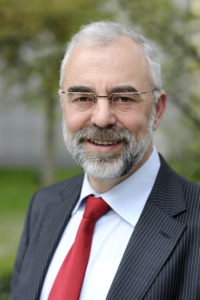 Mr Paul van Son laid out the recent development on DII's activities in Desertec 3.0.
Dii's goal from the beginning has been to develop the renewable energy market in MENA.
It was never about Dii as an industry group developing projects, but rather about partners and other companies and governments doing so with or without guidance from Dii.
This is what we see happening now. After this first phase of 5 years, Dii moved from Munich to Dubai and spent about 4 years dealing with the region itself (Desertec 2.0).
Since last year, there have been both the elements of 'green Molecules' (such as hydrogen) and 'export to world markets' (compare it with LNG).
We call this phase Desertec 3.0. Europe is increasingly interested in it.
With the help of Prof Ad van Wijk, Frank Wouters and Hydrogen Europe, among others, a North Africa - Europe 40-40GW Hydrogen Strategy has been set up, which has now been adopted by the European Commission in the 'EU Green Deal'.
Paul van Son, chairman and director
Dii Desert Energy (Dubai): "In the Agnietenkapel in Gouda, you discover, that it is the Dutch, who are behind the big developments."