

A Century of Air Transport Cockpit Development
Click here to watch the recording back.
The Board of the KIVI Department of History of Engineering invites you to attend an online lecture organised in collaboration with the Histechnica association:
A Century of Air Transport Cockpit Development
Speaker: Fred J. Abbink (NLR and TU Delft - LR)
Date: Thursday 25 March 2021, 7.30 pm (7.30 pm)
Duration: 45 minutes, plus short break, followed by discussion.
Registration: Via the KIVI website. After registration, one will receive the link for participation via MS Teams.
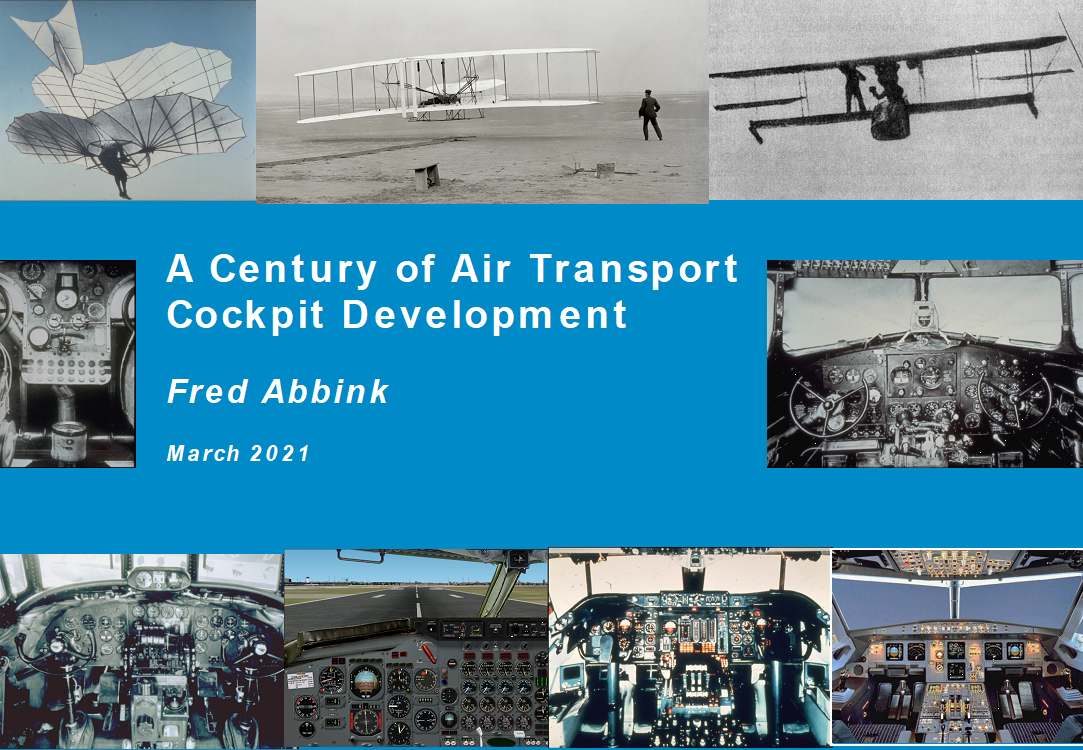
Summary of lecture
Electronic systems are playing an increasingly important role in aviation. They are essential for measuring and presenting data for control and optimal flight execution, for monitoring the various on-board systems, for communication and navigation, for avoiding dangerous weather conditions and flying against terrain or other aircraft, and furthermore for air traffic control.
The introduction of more and more sophisticated electronic systems (avionics) in aviation has made it possible to reduce the cockpit crew for intercontinental flights from five to two.
Currently, Airbus, supported in this by the European Union's Clean Sky 2 Programme, is developing on-board systems that will allow future commercial aircraft to be flown safely by a single pilot.
The presentation will give an overview of the development of aviation with a special focus on the development of the cockpit and the instrumentation used in it. Further detail will be given on the developments after World War II in civil aviation to today's commercial aircraft and the challenges that lie in the further reduction of the cockpit crew.
The presentation will be in Dutch; the texts on the PowerPoint slides will be in English.
About the speaker
Fred Abbink studied electrical engineering at TU-Delft and, after completing military service in 1969, went to work at the National Aerospace Laboratory NLR. There he worked, among other things, on the measurement and registration systems for the evaluation and certification of the Fokker 50, 70 and 100.
From 1981 to 1998, he was also part-time professor of aircraft instrumentation and avionics at the Faculty of Aerospace Engineering at TU-Delft. Here, he was involved in, among other things, the interfaculty Avionics course for electrical engineers.
After his retirement as general director of NLR in January 2010, he became a member of the Scientific and Advisory Board of the EU Clean Sky Programme, among other things. One of the tasks in this is to review the progress of major research and demonstration projects such as the Large Passenger Aircraft (LPA) Disruptive Cockpit Project, aimed at developing Single Pilot Operations for future commercial aircraft.
For further information on the KIVI Department of Engineering History,
see https://www.kivi.nl/afdelinge n/geschiedenis-der-techniek