

Antikythera Mechanism, the 2000-year-old Greek astronomical clockwork
The Boards of the Histechnica Association and of the KIVI SectionHistoryof Engineering are pleased to invite you to attend a lecture to be delivered by Prof Rien van de Weijgaert entitled:
Antikythera Mechanism, the 2000-year-old Greek astronomical clockwork
on Saturday 28 October 2023, starting at 11:00 am
Location: Science Centre, Bouwcampus 26, entrance 'C', Van der Burghweg 1, 2628 CS Delft.
PLEASE NOTE: Location has changed! Entrance is from car park behind high-rise building. Access to car park is by driving licence.
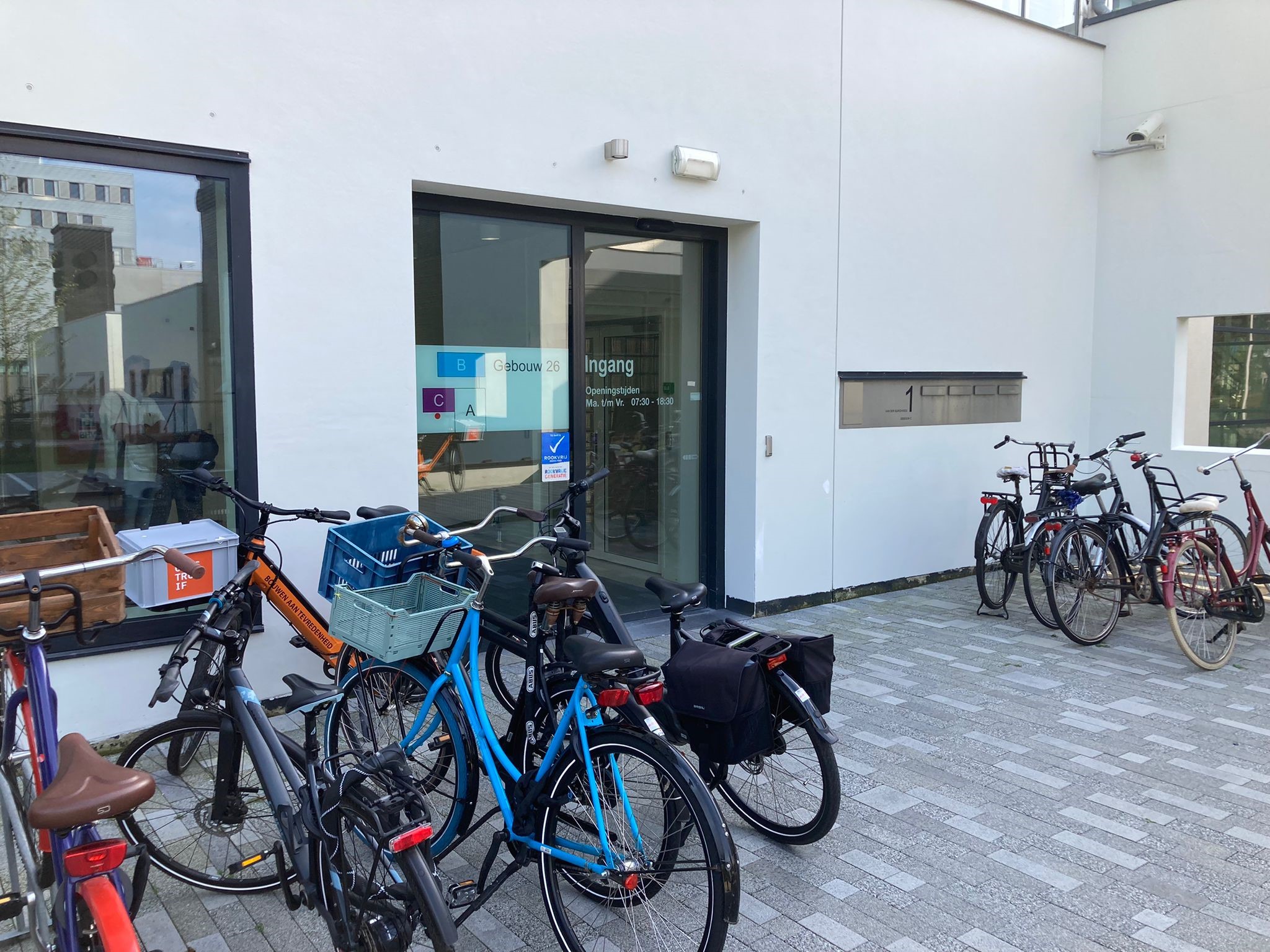
Entrance 'C' of the Science Centre
Programme
10.30:00 Walk-in with coffee and tea
11:00 Welcome and introduction
11.05:00 Lecture by Prof. Dr. Rien van de Weijgaert
11:50 Pause
12:15 Continuation of lecture and closing discussion
12:45 PM End of meeting.
Summary of lecture
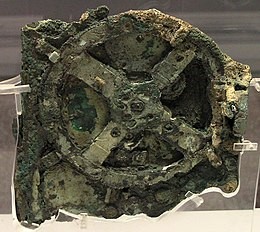
One of the most imaginative objects of antiquity is the Antikythera Mechanism, the world's oldest computer. At least 1,300 years before the first European clocks appeared, the ancient Greeks appear to have been able to create a stunningly sophisticated and complex mechanical clockwork. The at least 32 gears translated the astronomical knowledge of antiquity into a mechanical model. It tracked the course of moon, sun and probably the five then known planets in the sky, according to the then latest findings of Hellenistic astronomy.
Found by chance in 1900 by sponge divers on an Ancient Roman shipwreck near the islet of Antikythera, it has taken almost a century for the bronze instrument to begin to finally reveal its secrets. State-of-the-art technological research has led to the unlocking of the device's construction, while deciphering its many inscriptions has led to a dramatically better understanding of its operation and use.
Yet many questions remain unanswered. Was it a planetarium, and if so, where are the missing gears? What happened to this stunning technological knowledge of Greeks and Romans? Who made the device, and who invented it? Why are no other similar objects known from classical antiquity? It is clear that our ideas about scientific and technological knowledge, and the role of technical innovation in antiquity need to be changed.
Information about the speaker
Rien van de Weijgaert studied physics and astronomy at Leiden University, where he obtained his PhD cum laude in 1991 for the thesis 'Voids and the Geometry of Large Scale Structures' (supervisors: Prof. Bernard Jones, Prof. Vincent Icke and Prof. P.T. de Zeeuw). He then worked as an NSERC research fellow at the Canadian Institute of Astrophysics (CITA) in Toronto, Canada and as a research assistant at the Max Planck Institut für Astrophysik (MPA) in Garching, Germany. In 1995, on the basis of a KNAW fellowship, he joined the Kapteyn Institute at the University of Groningen, where he has been a professor since 2004.
His research interests include cosmology, structure formation and the large-scale structure of the Universe, as well as computational geometry and topology. For the past ten years, he has also been working on the history of astronomy and cosmology, in particular a research programme on the world's oldest astronomical and mechanical computer, the Antikythera mechanism from ancient Greek times.
Please register to attend this lecture:
- KIVI members should register via the KIVI website
- Members of Histechnica should register through the secretary hotzeboonstra@gmail.com
- Interested parties who are not members can also register through the above channels. There will then be a charge of €5.00.
The lecture will be broadcast live. You can participate via the following link: https://www.youtube.com/watch?v=pRlTW7PeeAE.
Upcoming activities at Science Center Delft:
- Saturday 25 November 2023 at 11:00 lecture by Marten Fluks and Edward Heerema "Development of tuber extraction"
- Saturday 16 December 2023 at 11:00 lecture by Dr Abel Streefland "University press in Delft"
Thursday 26 October presentation of Willem Wolff Prize 2023 to Museum Zaanse Tijd. Also visit to the Zaans Museum including industrial heritage from the "Verkade era". For programme see the KIVI website where you can also register, this can also be done through the secretary of Histechnica.
On the occasion of KIVI's 175th anniversary, the History of Technology Department has published a book highlighting the three founders of KIVI in the times in which they lived. The book will be available for free to members of Histechnica and members of the KIVI Department of History of Technology during the lecture.