

Do we also see a work of art as the artist made it at the time?
In collaboration with the association Histechnica, the KIVI Department of the History of Engineering is organising an online lecture entitled:
DO WE ALSO SEE A WORK OF ART AS THE ARTIST MADE IT AT THE TIME?
- on the use of artificial intelligence in the study of cultural heritage -
Speaker: Dr Jan C. A. van der Lubbe
Date: Thursday 27 May 2021
Start time: 19.30 (half past seven in the evening)
Duration: 45 minutes, then short break, followed by discussion.
Registration: Via the KIVI website. After registering via the website, you will receive the link to participate in this webinar.
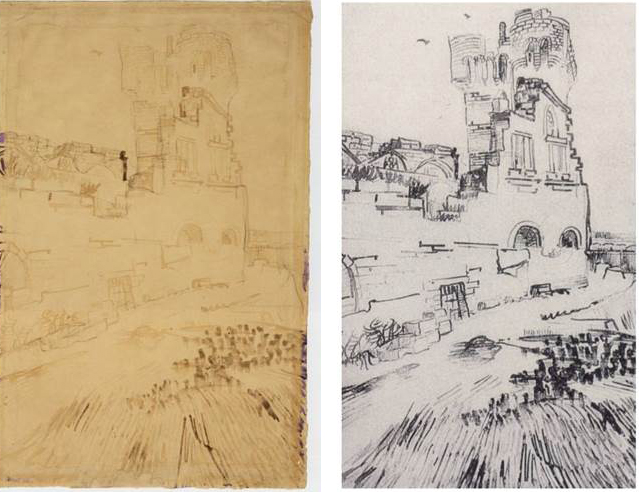
A Van Gogh, Is what we see now also what it was?
Summary of lecture
Artificial Intelligence, Artificial Intelligence (AI), is very much in vogue these days. There is a lot of talk about it. If you have a problem that you can't solve then you shout "AI" and you'll be fine. Manufacturers too have now understood that products sell better if you say that AI technology has been used. Still, there is not much new under the sun. Many methods have been used for a long time. The progress is more in the possibility of miniaturisation (ICs) and the availability of more computing power. The latter is especially important when applying AI for the purpose of studying cultural heritage. This is what this talk by Jan van der Lubbe is about.
In practice, an art historian asks many questions regarding a work of art. These questions concern, for example:
- authenticity of an artwork: People say it is a Karel Appel, but is it a real one?
- dating: That etching was made by Rembrandt, but did he really make it in 1648 or is it perhaps a print of a later date?
- originality: A Van Gogh has aged and discoloured considerably over time. What did the painting look like at the time he made it?
In this talk, Jan van der Lubbe shows step by step how to use AI to distinguish genuine and fake paintings, how to detect differences in paper and then use it to date works of art executed on paper. And how to use advanced AI techniques to make reconstructions of artworks that have deteriorated significantly in quality over time.
If you do not yet want to use AI yourself, after this talk you will at least have some tools to judge whether or not you should go to 'Between Art and Kitsch' with that one Van Gogh you probably still have in the attic.
About the speaker
Jan van der Lubbe studied mathematics, computer science at TU Delft and philosophy at the University of Amsterdam. Throughout his academic career, he was a researcher at TU Delft and Leiden University. From the beginning, he was there working on what would later be called AI. His main interests were algorithms for Reasoning with Uncertainty and methods for automatic image interpretation.
He is author of a number of scientific books including Information Theory and Basic Methods of Cryptography. In the field of philosophy (semiotics), he wrote the book Sign and Meaning with Prof. A.J.A. van Zoest. He has also written a number of books on art and art history, including François Pieter ter Meulen and the Hague School. He was involved in a large number of exhibitions and was guest curator at Paleis het Loo. Jan van der Lubbe played an important role in the NWO research programmes Token and Science4Arts, which focused on applying technical and natural sciences for the benefit of cultural heritage. His most recent result, which also attracted international attention, was the application of AI and neural networks to works by Van Gogh.