Dynamics at the Nanoscale
Click here to watch the recording back.
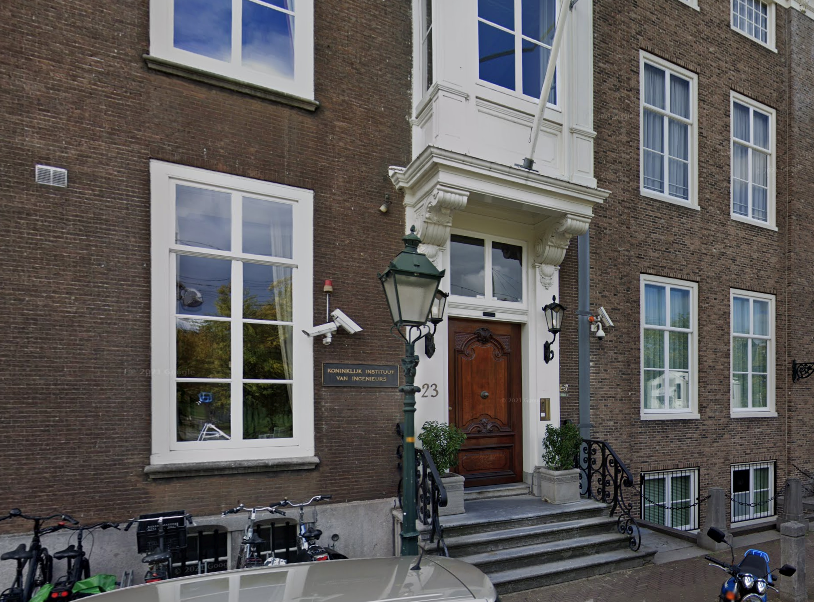
The boards of the association Histechnica and of the KIVI Department of the History of Engineering are now pleased to invite you to attend a lecture to be given by Prof Peter G. Steeneken (TU Delft, faculties TNW and 3mE) entitled: Dynamics at the Nanoscale.
Programme:
Note: The time of the lecture has been adjusted due to current Corona measures.
14.30:00: Walk-in with coffee and tea
15:00: Welcome and introduction
15.05:00: Lecture by Prof. Dr Peter G. Steeneken
16:00: Break
16:20: Continuation of lecture and closing discussion
17:00: End of meeting.
Please register toattend this lecture:
- KIVI members can register via the KIVI website
- Members of Histechnica can register through the secretary hotzeboonstra@gmail.com
- Interested parties who are not members can also register through the above channels. Please note that there will then be a cost of Eur 5.00.
The KIVI building is subject to a Corona check. To this end, you must be able to show a valid QR code or a recent negative PCR test.
The lecture will be broadcast live; you can also register for this via the above-mentioned ways. There is no charge for this.
Summary of the lecture
Mankind has always been fascinated by motion in our universe. As early as ancient times, instruments were developed to study the orbits of celestial bodies. The development of better telescopes and clocks in the 17th century, the contributions of Dutch researchers such as Huygens in the Delft area, and the discovery of Newton's laws led to the emergence of the field of dynamics, which studies the motion of objects under the influence of forces. Microscopes allowed ever smaller movements to be studied, and advances in precision manufacturing allowed mechanical devices to be made with ever smaller dimensions.
The last few decades have seen a revolution in microfabrication technology, as micro mechanical systems can be manufactured using the same methods as electronic chips. As a result, billions of such new sensors and actuators are produced every year today, and micro electromechanical systems (MEMS) are in almost every mobile phone. However, it is becoming increasingly challenging to measure and control the smaller deviations and higher frequency dynamics of MEMS.
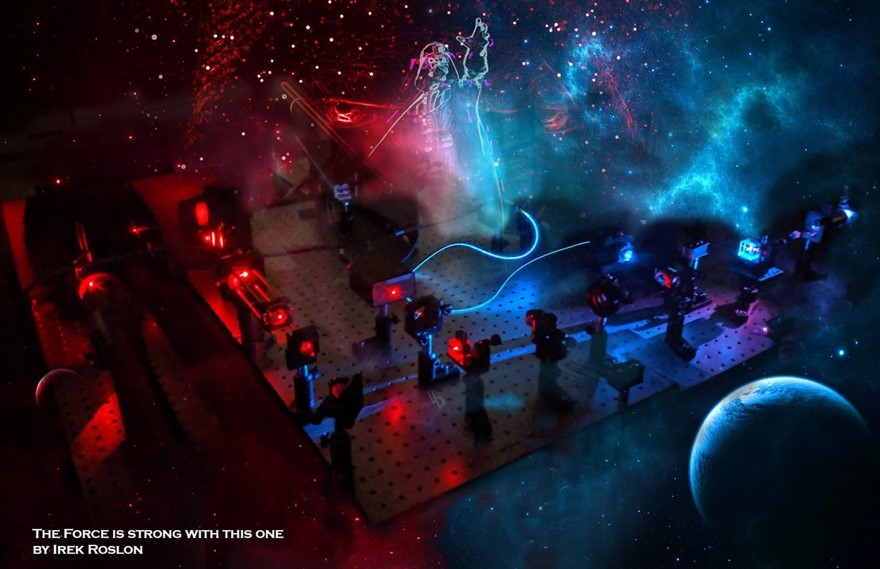
Today, we are working on the next revolution: realising nanoscale mechanical systems. For this, we use advanced measurement setups (see figure) and materials such as graphene, only 1 atom thick, to build understanding and enable new, better applications of dynamics at the nanoscale.
Information about the speaker
After his studies (1997) and PhD (2002) at the University of Groningen in solid-state physics, Peter Steeneken joined the Philips Physical Laboratory in Eindhoven as a principal scientist to focus on the research and development of micro- and nanomechanical systems. In 2006, the semiconductor division split from Philips and he continued his work at NXP Semiconductors. This led, among other things, to the development of new electromechanical switches, a microscopic clock integrated into silicon and smaller pressure sensors, and to 44 US patents.
In 2013, he became a part-time professor at the Kavli Institute for Nanoscience at TU Delft, and since 2017 he has been a full-time professor in the Department of Precision and Microsystems Engineering at the Chair of Dynamics of Micro and Nanosystems at the Faculty of 3mE. As leader of the sensors work package within the Graphene Flagship consortium, he is developing new graphene gas, pressure and biosensors with European partners, and as coordinator of the Plantenna project, he is working with Dutch technical universities on an internet of plants, where wireless sensor networks will contribute to higher yields in agriculture and horticulture.
Upcoming activities
- saturday 22 January 2022 at 11:00 lecture by Ms Prof Jenny Dankelman: "Technology for minimally invasive surgery and interventions" at Science Centre Delft
- saturday 26 February 2022 at 11:00 a.m. lecture by Mr G.W. de Graaf: "De Indische Mijnspoorwegen" at Science Centre Delft
- 24 - 30 April 2022 Study trip Bologna and Turin