

History of our scale and its calculations
The boards of the KIVI Department of the History of Engineering and the Histechnica Association are pleased to invite you to attend a lecture to be given by Ir. G.A.J.M. Van Ditzhuijzen entitled:
History of our scale and its calculations
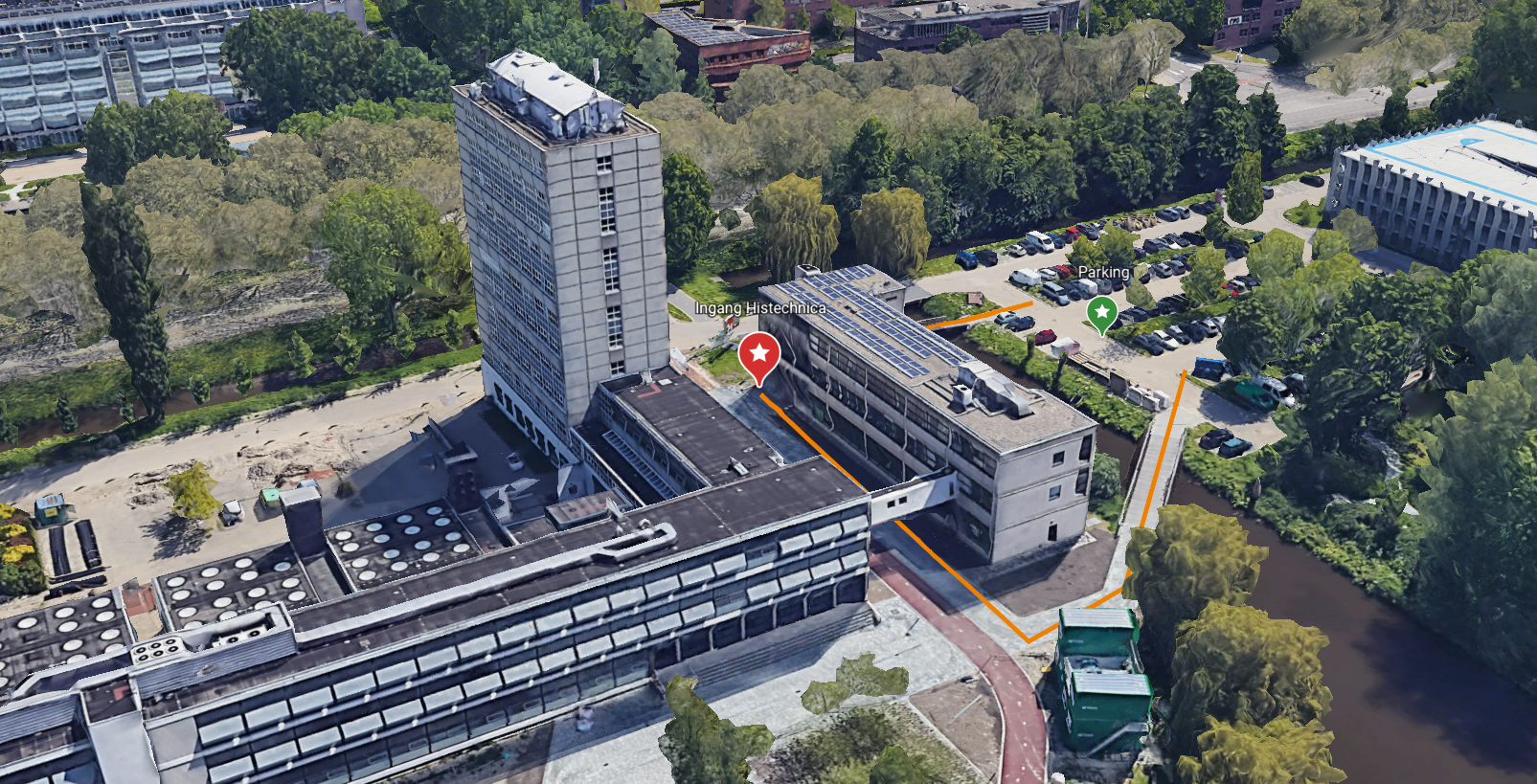
Entrance 'B' of the Science Centre
Programme
10.30 hrs: Walk-in with coffee and tea
11:00: Welcome and introduction
11.05 hrs: Lecture by Ir. G.A.J.M. Van Ditzhuijzen
11:50 a.m.: Break
12:15: Continuation of lecture and concluding discussion
12:45: End of the meeting
Summary of lecture
Music has always been very much associated with mathematics. This has to do with the number sequences, which determine the harmonic relationships between tones. When two different tones sound beautiful together, the frequencies are in harmony and in proportion to whole numbers. It is not for nothing that the whole number worshipper Pythagoras (572 - 500 BC) devised a scale with ratios in whole numbers.
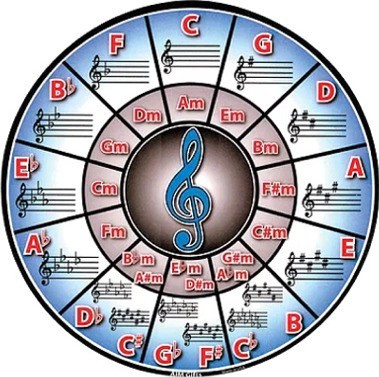
Circle of fifths
The lecture will include a bit of oscillation theory, what natural harmonics are (fundamental, overtones) and various divisions of the octave: Pythagoras tuning, pure tuning, proportional tuning. And why some intervals on the piano are actually out of tune.
Names of prominent mathematicians and physicists who pass the review include besides Pythagoras: Aristoxenos (360 - 300 BC student of Aristotle), Gioseffo Zarlino (1517-1590, Venice), Simon Stevin (1548-1620), Christian Huygens (1629-1695), Leonard Euler (1707-1783) and finally Prof Adriaan Fokker (1887-1972), the designer of the Euler organ with 10 tone genera and the Fokker-Huygens 31-tone organ. Mathematical reflections of some musical instruments are also discussed.
Information about the speaker
After studying Mechanical Engineering (majoring in Control Engineering), Guus spent his working life at Hoogovens, Hoogovens Technical Services and Corus, in the field of automation of rolling mills with many complex mathematical models. But modelling the iron and steel process also had his interest. As these models were supplied to other companies (e.g. Tata Steel, India), he travelled a lot and always took an exotic local musical instrument with him.
Even during his student days, he sang and learned to sing harmonically pure with other voices. He also learned to play an old trumpet (self-taught). Later at the Teisterband (Heemsteeds Herenblaasorkest) he switched to slide trombone. Interest in music and mathematics has been there since the 4th grade Gymnasium, where physics lessons explained the vibrations of organ pipes and (violin) strings.
To attend this lecture, you need to register:
- KIVI members should register via the KIVI website
- Members of Histechnica should register through the secretary hotzeboonstra@gmail.com
- Interested parties who are not members can also register through the above channels. There will then be a charge of €5.00.
The lecture will be broadcast live; you should also register for this through the above channels. There is no charge for this.
Upcoming activities in Science Center Delft
- Saturday 24 June 2023 at 11:00: lecture by Prof. F.J. Abbink "Radar and Electronic Warfare in World War 2"
- Saturday 23 September 2023 at 11:00: lecture by prof D. van Delft "Invisible life; Antoni van Leeuwenhoek"
- Saturday 28 October 2023 at 11:00: lecture by Prof Rien Weygaert "The Antikythera astronomical computer"
- Saturday 25 November 2023 at 11:00 a.m.: lecture by Marten Fluks and Eduard Heerema "Development of tuber mining"
- Saturday 16 December 2023 at 11:00: lecture by Dr Abel Streefland "University press in Delft"
On the occasion of the 175th anniversary of KIVI, the History of Engineering Department has published a book highlighting the three founders of KIVI in the times in which they lived. The book will be available free of charge during the lecture for members of Histechnica and for members of the KIVI Department of History of Technology.