
Company visit: e-Traction Europe B.V.
Report on the field trip to e-Traction Apeldoorn on 7 February 2019
(Guido Zwart, KIVI Department of Mechanics):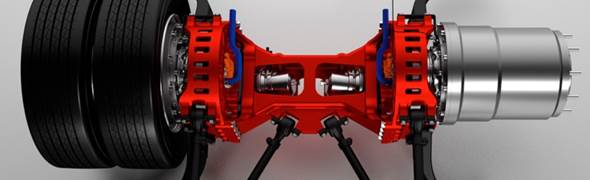
Founded in the Netherlands, e-Traction has been working on electric propulsion for road vehicles since 1981. In September, it proudly presented its latest powertrain 'TheMotion 2.0' at the 'Internationale Automobil-Ausstellung' in Hannover. Here, the two synchronous electric motors are located in the wheels of the rear axle. The rotors with permanent magnets rotate around the stators, taking the tyres with them. Each of the motors thus directly drives its own wheel, making a differential unnecessary. In buses, the system enables low-floor and unrivalled peak efficiency, between battery and axle power, of 94%. Peter van de Wal (CTO) tells us in the packed room that the electronics are set to achieve the highest efficiencies under relevant operating conditions. This significantly extends the range of battery-powered city buses. City buses are converted from diesel- to electric- traction by placing batteries on the roof and in the vacated engine compartment. The e-Traction powertrain also lends itself well to hydrogen-powered buses: The hydrogen-fuelled fuel cell then provides the electrical energy.
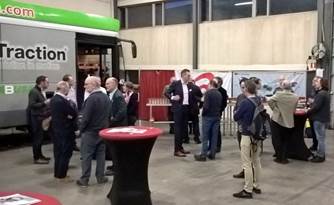
What stands out on the tour is the compact metal housing of the so-called inverter, which converts up to 180 kilowatts of power from direct current to pulse-width controlled 3-phase alternating current: It is not much bigger than two Coke bottles. And if you then look at the heart of the device through which the power flows: the 'Insulated Gate Bipolar Transistors' (IGBTs), they are even much smaller than thought. To prevent the heat released during the conversion from heating up those tiny elements to critical temperatures, things are cooled with water. As the efficient system does not produce enough heat to heat the interiors of electric city buses in winter, a diesel heater is usually used for this purpose.
After the tour, we are driven around the surrounding industrial area in the e-Traction test bus. Our driver demonstrates that the bus brakes almost to a standstill on the electric motors. On one of the displays in the dashboard, we see a white cube bar go out with each braking to show how much the battery is charging in the process.
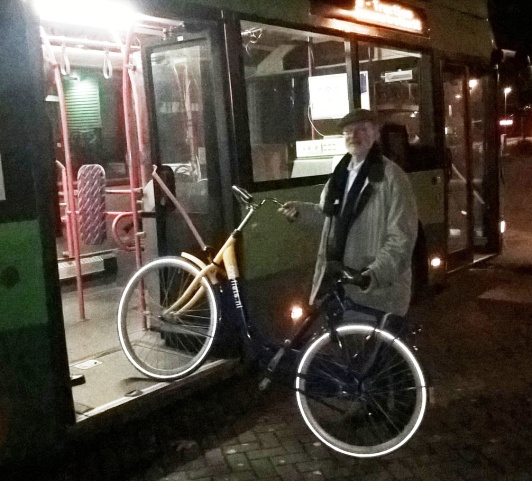
Our driver: 'The acceleration torque from standstill, which is naturally greater with electric motors than with internal combustion engines, is properly tuned to prevent standing passengers from accumulating in the back of the bus'. Afterwards, e-Traction offered to take visitors who had come by public transport to Apeldoorn station by electric test bus. Unfortunately, there appears to be only one candidate. That lucky person boards the comfortable bus with o.v. bike and all.
Thanks to e-Traction's Hendrieke Jonkers and her colleagues for the smooth organisation on site.
Dutch-founded e-Traction has been working on electric propulsion for road vehicles since 1981. In September, it proudly presented its latest powertrain 'TheMotion 2.0' at the 'Internationale Automobil-Ausstellung' in Hanover. In this, the electric motors are located in the wheels. In buses, this enables a low floor and an unrivalled efficiency of 94%. A great time to visit this interesting company!
Organiser
Mechanica
Name and contact details for information
Guido Zwart