

What is the impact of autonomous driving on traffic safety?
Report of the webinar dated 31 March last titled What is the impact of autonomous driving on traffic safety?
On 31 March last, KIVI Vehicle Technology organised a Webinar entitled "What is the impact of autonomous driving on traffic safety?". The online meeting was well attended with 50 participants. In a clear manner, the presenter Dr Olaf op den Camp, senior consultant integrated safety at TNO, took the participants through the developments towards fully autonomous driving and its impact on traffic safety.
Since the late 1970s, passive safety systems such as seat belts, crumple zones and airbags have reduced the number of road casualties. With the introduction since the mid-1990s of active safety systems, the number of road casualties has fallen even further. This is because the vast majority of accidents have their cause in the driver of the vehicle such as distraction (a.o. the mobile phone), sleep deprivation, drink-driving or the driver's abilities to fully control the vehicle. A minority of accidents are due to causes such as road conditions or vehicle defects.
In the coming years, more and more vehicles will be equipped with systems for autonomous driving and these systems will be further developed by manufacturers so that the ultimate goal: autonomous driving without driver assistance under all circumstances is achieved. With the Streetwise programme, TNO is trying to develop a global standard for connected automated driving systems through real world scenarios, while also providing a platform where manufacturers can exchange data and scenarios. Just a simple overtaking manoeuvre has many possible scenarios that need to be captured in the systems. The point is that participating in traffic is a social thing while automated vehicles are a technological thing. So it requires a huge challenge for technology to take over the social aspect of road users. But the better manufacturers succeed in this and the more vehicles are equipped with these systems, the safer it becomes on the road.
After Olaf's lecture, a lively discussion on the subject unfolded, which clearly showed that this topic is very much alive among the participants. All in all, a useful and successful meeting that can be looked back on with great pleasure.
Download the slides of the presentation here.
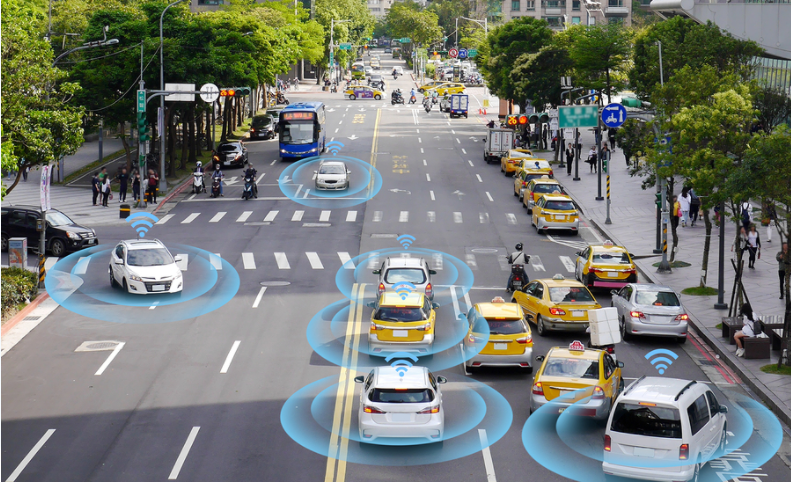
What is the impact of autonomous driving on traffic safety?
Traffic safety has improved drastically in the last decades. One reason is the introduction of passive and active safety systems in passenger cars. The industry is putting large efforts in developing automated vehicle systems, that are able to take over control of a human driver over at least a large portion of a trip. The objective of these developments is to increase mobility and efficient use of the roads, the reduction of the carbon footprint and emissions, and to increase traffic safety by taking human drivers out of the loop.
It is not the objective of the presentation to provide an overview of the innovative solutions that can be expected regarding connected cooperative automated mobility systems (CCAM). The focus is more on the development of safety assessment methods to determine whether these newly developed systems can be safely deployed on the road, or under which constraints such systems can be approved by road and vehicle authorities. Worldwide there is a need from authorities to come to an objective judgement regarding safe deployment of systems in view of the increasing complexity, the speed of innovation and the integration of new technologies such as AI.
The presentation will show the role of TNO in this serious playing field, which methods we are developing to support all stakeholders such as authorities and industry in the required safety assessment, and how we create a worldwide impact with these developments.
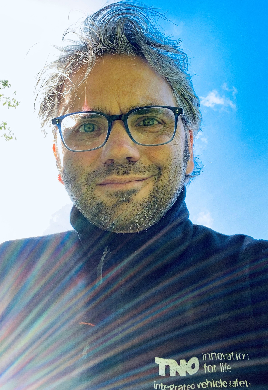
Olaf Op den Camp is senior consultant at TNO Integrated Vehicle Safety and holds an engineering degree in Mechanical Engineering and in Biomedical Engineering from the Eindhoven University of Technology. In 1996, he obtained his PhD degree with a study into the identification of material characteristics of biological tissue. In 1995 he joined TNO. Since 2010, he works at the TNO department Integrated Vehicle Safety as senior consultant with a focus on scenario-based safety assessment of advanced safety systems and automated driving systems. He initiated the CATS project in 2014 that resulted in a test protocol and a testing system for assessment by Euro NCAP of Cyclist-AEB systems.
He is technical lead of the StreetWise scenario database development at TNO and is seconded to the NTU university in Singapore for the development and implementation of a scenario-based safety assessment framework to support safe deployment of Autonomous Vehicles in Singapore within the CETRAN program for the Land Transport Authority (LTA). Furthermore, he is involved as an expert in several standardisation working groups, in ISO and well as in SAE.