

Reusing buildings, or just demolishing them
The presentations by Frank Hofmans and Rob Stark can be found under 'Documents'. Murk Wymenga's presentation is available on request (via email to Elfride.dijkstra@kivi.nl)
Building transition is a very hot topic. That was the reason for region Gelderland to organise a seminar on this subject on 14 June 2023. We had invited three speakers: Frank Hofmans, Murk Wymenga and Rob Stark.
Frank Hofmans of the engineering firm ABT explained to us the importance of transformation and/or reuse of buildings. In recent decades, the focus has been on reducing the energy consumption of buildings in the use phase. Meanwhile, prompted by the signed climate agreement, we see a shift towards sustainability objectives such as Paris proof and a circular economy.
To reduce greenhouse gases (CO2), we need to be very careful with material use. To achieve the climate agreement goals, we really need to build differently. We need to develop buildings that are built adaptive, detachable and climate-positive.
An approach to any building task should be:
- Prevention; should we really build? Not building is more sustainable.
- Value preservation; building differently or building reused; Is building from what you have and that requires investigative design.
- Value creation; What we build with bio-based materials or materials with low environmental impact.
Frank lied showing us some practical examples of building transformation. He sees an increasing awareness among clients for a sustainable way of building. Frank believes that reuse of existing buildings (or building components) should become a matter of course, or at least be carefully considered.
Frank concluded with: 'The role of the engineer is important. This is very appealing to me as a KIVI member.
________________________________________________________________________________
Murk Wymenga told us what Schipper Bosch is doing in the field of building transformation. He did this using a number of examples. I have described two of them:
1. De Nieuwe Stad is a new "city district" in the Oliemolenkwartier in Amersfoort. Prodent used to make toothpaste and Erdal shoe polish here. From the beginning of this century, both factories had stopped and the site pauperised. We are talking about an area of 13,000 m3. In May 2013, the municipality of Amersfoort, developer and investor Schipper Bosch and urban development agency ZUS decided to redevelop the area together. The existing buildings were given a different function. Murk explained how this was tackled. You don't decide in advance what should be there, but set ambition frameworks where, over time, the piece of city can grow flexibly in consultation with new users and iniatives.
What do you want in the new city
Going out I going to the market I getting together on a city square I eating out I living in special homes I a beach to hang out on I the industrial heritage should remain I space for unique crafts I innovative entrepreneurs are welcome I sports and housing for students.
With participation evenings, users and stakeholders were allowed to use yellow stickers to comment and indicate what they thought was important. It has become a very cosy new city.
2. IPKW Murk explained how the old AkzoNobel site on the Kleefse Waard, has been revived. The newspaper read:
Real estate developer targets start-ups to grow.
Former Akzo factory becomes nursery for energy and environmental technology.
Meanwhile, this has largely been realised. With new current initiatives, new ways of building are now being introduced. For instance, building in wood provides a nice contrast to the old heritage structures. And forms a beautiful setting for conferences and other events on the future of sustainability and the energy transition.
________________________________________________________________________________
Rob Stark of Imd disagreed with our seminar title and had changed it a bit: Reuse and not Demolish
He song showed us through a number of examples that reusing buildings is almost always possible. In doing so, he distinguished between reversible and irreversible transformations. The words speak for themselves, with irreversible you cannot go back and with reversible you have the option of using it again elsewhere and differently.
Lower House (irreversible/reversible)
He started with the temporary housing of the House of Representatives. The Lower House members were temporarily housed in the old Ministry of Foreign Affairs building. Not much needed to be done to the offices but meeting rooms, the Plenary Hall, had to be created. This hall covers several floors. As a result, several intermediate floors had to be removed.
Transformation of one of the water towers in Utrecht (irreversible)
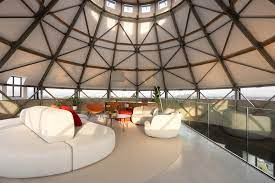
The water tower on Amsterdamsestraatweg in Utrecht has been transformed into an exclusive residential building. The lower four layers of the tower contain a commercial space and three identical studios. At the top, largely actually in the 1000m3 water barrel, a luxury flat has been realised over six floors. Adding daylight and outdoor spaces presented an architectural and structural challenge.
Parking garage in The Hague (reversible)
In Wegastraat in The Hague, extra parking space was needed for a nearby newly built office building. This was realised by building a parking garage in an existing office building. Steel construction was used for the specific parts required for the parking function. These steel components can be dismantled in the future, allowing the building to be transformed back into an office building.
Use of a donor skeleton (reversible)
At BIOpartner in Leiden, both a demountable skeleton and a donor skeleton were used. The overall steel structure was built from a steel structure made available from a former building of the University of leiden. By connecting the new hollow-core slab floors to the steel structure in a demountable way, a highly durable structure was created that can be given another life in the future.
_________________________________________________________________________________
For this seminar, we were guests of the Protestant church in Velp. That was a good choice. It was an instructive and interesting evening.
On behalf of KIVI Region Gelderland, Gerard Thomas
SEMINAR: Reuse buildings, or just demolish them
Wednesday, 14 June, 6pm-8.30pm
The days of growth and new construction are over. Transformation and repurposing of buildings is the important task in the future. Design and the designer play an important role in this task and finding solutions.
Today, demolishing these buildings is not the most obvious choice. From a sustainability perspective, but also from a cost perspective, people often look at reusing the building. If the building can be reused, it saves a lot in environmental burden by requiring less transport operations, less energy for demolition and new construction activities, but most importantly, less new material.
The approach to such a development differs fundamentally from the approach to a new building. In a new construction, one will design a building to suit the user's programme. When reusing a building, there will be much more of a search for a user that suits the building. Before it can be determined which function best suits a building, it is important to establish what the building's capabilities are.
The programme is as follows:
18.00 h Reception with coffee/tea and a sandwich
18.25 h Opening by Wilbert Coenen, board member KIVI Region Gelderland
18.30 h Presentation by Frank Hofmans ABT, https://abt.eu/
19.00 h Presentation by Murk Wymenga, Schipper Bosch www.schipperbosch.nl/
19.30 hours Presentation by Rob Stark, IMd Raadgevende Ingenieurs www.imdbv.nl
20.00 Hour Panel discussion
20.30 hours Closing
Cost: KIVI members €5, non-members €25, students free of charge
Examples of building transformation:
https://abt.eu/nieuws/hergebruik-bestaande-gebouwen-urgenter-dan-ooit/
https://imdbv.nl/nieuws/exclusief-wonen-in-een-oude-watertoren
https://schipperbosch.nl/open-hofkerk-lawijckerhof-wolfheze/