

Hiber
Guest speaker Tom Krikke gave a lecture on the development of the start-up company HIBER which was launched in 2016. The name and bear logo is a nod to hibernating. Hibernation; only when the HIBER nano satellite comes over can a message be sent from the "earth" modem which is received.
Hiber is a company with 40 employees based in Amsterdam where nano satellites will be used to develop a world-wide coverage communication system for various specific applications where ordinary communication satellites do not provide or are too costly. The satellites are the size of a shoebox and will be put into polar orbit at an altitude of about 600 km by means of a launcher.
The first satellite was launched with a PLCV - C 43 rocket from INDIA and the second from the US with a space X Falcon -9 rocket; HIBER satellites are launched together with other satellites from a launch vehicle.
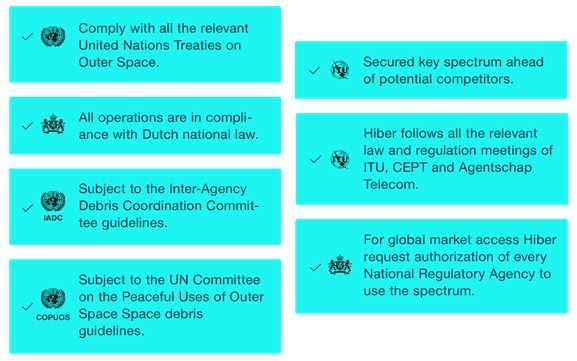
HIBER satellites comply with all legal world-wide protocols (China excepted) and are built in Delft at a specialised company ISIS; next year, a next generation of satellites should be ready that will be able to perform heading and orbit corrections with its own propulsion system. They will also almost halve in size; current satellites weigh about 8 kg and have a lifespan of about 3 years after which they fall back into the atmosphere and burn up. The new nano satellites will have their own destruction system i.e. can be sent to the atmosphere for burning. Manufacturing a nano satellite takes 3 to 4 months.
The aim is to place about 40 satellites, all of which will orbit the earth in 1.5 hr and thus provide full world coverage. Transmitting a message will cost 50 ct; in order to earn (much) money from this project, GIGA data needs to be sent because building a satellite and bringing it into position costs about 1 million euros. Energy for the satellite will be generated with small solar panels which is possible because the satellite's orbit falls 60% in the sun light side.
Currently, two HIBER satellites are orbiting which were successfully launched on 29 Nov in INDIA and 03 Dec 2018 in USA. Hiber 1 and Hiber 2 receive data via a unique frequency, assigned to Hiber by Telecom Agency and ITU; obviously in encrypted code. Applications of messages to be sent are from companies that want to track oil transports or where the condition of the land (humidity and groundwater level) or transport of parts/train wagons needs to be tracked. According to the speaker, customers abound and it is the technical challenges at the moment that are (still) an inhibiting factor.
Attendees showed their technical ingenuity as the many questions were of a technical, environmental and business nature. The speaker was pleasantly surprised by this and offered to pass on his Email address in case not all the questions had been asked: Tom.krikke@hiber.global
At a time when fast and instant global communication has become more important than ever before , it is not surprising that even for places in the world where regular tele communication is not available , a solution has been found with a nano communication satellite system.
The Dutch company HIBER has succeeded in developing ""mini"" satellites which have now already been successfully launched in December 2018 . Thus, a low power global area network was rolled out which provides world-wide communication coverage within the world ""space"" legislation.
A simple modem can be used to connect to HIBER low-flying satellites anywhere in the world, after which data traffic can be established.
A simple communication package is available at www.Hiber.Global.
This lecture by HIBER will explain this new form of communication.
Programme :
12.00 - 12.30 Reception
12.30 - 13.30 COFFEE TABLE
14.00 - 14.45 Presentation by Mr Tom Krikke
approximately 15.oo hr End of lecture