

HIsarna, sustainable steel industry


Speaker: Ir. Johan van Boggelen CEng MIMMM, Operations Manager HIsarna Pilot Plant Research & Development, Tata Steel
Introduction
HIsarna is a new process to produce liquid hot metal from ore and coal. The process is characterised by lower energy consumption and hence lower CO2 emissions than the conventional process, and the ability to use ore and coal directly without the need for agglomeration or coking. Tests conducted with the HIsarna pilot plant have shown that the process works and can efficiently process a wide range of raw material grades. Development has now reached the point where it needs to be demonstrated that the process can also continue to operate efficiently and stably for long periods of time, which is necessary before scaling up to industrial scale can be carried out. To achieve this, the pilot plant will have to be operated continuously for an extended period of time, with iron production taking place 24 hours a day for a period of several weeks.
The name HIsarna is an amalgamation of HiSmelt - Rio Tinto's smelting process - and Isarna, Celtic for iron. Hence the two capital letters. Rio Tinto (red river) was originally a Spanish copper mine, now an Australian mining multinational.
History
1990. Hoogovens IJmuiden started developing cyclone technology for the direct reduction process.
2004 Start of research at IJmuiden on smelting process and direct reduction.
2007 Cooperation with Rio Tinto (HiSmelt) and ULCOS (=Ultra LowCO2 Steelmaking).
2010 Then construction of pilot plant started.
First (A) campaign took place in 2011. First tonne of hot metal is on site. Did cost as much as 20 million.
2012 The B campaign. Here, 80% of the target was achieved.
2013. The C campaign. By then, coal with 23% volatile matter could be used. Steam Coal (= boiler coal) with 23% VM.
2014. The D Campaign. Then already 30% of the Produced Iron went to the steelworks and converted into steel.
2017 Now the E campaign is being started. Hopefully, production will now be uninterrupted for longer periods. Target 6 months in a row. Also, Rio Tinto has now been bought out. All knowledge is now owned by Tata Steel.
Technology
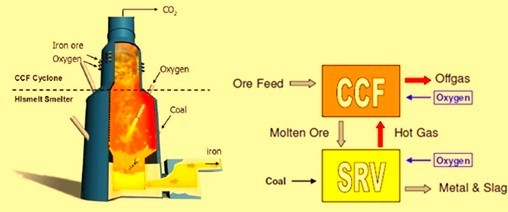
Roughly speaking, the furnace consists of 2 parts. The lower part is the reduction/melting part SRV (=Smelt Reduction Vessel). This is where the molten iron ore particles fall and powdered coal is injected to achieve reduction to Fe. Hot gas (CO) rises.
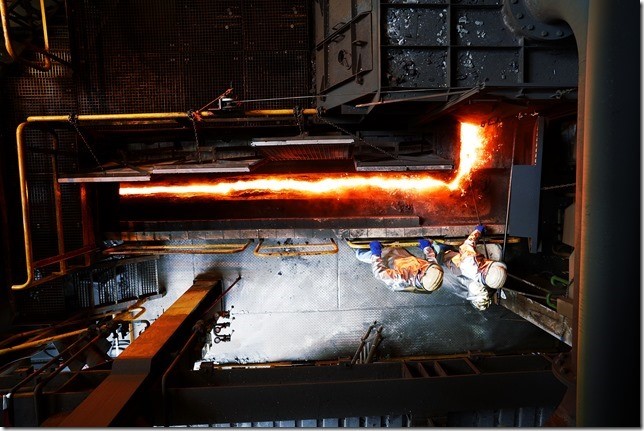
The lower part, which contains liquid iron and slag, is lined with refractory rock. Above it is water-cooled wall. Possibly later for steam production. Liquid iron continuously flows out through the drain chute into a mixer. Slag is drained around every hour with drilling. Oxygen is injected here for post-combustion. So that provides that high temperature, which melts ore.
The upper part is the CCF = Cyclone Converter Furnace. Ore is melted and additional oxygen provides post-combustion to CO2. In this process, 20% less CO2 is produced than in the blast furnace process. This is due to the lack of coking plants and ore preparation (pellet plant and sinter plant). If the CO2 can be captured and recycled (CCS = Carbon Capture Storage), this saves as much as 80%.
Ore is already milled to the right size distribution by the ore suppliers. Coal still needs to be milled separately before deployment in HIsarna is possible. Currently this is done at a mill in Limburg, but before the end of the year HIsarna's own coal grinding and drying plant should be operational.
The final product hot metal still contains 4% carbon. Going lower to steel grade means too high temperatures.
Finance
The total project will be around 75 million. 25 million for final campaign and investment. EU gives 7.4 million grant and Netherlands 1.5 million.
Description
HIsarna is a new process to produce liquid hot metal from ore and coal. The process is characterised by lower energy consumption and thus lower CO2 emissions than the conventional process and the ability to use ore and coal directly without the need for agglomeration or coking. Tests conducted with the HIsarna pilot plant have shown that the process works and can efficiently process a wide range of raw material grades. Development has now reached the point where it needs to be demonstrated that the process can also continue to operate efficiently and stably for long periods of time, which is necessary before scaling up to industrial scale can be carried out. To achieve this, the pilot plant will need to be operated continuously for an extended period, with iron production taking place 24 hours a day for a period of several weeks
Speaker(s)
ir. Johan van Boggelen CEng MIMMM, Operations Manager HIsarna Pilot Plant Research & Development, Tata Steel
Location
Organiser
Region North-Holland
Name and contact details for information
Guus van Ditzhuijzen