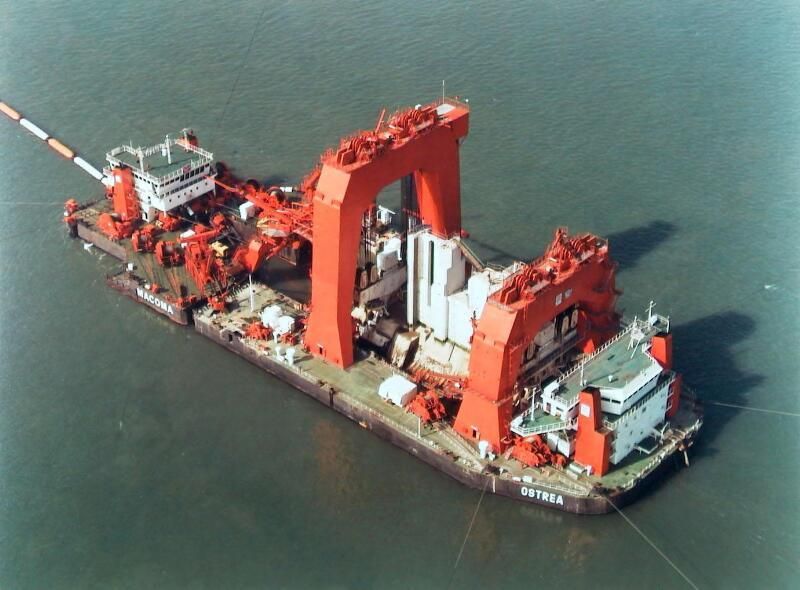

Lifting vessel Ostrea - Eastern Scheldt Storm Surge Barrier
To fill a gap in our programme, fellow region member Ton Thoolen had been found willing at short notice and to our great appreciation to give a presentation on the construction of the Oosterschelde Storm Surge Barrier. A unique project which, although long overdue (opening 4 October 1986), is still a textbook example of Dutch 'creative thinking, scoping doing' and...... whose lessons learned may come in handy again in the future to protect us and other countries from rising sea levels.
A large number of photographs were used to show how the dam was built and the function of the various navigational tools.
To build the dam, a construction pit in the artificial island of Neeltje Jans was used. This is where the huge concrete pillars were made, which were then sailed to the right place with a specially designed lifting vessel, the Ostrea. Mats were placed under the piers to prevent the sand from shifting in the seabed. A special ship, the Cardium, was also built to lay these mats. Before the pillars and sills were placed, the sandy soil was compacted using a special technique in which piles, which were vibrated into the ground and then withdrawn, had to reinforce the subsoil. The vessel built for this purpose was the Mytilus. Finally, the Macoma, which was coupled to the Ostrea during the work to very precisely clean the mats with a suction pipe just before the piles were placed on them.
The focus during the lecture was on the Ostrea (test load 11,000 tonnes) with attention to quite a few details. Why did we do it this way, what went wrong, could we prevent it, why does the ship have such a strange shape?
33 KIVI members were present during the meeting.
The board of KIVI Region Noord-Holland has the pleasure of inviting you to attend a presentation by our fellow regiolid Ton Thoolen.
In our programme, another company visit was planned for October or November, but unfortunately it had to be postponed to spring 2020.
At short notice, Ton has been prepared to give us a presentation on the construction of the Oosterschelde Storm Surge Barrier, a unique project which, although long overdue (opening 4 October 1986), is still a textbook example of Dutch 'creative thinking, creative doing' and...... whose lessons learned may come in handy again in the future to protect us and other countries from rising sea levels.
The lecture will indicate how the barrier was built and what the function of the various navigational instruments was.
The focus will be on the lifting vessel Ostrea (test load 11,000 tonnes), focusing on quite a few details. Why did we do it this way, what went wrong, could we prevent it, why does the ship have such a strange shape?
Programme
12:00 - 13:30: reception with drinks, followed by coffee table
13:30 - 15:00: lecture by Ton Thoolen
Information about the speaker
After studying Mechanical Engineering (with a major in Transport Engineering), Ton joined the offshore shipyard IHC Gusto in Schiedam. There, he worked on the design of offshore crane vessels (then only up to 7,000 tonnes - recently, Heerema's new ship Sleipnir, with 20,000 tonnes of crane capacity, adjusted the global lifting record to 15,300 tonnes!), drilling rigs, drill ships, pipe-layers, Brent Spar, etc. Just before that yard closed, switched to the group that designed almost all the working vessels for the purpose of building Stormvloedkering Oosterschelde.
Contribution to costs for lunch and lecture for members is € 15,=. For non-members € 40,= including two months' donor membership.