

MX3D

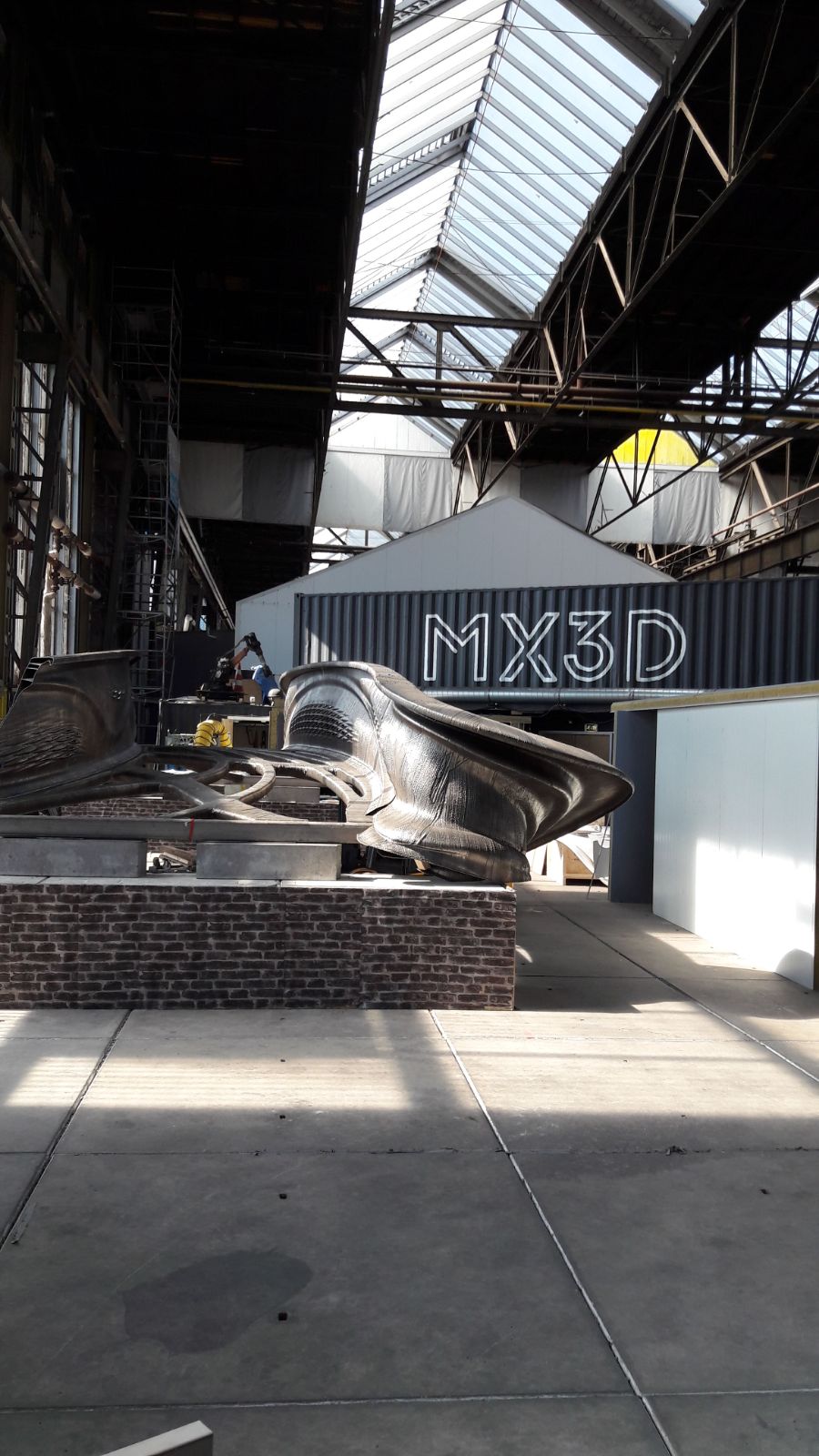


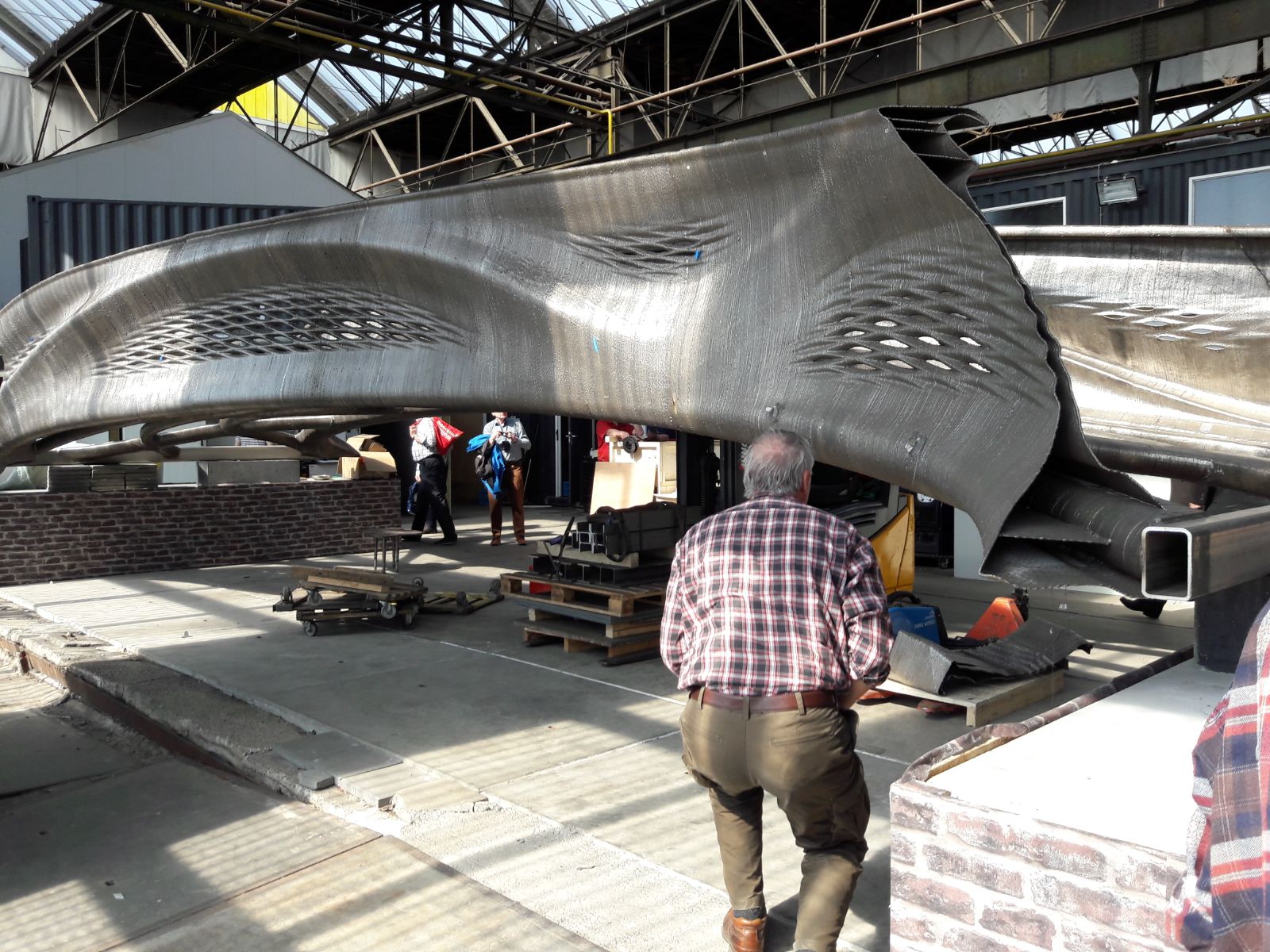

MX3D's visitor centre was a wonderfully cool space in the old NDSM hall where 28 KIVI members were given a fascinating presentation by Gijs van de Velde.
In a presentation on two screens, using an intriguing out-of-the-box thinking video and clear pictures, the lady and gentlemen present were introduced to the pop-up company of artist Joris Laarman. Joris has become widely known for his "bone chair" which is exhibited in many museums around the world. This bone structure is a Laarman Lab characteristic way of thinking to give strength to utensils instead of the old familiar lattice construction. So too now to a world-first stainless steel 3D robot-printed bridge. In the presentation, the hick-ups, the problems and the limitations were explained as well as the fact that the world's first 3D printed bridge was recently achieved by TU Eindhoven with a concrete bicycle bridge.
Using examples, the aspect of material strength during printing was explained and a bronze 3D printed (and subsequently polished) ship's propeller proved that the 3D printing (welding) process does not change the material strength of the used welding material to a negligible extent. The knowledge of companies such as ARUP and Arcelor Mittal helped MX3D with this.
Joris Laarman's bridge design is printed out by ABB robotic welding printers. These are controlled by software specially developed by MX3D, which allows the special curved and curled bridge shapes to be welded. The entire bridge consists of single parts that will be welded together and before installation (scheduled for completion October 2018), a steel plate construction will be applied to the walking surface because the municipality of Amsterdam could not agree to a proposed glass walking floor. After strength testing and coating, the bridge will be transported on a pontoon to its final destination where it will form a new attraction in the very special environment of Amsterdam in addition to a connecting function.
In the workshop, KIVI members were able to do a hands-on on the bridge and also view an MX3D bicycle printed by Delft students. After the excursion around 16.15, the group went for a drink and an after-discussion to the catering establishment PLLEK from where everyone chose a ferry time suitable for him/her to return home.
Description
Amsterdam start-up MX3D has been commissioned by the Municipality of Amsterdam to produce a stainless steel 3D-printed bridge, which is expected to be placed at its final location, the Oudezijds Achterburgwal, this year. The unique design of the bridge was conceived by designer Joris Laarman, with construction company Heijmans providing architectural and technical support. MX3D wrote intelligent software, transforming a robot and a welding machine into a printer for 3D printing metals on an architectural scale. The initial design for the bridge gradually changed significantly. As knowledge of safety requirements, material properties and technical potential grew, the final model came into being in early 2017 after which, in March 2017, production and assembly of the 12 m long x 7.5 m wide and 2.1 m high bridge began. During the bridge's production, MX3D engineers remain continuously involved to improve the autonomous 3D fabrication robots.
The MX3D project was made possible thanks to close cooperation with partners Autodesk, Heijmans, Joris Laarman Lab and ArcelorMittal and with support from Arup, Air Liquide, ABB Robotics and Lenovo. Sponsors are STV, Oerlikon and Plymovent. Public partners are TU Delft, AMS Institute (Amsterdam Institute for Advanced Metropolitan Studies) and the Municipality of Amsterdam.
LOCATION
MX3D
Neveritaweg 15
1033 WB Amsterdam
(NDSM shed, IJ side in black containers entrance visitor centre)
Note: From CS, take the NDSM ferry from 13:45!
Location
Organiser
Region North-Holland
Name and contact details for information
Theo Fikke