
CES Materials Selection (10 places left)
| Workshop Cambridge Engineering Selector | |
|---|---|
| NHL University of Applied Sciences, Leeuwarden - High property divided by low property. | |
|
The reception this time is from half past four, as a comprehensive programme including lecture and practical has been carefully set up for the participants. |
|
|
This is the fourth meeting already in the framework of knowledge exchange meetings of the Royal Institute of Engineers at the NHL Hogeschool and the third organised by KIVI together with Mr Jaap F.J. Verhage. It is fair to say that this is also the last activity Mr Verhage will provide as a lecturer in Materials Science. He will retire after the 2015/2016 school year. |
|
|
Around 17:00, everyone found the room and Mr Jaap F.J. Verhage could start. After explaining the Cambridge Engineering Selector[1] (CES for short), some parameters and the usefulness of the application, a short break follows with the now customary soup, sandwiches and fruit. |
 |
|
After covering a considerable distance, from the lecture theatre to the computer lab, the participants get to work with the CES on the computer themselves. It promises to be a spirited and interactive programme focusing on sharing the high trait by the low trait. |
|
|
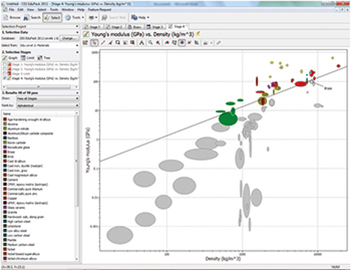
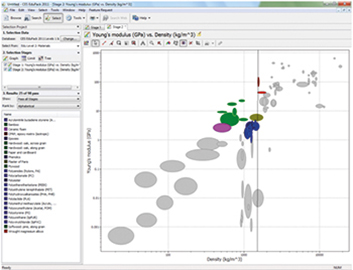
Each participant works on their own computer and follows the steps Jaap conjures up on the screen. Driven, Jaap gives participants one task after another. He also fires off questions and regularly checks whether everyone can follow him. If the participants do not succeed, he recreates the steps on the big screen or stops by to see what is useful to change. Participants are expected to pull out these kinds of charts on the screen in quick succession: |
|
 |
 |
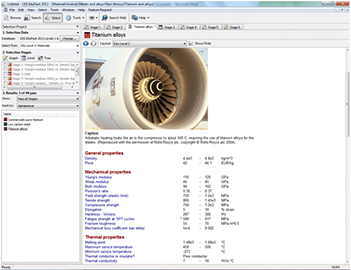
| After a while, it is clear what a powerful application this actually is and participants get to grips with how to use it. By operating the buttons yourself, new insights are easily gained. Besides properties and combinations of properties, the programme's database is full of applications, manufacturing processes and shapes. | |
 |
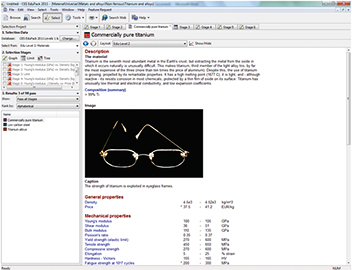 |
Another important aspect on which material choice can be based is sustainability. Thus, in addition to manufacturing, use and end-of-life are considered. In the CES, this is translated a number of indicators. Good to know that these 4 indicators are included in relation to a material selection
|
|
|
The pace is brisk and the participants manage to complete almost all tasks. There is even time for an extra problem at the request of one of the participants. Jaap explains in class which parameters should be chosen and what the graph will eventually look like. |
|
|
Inspired and enthusiastic, most participants went home around a quarter to 10. We succeeded in getting the participants interested in CES and who knows, maybe they will use it in the future! |
|
|
More information about CES and/or materials science issues in general? Please contact Mr Jaap F.J. Verhage. |
|
|
Attending or giving a workshop or presentation yourself? Contact Mariska van Cronenberg | m.vancronenberg@online.nl | +31 6 512 02 681 |
|
|
Text: Ir. Mariska van Cronenberg |
|
| [1] CES is a computer application that enables materials experts and product development teams to find, investigate and apply material property data. | |
|
|
|
Description
Region North organises knowledge exchange meetings at NHL University of Applied Sciences. These meetings are exclusively for KIVI members, students and teachers from the Institute of Engineering at NHL University of Applied Sciences. Host for this Cambridge Engineering Selector Workshop is the NHL University of Applied Sciences' Department of Engineering.
Using the world's largest material selection software package, you will gain insight into the best material suited to the desired properties, manufacturing and shape. On Thursday 19 May, based on a step-by-step plan and using this material selection tool, you will choose the most suitable material for your product or manufacturing process. The workshop/practicum will take place at NHL University of Applied Sciences and will be led by Mr Ir. Jaap F.J. Verhage.
More information about CES can be found at: https://www.grantadesign.com/education/edupack/
The programme is as follows:
16:30 hrs - Reception in F2.014
17:00-18:30 hrs - Theory in F2.014
18:30-19:00 hrs - Break in F2.014
Soup and sandwiches will be provided
19:00-21:00 hrs - Practicum in H2.015
You will get to work yourself during the practicum. Based on the questions and assignments in the practical guide, you will learn how to select the most suitable material and make decisions about the material.
After the practical session, you will have the opportunity to ask questions, talk and discuss the material over a drink in F2.014.
A maximum of 16 places are available for this workshop, which will take place with a minimum of 10 participants.
Location
NHL University of Applied Sciences
Organiser
Northern Region
Name and contact details for information
Ir. Mariska van Cronenberg | +31 6 51202681