

Underground pipelines (GIV)

Description
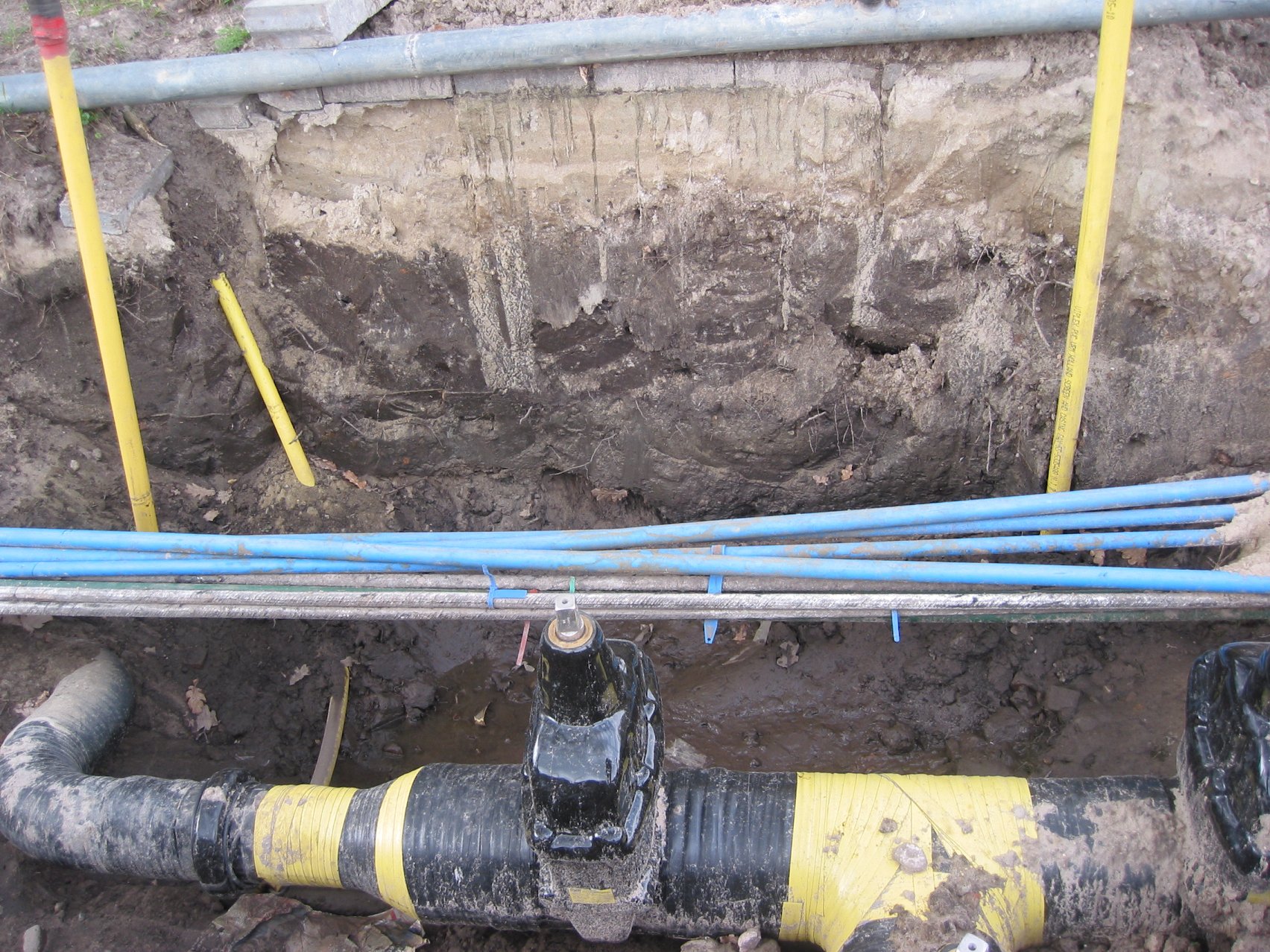
Pipelines have become an integral part of our society. They provide an extremely important part of the transport of goods. Mainly gas and liquids are pumped, but also solids can be transported by pipeline. The materials from which pipelines are made are diverse. For high-pressure pipes (> 16 bar internal pressure), steel is almost exclusively used. In low-pressure pipes, plastic (PVC, PE), fibreglass-reinforced plastic, ductile iron and concrete are also used as materials. Distinctions can be made according to the pressure regime: free-flow pipes (sewage) or pipes with internal pressure (natural gas, oil, water), but also according to the risks of the piping system when transporting hazardous substances (explosion, toxic) and non-hazardous (water, low-pressure natural gas). In the Netherlands, additional requirements for pipelines are determined by the location (location) of the pipeline. In particular, this applies to pipelines in or near important waterworks (water defences, dykes, roads and railways) and pipelines located in groundwater protection areas.
Every (older) pipeline designer in the Netherlands is familiar with the PC (pipeline code) of the province of Zuid-Holland, a substantial book of requirements for crossing waterworks. The requirements are incorporated in NEN 3650 and the specific crossing technical requirements in NEN 3651 (1994). The PC was initiated in response to the arrival of transport pipelines for Groningen's natural gas by flood defence managers in South Holland. The flood defence function of the (mostly vulnerable peat) embankments had to be and remain guaranteed. Over the years (1968 to 1992), the PC grew from 20 to about 400 A4 sheets. One might ask why then another standard NEN 3650 was made. It turned out that if you want to introduce a standard in Europe, you have to do so with a standard issued by the NNI. That standard was not there, nor was the need for it; after all, we had the PC. Nederland BV, with Gasunie as promoter, thought we should definitely join in with our knowledge of gas transport pipelines in subsidence-sensitive substrates. In European standard EN 1594, much can be traced back to NEN 3650.
The introduction will also focus on the 2nd Bergambacht pipeline project. This project completed in 1995 includes a nearly 60 km long raw water transport pipeline from Bergambacht to Wassenaar. The pipeline (1.60 m) is partly made of steel and partly of concrete. About 10% of the pipeline was drilled as shield wells under dykes, roads, railways, canals and rivers. And all in the weak subsoil of South Holland where peat layers occur up to 14 m deep.
Speaker(s)
Ton has been a member of our association for several years and also secretary since Nov 2014. After studying civil engineering at TU Delft, he joined Tebodin, Consultants & Engineers. Underground transport pipelines and everything related to them have been Ton's field of work, to which he lovingly gave his time and commitment. Challenging, too, because especially in the Netherlands, with its soft and weak subsoil, pipelines have to be able to function undisturbed for years to come. After NNI decided in 1989 to draw up a NEN standard for gas transport pipelines as a basis for a European standard, Ton had the opportunity to invest a lot of time in it. In 1992, the 1st version of NEN 3650 was published. The standard, now as the NEN 3650 series, has now been revised for the 3rd time.
Location
the Gorechthuis, Hortuslaan1, 9751 BE in Haren
Organiser
Region North
Name and contact details for information
Ton Wester
Register via
Ton Wester GIV Registration for this activity is via the GIV. Please also register there.
twester@ziggo.nl