

Polytec Composites NL BV - Roosendaal
With some 300 employees, Polytec Composites is one of the largest employers in the Roosendaal region. 'Yet many people do not know what goes on behind the walls of our factory,' says plant manager Stef Suijkerbuijk of the company operating in the automotive industry. 'It is high time this changed, because we are a young and innovative company that is constantly looking for new talent.'
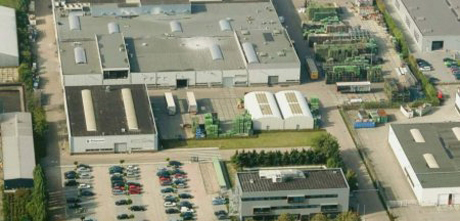
AIR PHOTO Plant Roosendaal
Polytec Composites is part of Austria's Polytec Group. This company is a leading developer and manufacturer of high-quality plastic parts for, among others, the automotive industry. The company has four business units: plastics, car styling, industrial and composites. Polytec Group is headquartered in Hörsching, Austria. The company also has 25 production sites in Germany, Hungary, Belgium, Sweden, the United Kingdom, the Czech Republic, Slovakia, Turkey, the United States and China. Polytec Group employs over 4,500 people worldwide.
Unique and innovative

Various components in one press stroke
At Polytec Composites in Roosendaal, plastic parts for luxury cars are produced, such as car underbody protection plates and battery housing in which the latest batteries are protected. This is done in a dynamic factory with a high degree of automation. Stef Suijkerbuijk: 'Ninety per cent of our customers are abroad. We mainly produce for cars in the premium segment, such as Mercedes C- and E-class, Audi A4 and A6 and Jaguar F-Type and F-Pace. The big difference compared to competitors, is that we are able to include a large number of different components in one press stroke. Not just a protective layer, but also a heat shield and a layer for sound absorption, for example. This is done fully automatically, allowing us to quickly achieve a high-quality end product while keeping the cost price low.'
Not cyclical
He points out that the Roosendaal-based company has the wind in its sails. 'Take sales of the Mercedes C- and E-class, for example. Those are going like clockwork. Some 400,000 such cars roll off the assembly line every year, for which we can supply the parts. The premium segment in the car industry is less sensitive to economic cycles than cars in other price categories. This is of course only beneficial to our company, as it means we are less affected by fluctuations in demand for our products'
Extensive automation
A total of 18 presses are used at Polytec Composites. 'We have presses with press forces ranging from 100 tonnes to 4,300 tonnes. This enables us to produce ever larger, thinner and faster. Huge parts come out of the presses in a short time. In addition, the internal organisation in our company is also changing at lightning speed. Five years ago, we had ten robots here in the factory. Now, more than 30 robots are already operating.' This far-reaching automation also requires skilled employees who can operate all these robots in the factory. 'The complexity of the machinery makes working at Polytec Composites incredibly fun, but also difficult at the same time. We are therefore constantly looking for young people of the iPad generation who have knowledge of automation, or are able to pick it up quickly.'
Learning by doing
Polytec's production department employs some 180 people. In addition, some 120 people work in departments indirectly involved in production and a number of people work in the engineering department. The education and training of new employees is largely done internally. 'There is an MTS course for injection moulders, but you can't learn how to work with printing presses at school. Many people who come in here often only see a printing press for the first time in their lives. We therefore work here according to the principle of 'learning by doing'. In addition, Polytec Group is organised internationally as a so-called matrix or network company. 'This means that some of our employees do different work for different plants. Our people work in an international working environment with many foreign contacts both internally and externally. That makes it extra attractive for many people to be allowed to work here.'
Working on improvement projects
Suijkerbuijk says that Polytec has quite a few trainees. technical business administration and mechanical engineering students in particular often feel right at home here. We always find it refreshing and challenging to work with trainees. Our team of employees is quite young and we have many ideas, not all of which we can explore ourselves. We therefore regularly give interns the opportunity to work on these improvement projects. This regularly leads to surprising innovations.' As an example, the plant manager mentions an intern who was given the chance to investigate the start-up procedure on a new press. 'Initially, we always had four reject parts after starting up this press. By optimising the start-up of the same machine, we now only have one reject part per start-up. Moreover, we may be able to roll out this solution to other presses as well, which will allow us to reduce the number of reject parts massively. This will save us hundreds of thousands of euros a year. The intern who carried out this research has now also joined our company on a permanent basis.'
Battery boxes for hybrid and electric cars
The plant manager sees two important developments for the future in automotive industry. 'On the one hand, we note that OEMs are continuously looking for weight reduction, to make their vehicles as light as possible. In addition, car manufacturers are also increasingly focusing on the development of hybrid and electric cars. These developments also present opportunities for Polytec. Because we are uniquely capable of producing lightweight components. In addition, the demand for battery boxes for electric cars will only increase in the coming years. The production of these battery boxes is quite complex, but we are already working hard on this. We expect these efforts to pay off in the future.'
Programme
14 .30: reception with coffee/tea
- presentation : Stef Suijkerbuijk, plant manager
- tour in groups by 5 employees
- question block+networking
17.30: closing with drinks