

Motivation & ownership
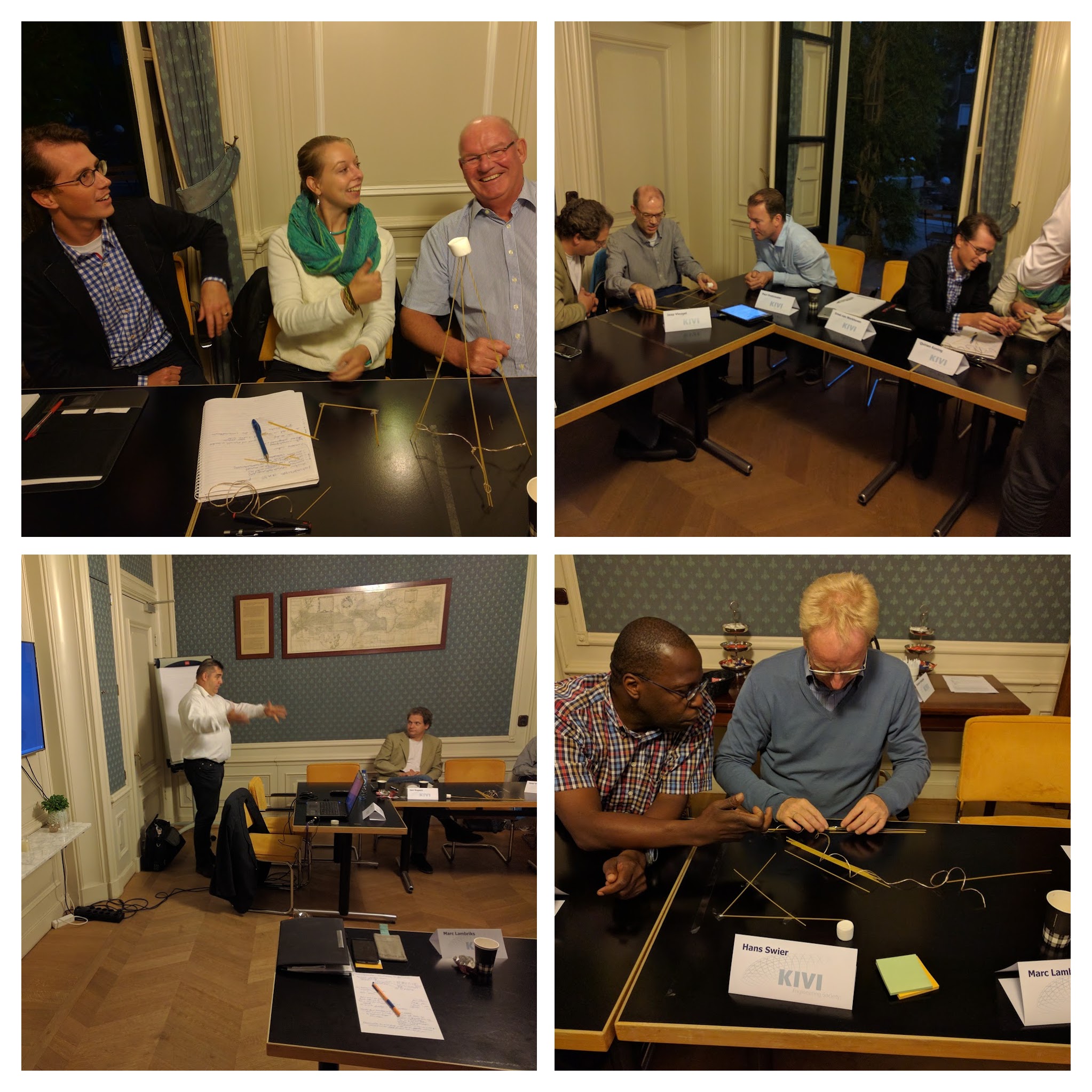
The workshop 'Motivation & Ownership' was held on 22 September 2016 at KIVI in The Hague . Twan Hillebrand (LeerMaatWerk) started the workshop with a short introduction about his background as a trainer. LeerMaatWerk works from the principle of 'Troaching': training, advising & coaching. From here a bridge was made towards the Organisation-Result Compass. This focuses on leadership, surrounded by knowledge transfer, work capacity and historical awareness. The three pillars of the compass must be in balance! Ultimate goal of leadership is to bring someone into action. This is only possible if he believes in it. Then you want this person to be involved (emotion). You do this through physiology (receiving stimuli).
You can't teach motivation, you can stimulate it. For example, money will not motivate in most cases, only if the processes/goals are very clear. Very generalised, every person has six 'motivation buttons': structure (doing something at regular intervals), result (pat on the back), form (looking for balance), assisting (helping selflessly), power (control) and truthfulness (why is this so).
Ownership should be a direct consequence of motivation: if a person is motivated, they will automatically take ownership of a problem or action. This develops through direct feedback (and not once a year during a performance review). Therefore, address people on performance, not behaviour.
Here is where the slides from the evening can be reviewed again. The workshop was rated very highly by the participants! Afterwards, there was considerable discussion over drinks. Many thanks to everyone for participating!
Description
Introduction:
The value of human capital is an issue within every company. In crisis conditions, the focus is mainly on productivity and personnel costs. In sunnier times, the focus is mainly on the added value of human capital for an organisation. The question is: How do we deploy human capital in the best possible way and how can we grow human capital?
The 5 dimensions of human capital are:
1. individual motivation
2. individual capabilities
3. leadership
4. organisational climate
5. synergistic effectiveness
These are the 5 terms that together define the total of human capital within an organisation. Currently, the focus within the business world is on the term individual capabilities. The most common words used to describe this dimension are ownership and motivation.
The market is picking up and the pressure on employees is increasing. In addition, newly qualified staff are flowing into the organisation. The question is: How do we ensure that current employees deliver the maximum possible and do not leave for the competition? The 2nd question is: How do we make a new employee fit directly and seamlessly into the existing team? The answer to both questions is partly ownership and partly motivation.
In the Motivation & Ownership masterclass, you will learn to translate from theoretical insights to your own practice. Through theory, discussion, reflection and creative work forms, you will experience what motivation & ownership means for you, for your employees and for your organisation.
Target group:
This master class is intended for professionals who regularly form part of a team or lead a team or organisation. A professional who, wants to improve their own value or the human capital of the organisation, by positively influencing and effectively applying the 5 dimensions of human capital.
Speaker(s)
The programme is put together and facilitated by LeerMaatWerk V.O.F. human capital engineering specialists for "own" wise professionals, leaders and managers.
Twan Hillebrand left the army after 22 years and entered the "civilian" market of people and organisation development. After trainer/coach, he quickly progressed to project leader and director of training. After three years, he started LeerMaatWerk vof, a training and consultancy agency that focuses on people and organisational development with a focus on leadership. Convinced that leadership cannot be taught by looking at presentations with models, Twan approached the market differently. On the one hand, by keeping in touch with his military background and, on the other, by his training slant that focuses on how to learn, inspire and motivate. For instance, he takes participants in his development programmes on a battlefield tour. In which, by visiting a well-known or less well-known location from WWII, the similarities and differences between a military organisation and the participant's organisation are laid out
Location
Organiser
Commercial Engineer
Name and contact details for information
Marc Lambriks