

The AFCEA seminar 'A data-driven criminal justice chain' will be organised on Friday 26 November from 11.00 - 15.00 at the Police Training Centre de Yp location, in The Hague. Four briefings will address various relevant aspects of chain automation in the criminal justice chain.
Four briefings will deal with various relevant aspects of chain automation in the criminal justice chain:
- The Operational Police Platform as a launch pad for national registrative operational work processes and data exchange
- The potential of Dynamic Case Management
- Linked Data and FAIR Data as architectural conditions
- Scenarios as carriers of Knowledge Graphs
Please register at https://www.eventbrite.nl/e/tickets-afcea-seminar-een-data-gedreven-strafrechtsketen-183309201757.
Directions to the Yp can be found at https://www.politieacademie.nl/contact/locaties/Documents/17130-Route_academie_Den_Haag.pdf.
Context
A lot is going on in the IT domain at the National Police. One quickly thinks of large projects that are not running optimally but there are now also positive reports.
For instance, a lot of hard work is being done to replace a number of large registry Legacy systems, and it can be reported that the first modules have been delivered. In that context, the Innovative Registration Programme (PVR) focuses on the Operational Police Platform (OPP), as a launch pad for nationally harmonised operational work processes. Central to this are unambiguous registration and reliable and secure information exchange in the criminal justice chain.
The challenge is to convince chain partners of the benefits of a coordinated development process based on a target architecture. Besides formal registration processes, there are increasingly new data flows from 'social media' and from 'sensing devices', leading to the creation of extensive and complex data files. FAIR Data makes it possible to make such files safely available to all chain partners, so that exchange of data is guaranteed in a safe and reliable way. This uses 'data visiting' instead of 'data sharing', making distribution and multiplication unnecessary, with many relevant advantages of course.
From a business perspective, this technology is also used in combination with Dynamic Case Management software. This brings legislation, business rules and business processes together and standardises them. In combination with FAIR Data, it addresses the need to inform and commit many stakeholders in an unambiguous and reliable way.
The large and complex data collections thus created also call for innovative inclusions. A trend can be observed to present the linked data in the form of 'knowledge graphs'. This creates meaningful visualisations, which can be used to make fast, frequent and responsible decisions on the three classic control levels. Prof Peter de Kock has a remarkable career behind him: After the Film Academy, he spent 15 years travelling the world as a documentary filmmaker focusing on terrorist attacks. Then switched to the police and manifested himself as a team leader in the field of covert operations for a period of 10 years. Then earned a PhD on an empirically developed scenario model resulting in an appointment as part-time professor, Head of Crime & Safety. In parallel, he founded the company Pandora Intelligence which translates the acquired knowledge into advanced analytical methods focused on data-driven risk management.
The four speakers will address questions and suggestions from the participants of this promising seminar during the concluding panel discussion.
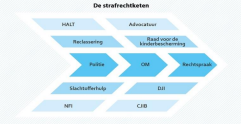

Programme
11.30 Walk-in with coffee or tea
12.00 Chain automation in the criminal justice chain, Some essences, Wim Broer, Vz. IPEEK Foundation
12.10 The Operational Police Platform (OPP) as a launch pad for nationwide registrative operational work processes and data exchange: Commissioner of Police Richard Vriesde
12.30 The potential of Dynamic Case Management, Daniel Meier, Salesforce / Mulesoft 12.50 Lunch break
13.30 Linked Data and FAIR Data as architectural conditions, Arie Hakemulder, Ambassador GO FAIR Foundation
13.50 Scenarios as carriers of Knowledge Graphs, Prof. Dr. Peter de Kock, Tilburg University and Pandora Intelligence
14.10 Panel discussion
15.00 Closure and drinks
Registration
You can register via EventBrite: https://www.eventbrite.com/e/tickets-afcea-seminar-een data-driven-criminal-justice-chain-183309201757
The cost for participation, including lunch, is EUR 15 (AFCEA members) or EUR 25 (non-members). Government representatives and sponsors of AFCEA The Hague Chapter can attend free of charge by sending an email to ad.koolen@afcea.nl.
Legitimation
At the police location, you must be able to provide identification (Driving Licence/Passport).
Directions and parking
For directions see https://www.politieacademie.nl/contact/locaties/Documents/17130- Route_academy_Den_Haag.pdf
It is not possible to park on the police premises. If you come by car, you can use the P&R lot next to The Hague-Ypenburg NS railway station.
If you have any further questions, please contact Jaap van der Lelie, Secretary AFCEA The Hague Chapter, 06-53245648 - jaap.vanderlelie@kpn.com


Comments