

Fledged: European sustainable fuel efficiency process project
There are several sustainable alternatives to fossil fuels and feedstocks, ranging from hydrogen to biodiesel. One major contender is dimethyl ether. In the Fledged project, which falls under the European Horizon 2020 framework programme, ECN part of TNO and the Dutch company Frames Renewable Energy Solutions are working with partners in other European countries to develop an efficient process to make dimethyl ether from biomass or other renewable sources.

The route from biomass to dimethyl ether (including the gasification of biomass to synthesis gas and the synthesis of dimethyl ether from synthesis gas)
"The Fledged project fits with our goals to develop processes, with which we can convert both biomass andCO2 into various useful products as alternatives to fossil fuels and raw materials," says Jurriaan Boon, project leader for this project at ECN in Petten. He explains why dimethyl ether (DME) stands out favourably as a synthetic fuel. It resembles diesel and is suitable for diesel engines. The advantage is that it does not produce soot, because the carbon atoms in DME molecule are separated by oxygen atoms. In terms of energy density, it is comparable to ethanol. It is also easy to transport and non-toxic.
"DME may be gaseous under normal temperature and pressure, but if you compress it to five to six bars, you can transport it liquid in a tank just like LPG. You can make it from biomass, but also fromCO2 and sustainably produced hydrogen. In short, DME scores reasonably to well compared to other alternative fuels on several counts."
One drawback is, that using DME does require some modification of diesel vehicles. Also, DME is not yet recognised as a fuel within the EU. Ford and Volvo are lobbying for it. Europe is therefore still experimenting with it to a limited extent. By contrast, in New York City, municipal rubbish trucks from manufacturers Mack and Volvo are already running on DME. Incidentally, DME can also serve as a fuel for gas turbines and as a raw material for chemicals.
HIGH ENERGY DENSITY
"Many people see hydrogen as the egg of Columbus, but if you want to get some use out of it and achieve high energy density, you need to compress it strongly. One advantage of hydrogen, though, is that noCO2 but only water vapour is released during combustion," judges Glenn Rexwinkel, project leader for this project at Frames Renewable Energy Solutions in Enschede, part of Frames from Alphen aan den Rijn. Frames has been building installations for the oil and gas industry for years and started renewable energy activities a decade ago. In the Fledged project, the company is calculating the financial feasibility of DME production and is signing for the reactor design. "DME can be easily stored and transported liquid in an LPG tank. This makes it an easily manageable substitute for diesel and also much cleaner. That argues in favour of keeping low-maintenance diesel engines for a while until DME is available as a fuel. Combustion does releaseCO2, but it belongs to the carbon cycle if you at least make the DME from biomass and sustainable hydrogen."

Jurriaan Boon, Project leader ECN
EQUILIBRIUM REACTIONS
DME production involves a number of steps. First, biomass is dried and compacted. Then it is converted into a gas mixture of carbon monoxide, carbon dioxide and hydrogen using steam at 600 to 800 degrees Celsius. This is followed by its conversion into methanol through two reactions using a copper-based catalyst: an equilibrium reaction, in which carbon monoxide with hydrogen is converted into methanol and an equilibrium reaction, in which carbon dioxide with hydrogen is also converted into methanol. In the next step, methanol is dehydrated to dimethyl ether at 275° C and 25-30 bar, which is another equilibrium reaction.
"These equilibrium reactions never yield a complete conversion of carbon monoxide, carbon dioxide and hydrogen into DME, but with a trick it works," Boon explains. This is because all three equilibrium reactions produce water:

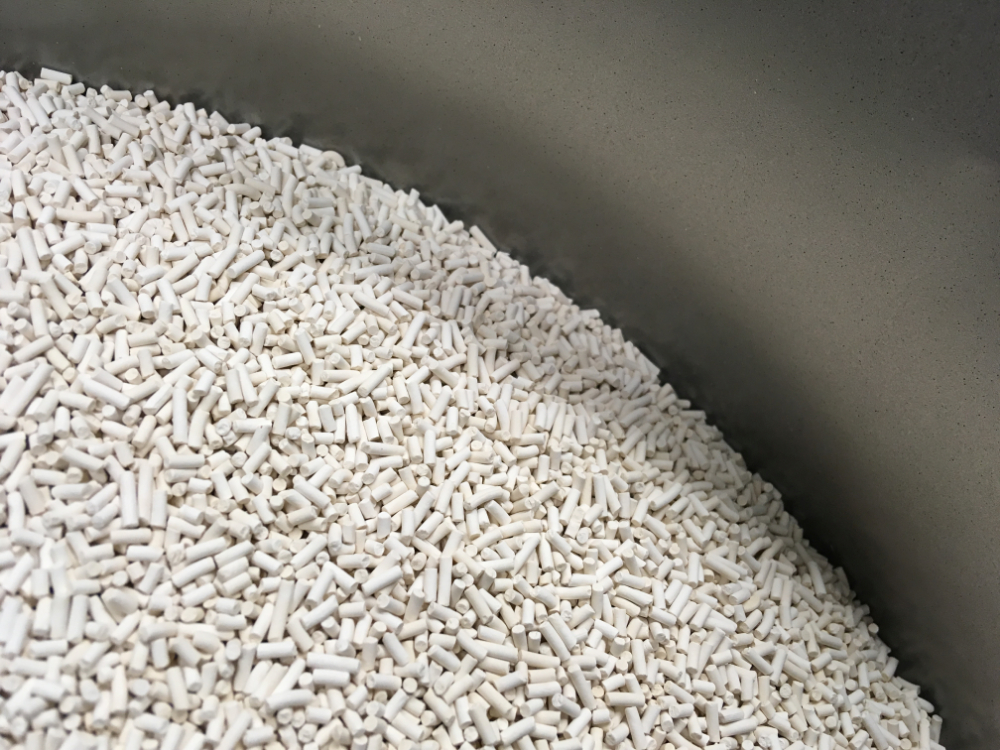
By adsorbing the water vapour using zeolite, you can convert eighty per cent of carbon compounds into DME
By adsorbing the water vapour using zeolite, the equilibrium in all three reactions shifts to the right according to Le Chatelier's (and Van 't Hoff's) principle. "That way, you can convert eighty per cent of the carbon compounds into DME. Only carbon monoxide and someCO2 and methanol remain. You can then separate the carbon monoxide from the product mixture by cryogenic distillation.

Glenn Rexwinkel, Project Manager Frames Renewable Energy Solutions
REFRESHING APPROACH
Frames Renewable Energy Solutions' task in the Fledged project is to calculate what the production plant will cost and at what price DME can be sold with or without subsidy. Rexwinkel: "We started by making a rough estimate of the price of the reactor even before we knew what it would look like. That's a refreshing approach. Traditionally, you only look at the costs at the end of a project, but now you immediately look at where the highest costs are."
In a traditional reactor, methanol is converted into DME using a catalyst, after which the product has to be purified. "At Fledged, we opt for a higher conversion by capturing water vapour with a sorbent. This then delivers a high yield in one go. The disadvantage, however, is that you have to regenerate the sorbent (zeolite, ed.) afterwards. It's always like that in chemistry: you never get a sheep with five legs and have to settle for the least limping sheep," Rexwinkel says.
"In chemistry, you never get a sheep with five legs, you have to settle for the least limping sheep"
Boon: "In our experiments in Petten, we work with columnar reactors. At some point, DME synthesis takes place in one of the reactors, while in the others the sorbent is regenerated by heating it up to 400 °C. A key research question is how to carry out this regeneration as efficiently as possible." The aim is to arrive at a multi-column semi-continuous process. The researchers started with reactor columns of 0.9 by 20 cm and are now experimenting with columns of 3.8 by 200 cm. Tests in 3.8-by-600-cm columns will follow next year.
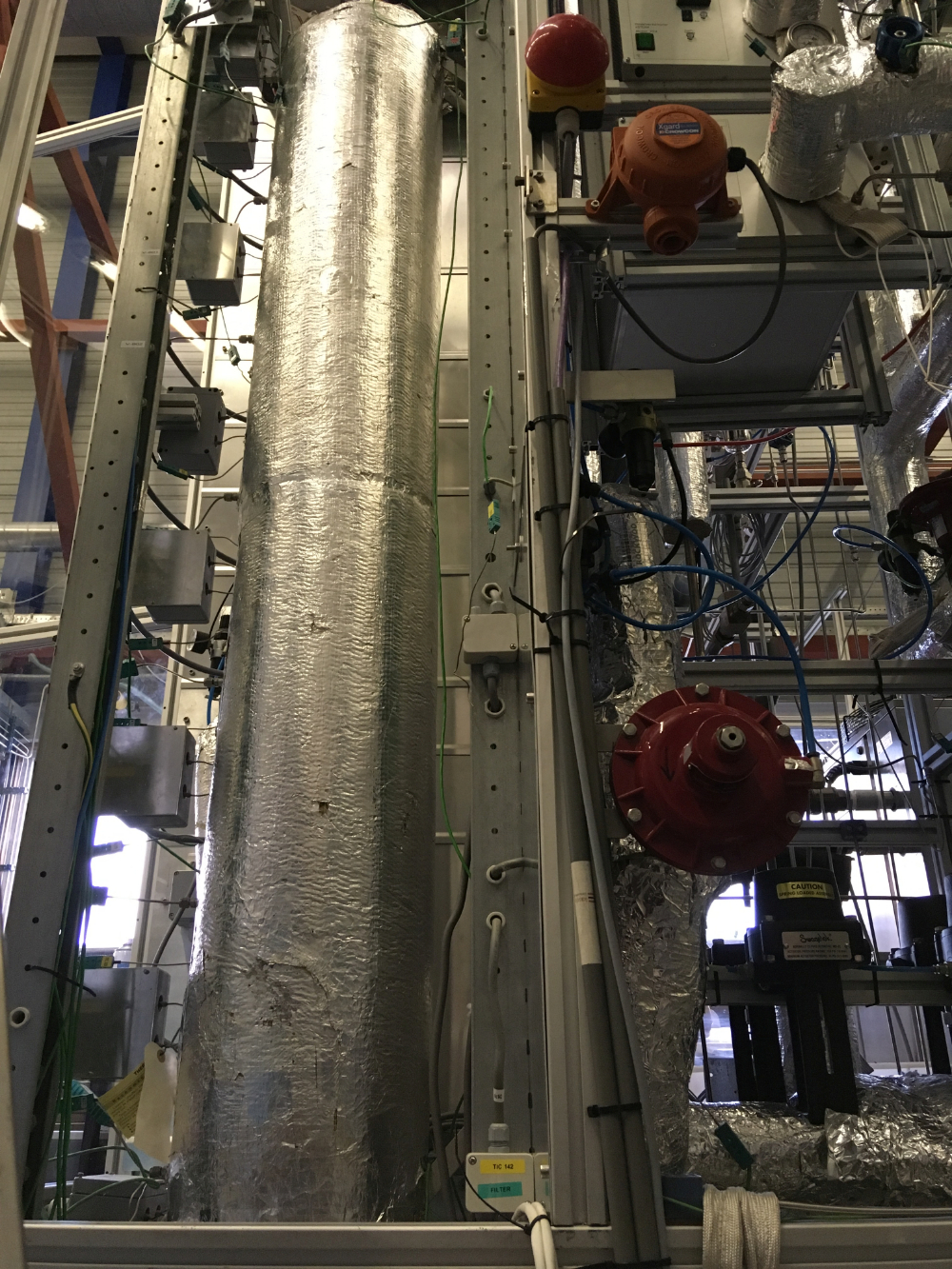
The researchers initially experimented with reactor columns with diameter 3.8 and height 200 cm
These six-metre-high reactor columns for SEDMES (Sorption Enhanced Dimethyl Ether Synthesis) will replace the two-metre-high
BIOMASS GASIFICATION
Research on biomass gasification is being conducted at the University of Stuttgart. "They too apply sorption and that is ofCO2," Boon continues. The pretreated biomass is steam gasified in a fluidised bed of hot calcium oxide-rich particles, producing hydrogen, carbon monoxide and carbon dioxide, leaving a kind of charcoal as a residual product. Some of theCO2 released reacts with calcium oxide to form calcium carbonate. Those particles with calcium carbonate go with the char to an incinerator, where the calcium carbonate decomposes into calcium oxide andCO2, and the char burns. Then the hot particles with calcium oxide go back to the gasifier. The nitrogen-free synthesis gas goes to DME synthesis after removing tar, sulphur and dust particles.
"You can determine the composition of the synthesis gas produced by capturing more or lessCO2. Normally, synthesis gas contains relatively much 'C' and little 'H'. To convert this with 'O' into DME, you have to reduce the carbon content and thus capture someCO2," Boon explains.
Projects have also been running at TNO/ECN for several years to make hydrogen from water using an electrolyzer. That may soon offer the possibility of also converting theCO2 released when processing biomass into DME.
LARGE VOLUMES
Replacing diesel in the long run requires large volumes of DME and thus large quantities of raw materials. This can be provided by the steel industry, for example. Steel production releases steel gas, which contains carbon monoxide and carbon dioxide. "You can convert the carbon monoxide into hydrogen and carbon dioxide using ECN's SEWGS process. Then you can convert all the hydrogen with carbon dioxide into methanol or DME, for example. You can capture and store the excessCO2. Steel producers now use the carbon dioxide as fuel for electricity production, among other things, but that could perhaps also be used as a raw material for DME, even if steel companies were ever to switch to other carbon sources to reduce the iron oxides in iron ore," Boon explains.
One of the partners in the project, Spanish company Eco Hispanica is also looking at the possibilities of producing DME from household waste and agricultural residues and is also calculating how much of it will soon be available in Europe. There are also plans to build a pre-commercial pilot plant at Eco Hispanica's site, which will make DME from waste biomass from the company's Madrid plant.
ECN expects to develop the technology for DME production to the point where a demonstration plant can be built in 2021 with a capacity of three kilograms of DME per hour. This also involves reducing costs as far as possible. This can be done by applying process intensification, or in other words by drastically reducing the number of unit operations. This should result in much lower investment costs. It is up to Frames Renewable Energy Solutions to come up with a suitable reactor design on this basis.
 EUROPEAN PROJECT
ECN part of TNO and Frames Renewable Energy Solutions, together with the University of Stuttgart, the Polytechnic University of Milan and the Spanish research council CSIC, are the main partners of the European research project Fledged. The project, called in full Flexible Dimethyl Ether Production from Biomass Gasification with Sorption Enhanced Processes, is part of the European Horizon 2020 framework programme along with other projects aimed at developing alternative fuels and mobile energy sources. The European Union is contributing €5.3 million to Fledged's total budget of €5.6 million. The aim is to reach technical readiness level 5 (TRL 5) with the development of processes for DME. At that level, industry can take over.
More info: www.fledged.eu


Comments