

ISPT and DPI collaborate with European industry in Circular Plastics Initiative
The world is struggling with huge plastic waste streams for which there are really hardly any solutions today. Much of that waste ends up in the environment. Once in the waste stream, it is dumped or incinerated. However, plastic is in fact a valuable material, very suitable as a raw material for circularity. Knowledge institutes ISPT and DPI therefore took the initiative to set up the Circular Plastics Initiative, in which they want to realise this circularity together with industry.

This drum screen of the Plastic Sorting Installation (KSI) at waste processor Omrin is the first link in the complex recycling process of plastics (photo: Omrin) European and all along the chain
A circular value chain in plastics connects all parties - from production through collection and sorting to recycling and reuse - and has a European dimension, says Tjeerd Jongsma, director of the Institute for Sustainable Process Technology (ISPT). "For an effective circular process, all raw materials must return to the producer and that requires that we at least adopt a European scope. What is essential here is that we link logistical and technological challenges." The Circular Plastics Initiative therefore includes international chemical companies, food producers and waste processors such as global packaging company Amcor, recycling multinational Tomra, waste processor Omrin, international toy manufacturer LEGO and chemical giants such as Dow and Nouryon. Normally, all these parties have little opportunity to meet, but on the initiative of ISPT and DPI, they are talking to each other.
In the last century, it was still something to be proud of: after the stone, bronze, and iron ages, man had arrived in the plastic age. Plastic, as we refer to it in proper Dutch, what a wonderfully versatile material it was. Functional, light and strong; how could we ever do without it? Today, that picture has tilted considerably and the focus is on the problems. Litter, microplastics and plastic soup define the image of the unabatedly versatile material.
To enable a reappraisal of plastic, but certainly also to save our planet from worse, it is vital to find a structural solution to the plastic waste problem. That is why there is now the Circular Plastics Initiative. This partnership around circular plastics unites knowledge institutes ISPT (sustainable process technology) and DPI (polymer technology) with international parties from the plastics, food and recycling/waste industry.
The ambitious goal is to come up with new insights and solutions that can lead to full circularity, especially focusing on single-use plastic packaging. The consortium considers the entire chain - from production, distribution and end use, through collection and sorting, to recycling and reuse. Its hallmark is a problem-solving approach, relying on state-of-the-art technology and, where necessary, the development of new techniques and processes.
The challenge is enormous: in Europe, for example, more than 60% of plastic production is not reused: it disappears into incinerators, wanders around as waste or cannot be recycled at all.
TWO PROJECTS
Under the Circular Plastics Initiative, two projects will start soon.
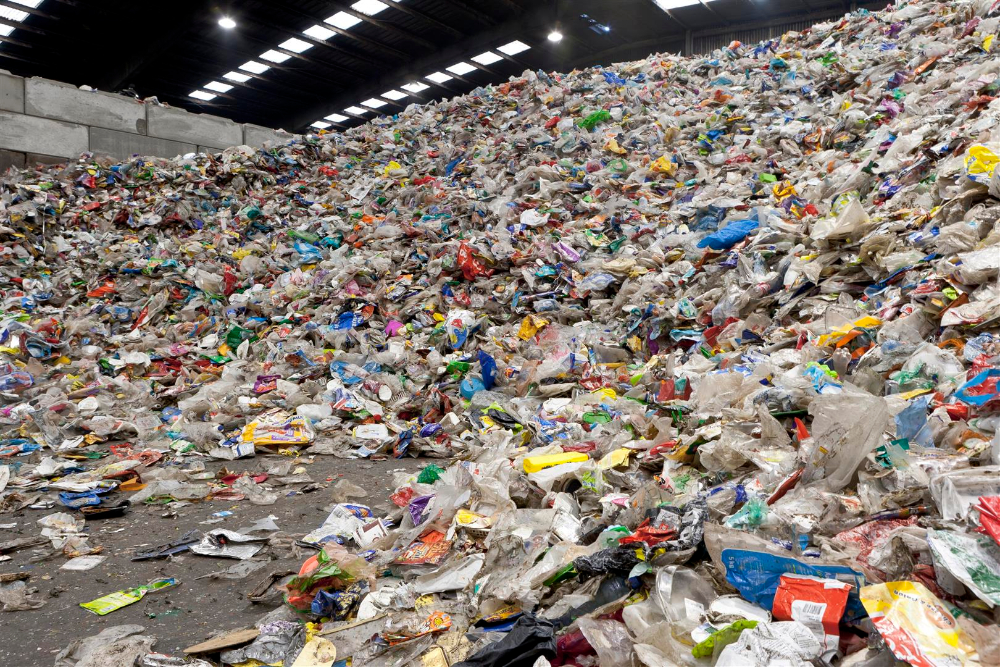
The post-consumer plastic waste stream is very complex in composition. Closing the loop requires a lot of effort in terms of sorting and separation, for example in the KSI (Photo: Omrin)

From plastic waste to reuse in a circular chain
The first project, coordinated by Ronald Korstanje of DPI, involves the highly detailed analysis of plastic from waste streams. In light of an open European market, it will be carried out on a relevant European scale. "We will do sorting tests with post-consumer plastic waste from various regions of Europe," says Korstanje. "This is important because waste collection systems can vary widely within Europe, and even within countries. There are also big regional differences in packaging shapes and designs. This all affects the quality and efficiency of the final sorting."
The plastics from the sorting tests are then analysed in detail for aspects such as polymer composition, types of additives and contamination. "We look at both the chemical composition and the physical functionality of individual plastics but especially the mixed plastics fractions," Korstanje says. "We want to get a good picture of the potential for mechanical recycling and chemical recycling so that we can achieve optimal recycling." The project will develop scenarios taking into account the proposed redesign of current packaging systems into recyclable variants as a number of major end-users plan to implement by 2025. It also includes innovations in sorting techniques that could lead to better and faster sorting of plastics.
The detailed analysis results of the sorted mixed plastics streams are important for the second project, which has a more process-technological angle. It is coordinated by Sascha Kersten, scientific director of ISPT and also professor of Sustainable Process Technology at the University of Twente. It focuses on chemical recycling of plastics, where polymer molecules are broken down and reduced to the molecular building blocks for plastics. Particular focus will be on polyolefins such as polyethylene (PE) and polypropylene (PP). These widely used plastics are subject to legal restrictions that preclude their use in food packaging after mechanical recycling. As companies such as Nestle and Unilever do want to start using recycled polymers, chemical recycling is the only option here.
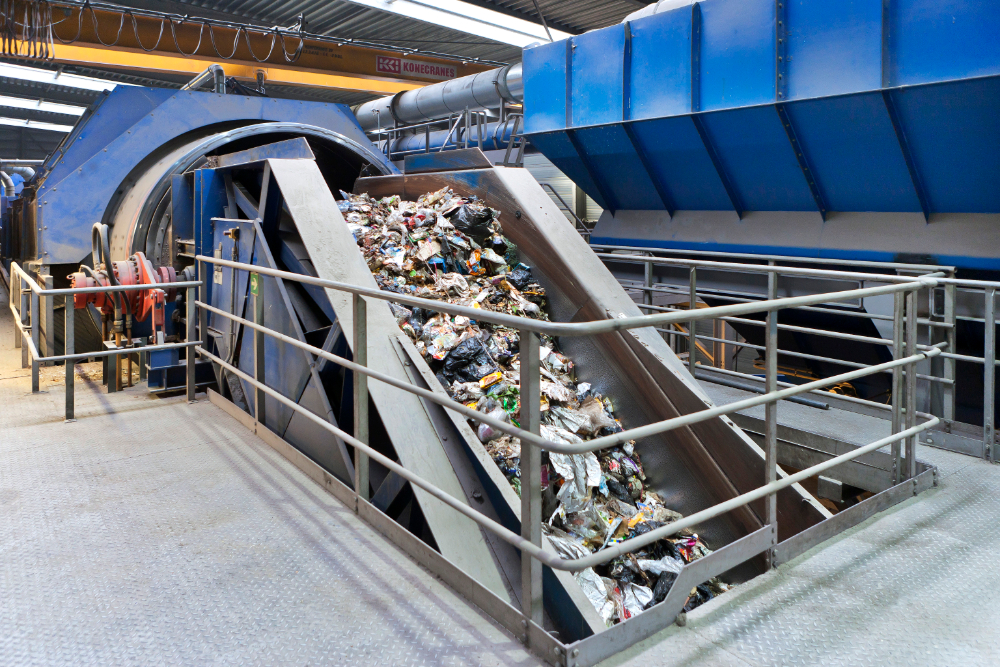
Sorting the plastic waste stream in the KSI at Dutch waste collector and processor Omrin, partner in the Circular Plastics Initiative (photo: Omrin)
PYROLYSE
Two thermal conversion techniques are central to Kersten's project: pyrolysis and gasification. In pyrolysis, the waste stream is heated oxygen-free to around 300-800 °C. This leads to a decomposition reaction in which the polymers 'fall apart' into smaller chains. "A lot of research has already been done on the pyrolysis of plastics," says Kersten. "The main conclusion is that for polyolefins, it is actually not possible to go all the way back to monomers. The catalysts required for this deactivate too quickly." He explains that pyrolysis produces an oil that is somewhat similar to the naphtha also extracted from petroleum. Producers of polyolefins such as PE and PP make the monomers for their polymerisations from naphtha in large naphtha crackers. Kersten: "Our approach now is to make a product from waste plastic via pyrolysis that can go into those crackers." The challenge here lies mainly in the contaminants present in the waste stream, for example chlorine, from PVC. "At least another purification step will be needed," says Kersten. "We will have to look very carefully at how we arrive at a product that can enter the cracker without any problems." The intention is to set up pilot studies in which the real waste stream is processed as soon as possible. He envisages a scale of about 10 kg of pyrolysis product per hour. This is sufficiently large to establish, with engineering input from the industrial partners, a reliable energy and mass balance and a good impression of the quality of the pyrolysis oil. "It would be a great result if, in this way, we have the prospect of chemically closing the plastic cycle in two years," he says He is optimistic: the consortium members are hugely motivated, it is a topic that appeals to everyone, there is urgency and technology is available.
ENERGY
Besides pyrolysis, the possibility of gasifying the waste plastic is also being explored. This takes place at much higher temperatures (over 1,100°C) and produces a mixture of carbon monoxide (CO) and hydrogen (H2) known as syngas. The chemical industry uses this extensively to synthesise, for example, methanol or a whole range of hydrocarbons (Fischer Tropsch synthesis). "Gasification is existing, large-scale technology," says Kersten. "It is not very difficult to adapt the concept of a coal or oil gasifier in such a way that you can gasify plastic in it. There are even companies already offering that." Incidentally, even with the gasification product, a purification step is still needed to remove contaminants.
When do Kersten and Korstanje think a circular plastic chain will exist? Do we need a long haul for that? Kersten hopes not, and according to him, we shouldn't have to: "Within half a century, we have created a plastic industry from scratch that we could not even imagine in the 1950s. Meanwhile, we are bursting with knowledge. So something really must be able to change." Korstanje adds that the industrial parties involved collectively have so much knowledge that this project could become a good start to getting plastic circular. "Moreover, they are also very driven to get this done together. So that's a very good basis for success."


Comments