

The arc cannot always be taut, but is an arc manageable?
How do you manage electric arc hazard?
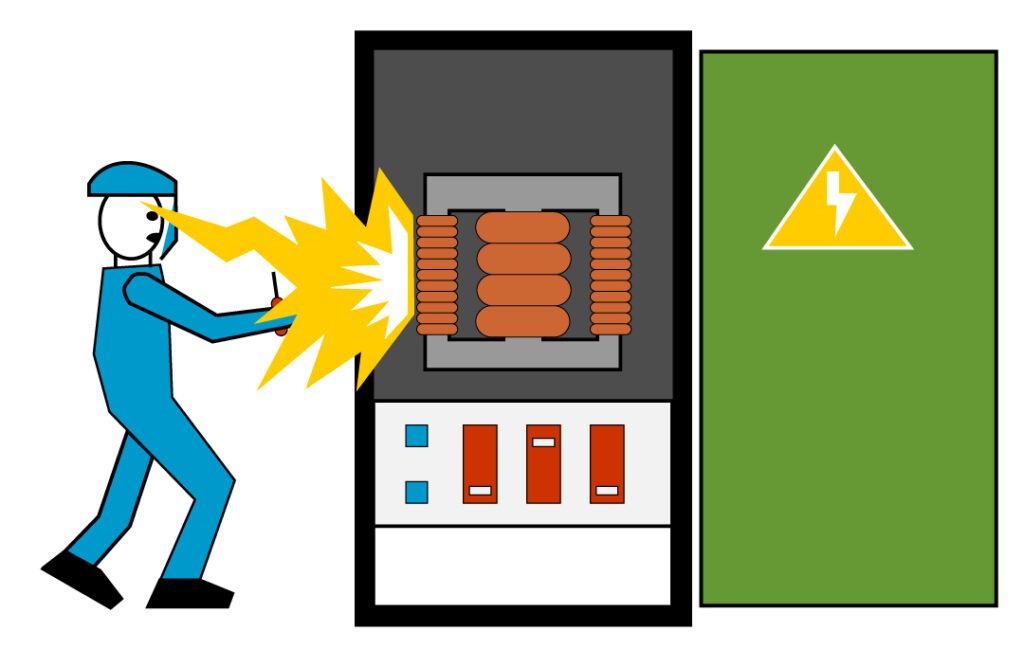
Arc hazard is often underestimated. When working on electrical installations, we usually think of risks of electric shock. However, it is the consequences of electric arcs that usually have great impact, ranging from damage to equipment and installations to serious personal injury.
What is an electric arc?
An electric arc is the sudden release of energy by an electric current flowing through the air between two conductors. When an electric arc occurs, a large amount of heat, light, noise, pressure wave and toxic substances are released.
This effect is equivalent to an explosion.
NEN 1010 (Electrical installations)
The first chapter of this standard points out the dangers of electric arcs in installations. However, taking measures to reduce the arc risk is not mandatory according to NEN 1010. For business-critical installations and installations with increased arc risk, e.g. outdated or poorly maintained installations, it is definitely advisable to take additional measures to minimise the arc risk.
NEN 3140 (Safe handling of electrical installations)
The updated NEN 3140 pays more attention to the danger of electric arcs. To reduce the risks and take the right protective measures, an RI&E on electric arcs is necessary. Based on the installation data, the arc energy at a specific workplace (at a certain device or part of the installation) must be determined. It can then be determined whether and which arc protection is required. However, determining the arc energy is complicated. Several factors have to be taken into account, including the duration of the fault, the height of the current and the distance between the person and the installation.
No electrical installation can be guaranteed to operate without the risk of arcing.
Distribution boards and panels are always subject to arc phenomena. Thereby, direct current (DC) installations are exposed to exactly the same hazards as alternating current (AC) installations.
Although most electrical installations are AC installations, there are almost always some DC loads to be found - to function optimally, every installation uses AC/DC converters. DC loads on electrical systems are increasing, especially with the integration of energy from renewable sources and technological developments such as electric vehicles, energy storage systems and LED lighting.
As a result, partial or full DC installations have become increasingly common, especially where offshore installations (ships and platforms), new installations sensitive to power quality disturbances, and certain onshore industrial applications are concerned. DC installations could become the 'new normal'.
Speakers:

Jorlan Peeters is managing director at HyTEPS.

Joep Dekker is grid & power distribution system specialist at Schneider Electric.
Left:
Watchback of the recording
PV systems NEN 1010-2015 E&W installation technology
Arc detection Scheider Electric Netherlands
Short-circuit calculation: ensuring safety and reducing risks
Don't be surprised by an earth fault in your critical installation