

Albert Einstein and the Black Hole
The boards of the KIVI History of Technology Section and the Histechnica Association are pleased to invite you to attend a lecture to be delivered by Prof J.A.E.F. van Dongen entitled:
Albert Einstein and the Black Hole

Programme:
10.30 am: Walk-in with coffee and tea
11:00: Welcome and introduction
11.05:00: Lecture by Prof Jeroen van Dongen
11:50 a.m.: Break
12:15: Continuation of lecture and closing discussion
12:45: End of the meeting
Please register to attend this lecture:
- KIVI members should register via the KIVI website
- Members of Histechnica should register through the secretary: hotzeboonstra@gmail.com
- Interested parties who are not members can also register through the above channels. There will then be a charge of €5.00.
The lecture will be broadcast live; you should also register for this through the above channels. There is no charge for this.
You can participate via this link: https://www.youtube.com/watch?v=xcB_1csEGFs
Summary of the lecture (in Dutch)
In September 1939, the paper that is now celebrated as the seed of the modern conception of a black hole was published by Robert Oppenheimer and his student Hartland Snyder: in it, they argued that a star may collapse without ever reaching a new equilibrium state, beyond its gravitational radius; it will become so dense that not even light emitted at its surface will escape. Just one month after Oppenheimer and Snyder's paper appeared, Albert Einstein authored another article in which he argued that there was a limit to how much matter could be concentrated in a spacetime, and that as a consequence no "Schwarzschild singularity" would ever appear in nature.
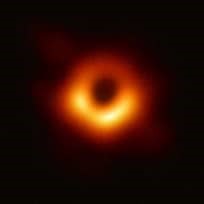
First picture of a black hole, April 2019
Did Einstein intend to argue against Oppenheimer and Snyder, without even citing their work? Did he even know of their paper, or is it a coincidence that the papers appeared so close to one another? And how are differences of opinion to be understood in the light of how these authors understood general covariance and the dynamics of spacetime? Using novel sources, we will address these questions, and try to answer how much in particular Einstein and his close colleagues knew of the way towards the unknowable: the path into the black hole.
Information about the speaker
Prof Jeroen van Dongen has been Professor of History of Natural Sciences at the University of Amsterdam since 2013. In doing so, he has been co-director of the Vossius Center for History of Humanities and Sciences since 2016 and Scientific Integrity Confidential Advisor since 2018.
Van Dongen studied theoretical physics at the University of Amsterdam and received his PhD in the history of physics from the same university in 2002. In his research, he mainly studies the history of twentieth-century physics.
Van Dongen has several publications to his credit, including the most recent from 2021: "String theory, Einstein, and the identity of physics: Theory assessment in absence of the empirical" (see also Prof Dr J.A.E.F. (Jeroen) van Dongen - University of Amsterdam (uva.nl))
Upcoming activities at Science Center Delft:
- Saturday 22 October 2022 at 11:00 lecture by Prof D. van Delft: Fissile material: ultracentrifuges, Abdul Khan and the Pakistani bomb"
- Saturday 26 November 2022 at 11:00 a.m. lecture by Prof E. Homburg: "A century of chemical technology"
- Saturday 17 December 2022 at 11:00 am lecture by Prof Dr H.J. Sips: "The great acceleration"
Study tour:
- Study trip Bologna and Turin will take place from 18 - 24 September 2022