Fissile material: Urenco centrifuges and the Pakistani bomb
Click here to watch the recording back.
The boards of the KIVI SectionHistoryof Engineering and the Histechnica Association are pleased to invite you to attend a lecture to be given by Prof D. van Delft entitled:
Fissile material: Urenco centrifuges and the Pakistani bomb
Programme
10.30 hrs: Walk-in with coffee and tea
11:00: Welcome and introduction
11.05:00: Lecture by Prof Dirk van Delft
11:50 a.m.: Break
12:15: Continuation of lecture and closing discussion
12:45: End of the meeting
Please register to attend this lecture:
- KIVI members should register via the KIVI website
- Members of Histechnica should register through the secretary hotzeboonstra@gmail.com
- Interested parties who are not members can also register through the above channels. There will then be a charge of €5.00.
The lecture will be broadcast live and can be followed via the link below (can also be viewed afterwards):
https://www.youtube.com/watch?v=58zEmiR72UQ
Summary of the lecture
In 1975, Pakistani metallurgist Abdul Khan, educated in Delft, returned to his homeland. Thanks to contacts with Urenco in Almelo, he had been able to steal secret ultracentrifuge technology that enabled him to produce highly enriched uranium in Kahuta. Not only did Khan provide Pakistan with an atomic bomb, he also sold his knowledge to "rogue states" North Korea, Iran and Libya. Meanwhile, in the Netherlands, whistleblower Frits Veerman fought in vain for rehabilitation. He had reported Abdul's spying at the time but was scorned, fired and thwarted by his employer and the BVD. 'If Iran throws a bomb on Israel,' Veerman said, 'it will have "Made in Holland" written on it.'

Abdul Khan during an excursion with Delft students
Information about the speaker
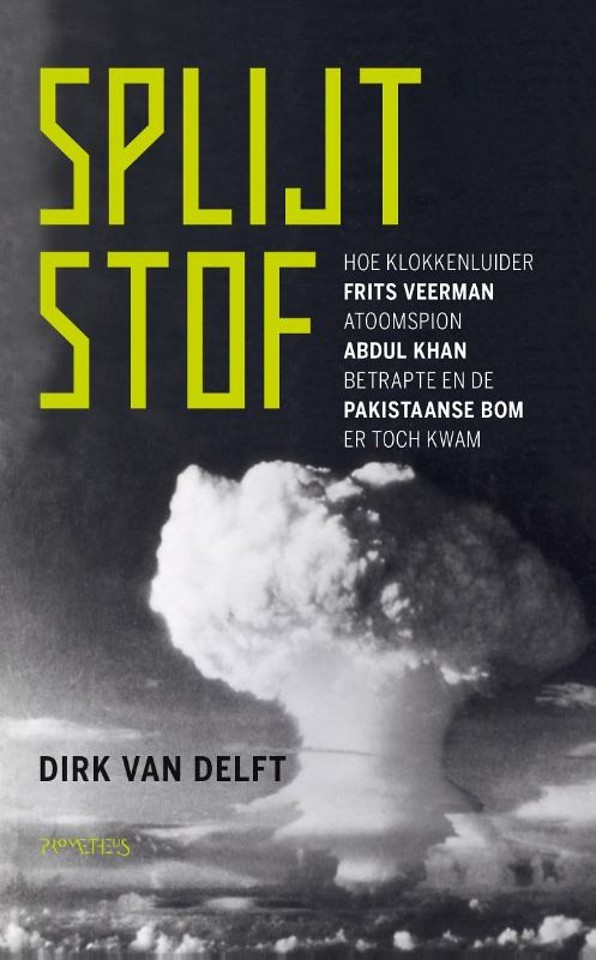
Dirk van Delft (1951) studied physics in Leiden. He stood in front of the classroom, was chief scientist at NRC Handelsblad and director of Rijksmuseum Boerhaave. At Leiden University, he is emeritus professor of 'Material heritage of the natural sciences'. Since his retirement in 2018, he has been a visiting fellow at the Institute Lorentz. In 2015, he obtained his PhD with Heike Kamerlingh Onnes. A biography. With Ton van Helvoort, he wrote Images without parallel: the electron microscope from Ernst Ruska to Ben Feringa (2018) and with Frits Berends the biography Lorentz: celebrated physicist, born conciliator (2019). Biographies of astrophysicist Henk van de Hulst (2020) and Antoni van Leeuwenhoek (2022) followed. In 2021, he published Splijtstof: how whistleblower Frits Veerman unmasked nuclear spy Abdul Khan and the Pakistani bomb came after all.
Upcoming activities at Science Center Delft
- Saturday 26 November 2022 at 11:00 lecture by Prof. Dr E. Homburg "A century of chemical technology"
- Saturday 17 December 2022 at 11:00 a.m. lecture by prof. dr. Ir. H.J. Sips "The great acceleration"
In addition, you are welcome to attend the presentation of the Willem Wolff Prize 2022 on Saturday 8 October. This has been awarded to the Weaving Museum in Geldrop. Besides the presentation itself, there will be a guided tour of the museum and a lecture on the Geldrop/regional textile industry. A convocation with all the details will follow later but you can book the date in advance.
On the occasion of KIVI's 175th anniversary, the History of Engineering Department has published a book highlighting the three founders of KIVI in the times in which they lived. The book will be available for free to members of Histechnica and the KIVI Department of History of Technology during the lecture.