

From thinking to THINKING
KIVI's Risk Management & Engineering Department organised the Working Symposium From Thinking to Pre-thinking on 26 April. On the attendance list, we saw not only members of the department, but also architects, safety experts, knowledge managers, contract managers and professors. In short, a mixed bunch with a lot of knowledge at hand. Recent real-life cases were discussed.
The company Stores & Offices owns a very large distribution centre, whose roofs need to be replaced. Steven Stovaerts, permanently employed by Stores & Offices becomes project manager of that work.
Stores & Offices commissions a consulting engineering firm to do preliminary design, final design, engineering, indicative drawings and parts lists. The alliance Barmasz / L & H Loads is awarded the contract. Barmasz is a contracting company; L & H Loads is a lifting company. The contract is a Design & Construct standard contract according to FIDIC. [1] The scope of work reads - very succinctly here:
- Detail engineering and procurement
- Fabrication of new roof in sections according to engineering firm's drawings; this is done in Barmasz's covered factory halls
- Transportation of roof sections to construction site
- Removal of old roof
- Installation of new roof sections
- Finishing
- Completion
- Guarantee 12 months after successful delivery
Steven Stovaerts does not commission the engineering firm to check the Alliance's risk analysis. He does instruct the engineering firm to conduct its own risk analysis of Barmasz's work. He also instructs the engineering firm to check Barmasz's quality control system and risk policy.
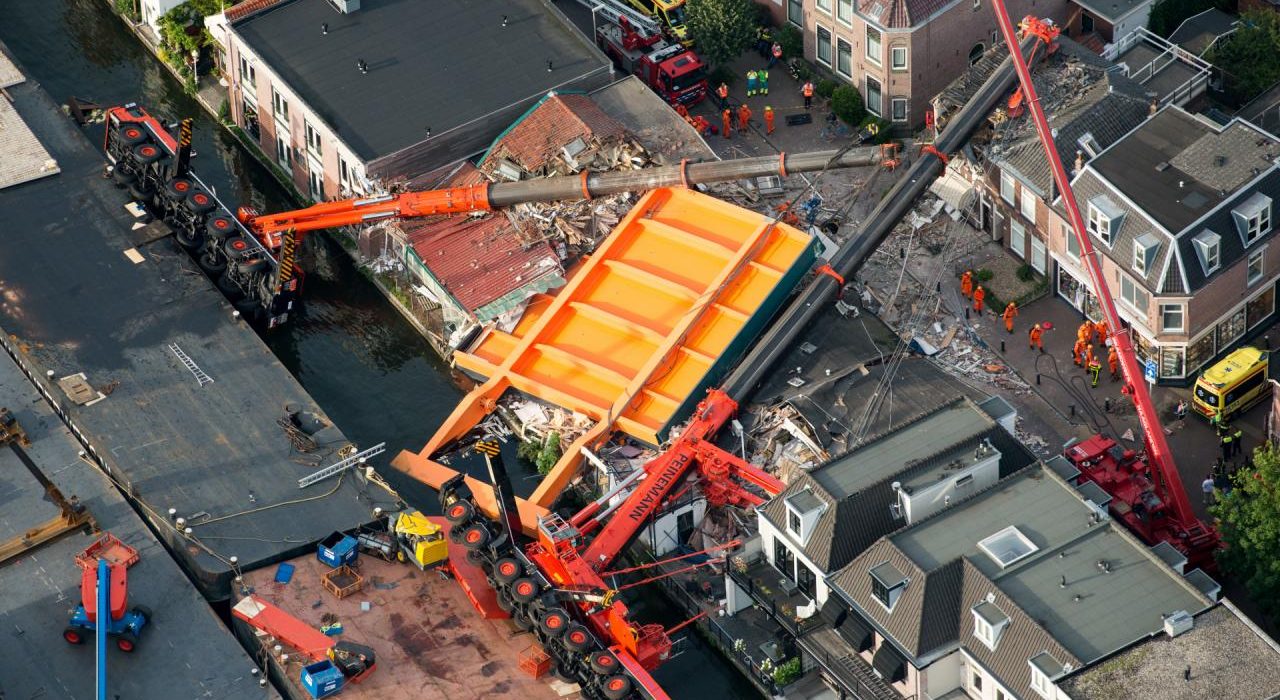
L & H Loads deploys two cranes to remove parts of roofs. One of the cranes is out of balance; there is an overload with the jib extended too far, the automatic safety lockout is disabled; no alarm goes off when the first part of the old roof is lifted. The crane falls over. The falling roof section hits 2 employees of a Stores & Offices tenant. One dies on the spot. The other is disabled for life.
The debates
On the basis of previously known discussion points, there was a pleasant, fierce, intense and at times even fiercely emotional exchange of views.
The question of whether Stores & Offices was negligent in its duty of care for the safety of people in the vicinity of the hoisting operation was answered with a resounding yes by all present. This means that the client Stores & Offices cannot get away with looking away without control when such a lifting job needs to be done. One considers the client fully responsible for the safety and health of people in the vicinity. The fact than Stores & Offices apparently did not include this undesirable incident in its risk management is predominantly (71%) seen as a Blind Spot. But when it comes to drawing consequences from this negligence, people are much less convinced. Whether Stores & Offices is responsible or co-responsible is rated 50/50. And whether Stores & Offices is (co-)liable is even more reticent. 30% say Yes. 70% say No.
Finally, the question on the personal liability of project manager Steven Stovaerts. The majority of voters (62%) think he should not be criminally prosecuted. There is a large minority (6%) who do think so, while there were many abstentions here (30%). People apparently did not dare to judge on such a vexed subject.
But on the warning duty of the engineering firm, people again judged with 100% conviction. It should have alerted project manager Steven Stovaerts to the need to check the contractors' quality control and risk management systems. That last judgment places a hefty responsibility on an engineering firm. Unsolicited advice. This could well be interpreted as begging for more work. In my opinion, an engineering firm would do well to defy this possible suspicion then.
A project like this - like all construction projects - goes through a number of phases. All participants are of the opinion that Stores & Offices failed in its Predictive Ability when awarding the contract to the Alliance, but also when supervising the lifting preparation, a lifting preparation that, incidentally, did not take place in this case. Stores & Offices did not have its Predictive Ability in order. It too has yet to come from Thinking to Pre-thinking.
It was an insight-enhancing, afternoon and evening event.
[1] FIDIC, Fédération Internationale des Ingénieurs-Conseils. The Design Construct Standard Contract is similar to the Dutch integrated contract UAV GC.
Description
New to the Risk Management & Engineering Department is Programme Committee. It is organising the Working Symposium From Blind Spots via Responsibility to Improving Predictive Ability on 26 April 2017. The aim is to arrive at a common assessment of technicians' behaviour and seek whether and when one could have better foreseen White and Blind Spots.
From Thinking to Foreseeing
Working Group Experience from RBT
Last spring, the then Analysis & Development Working Group presented a number of real-life cases in which technicians' mistakes caused huge damages. Participants discussed the causes of such incidents. How was it that an error in the application of technology was not noticed in time?
Was it an ordinary Basic Risk that every engineer should have mastered?
Or was it a White Spot in thinking? Did they know that a risk existed, but had not worked it out properly?
Or had they not foreseen the risk at all, i.e. a Blind Spot, while elsewhere the knowledge to know or find out was available?
Discussions were held in small groups. Practically everyone was able to contribute their own practical experiences and their own insights.
The afternoon was animated and full of energy.
Continuation and further steps
After registering, participants receive a short syllabus with a general explanation. Included are a number of practical cases that participants study in advance. Each practical case is accompanied by a few questions. Participants discuss in small groups and submit those answers during the session. Afterwards, the Programme Committee will count and classify those answers. The result will be published. In this way, the norm is measured: how do RBT members think about certain behaviour in certain situations? The follow-up to this Working Symposium will take place in June 2017.
A selection of cases: the lifting accident in Alphen aan den Rijn in August 2015, the bribery and whistleblowing at SBM, the destroyed flower farm of Esmeralda Farms in Ethiopia.
Location
Prinsessegracht 23, 2514 AP The Hague
Organiser
Risk Management and Engineering
Name and contact details for information
Fred van Iddekinge (fredvaniddekinge@gmail.com), Harry Spaas (hmspaaskok@hotmail.com) and John van der Puil