

Energy transition in public transport: Arnhem
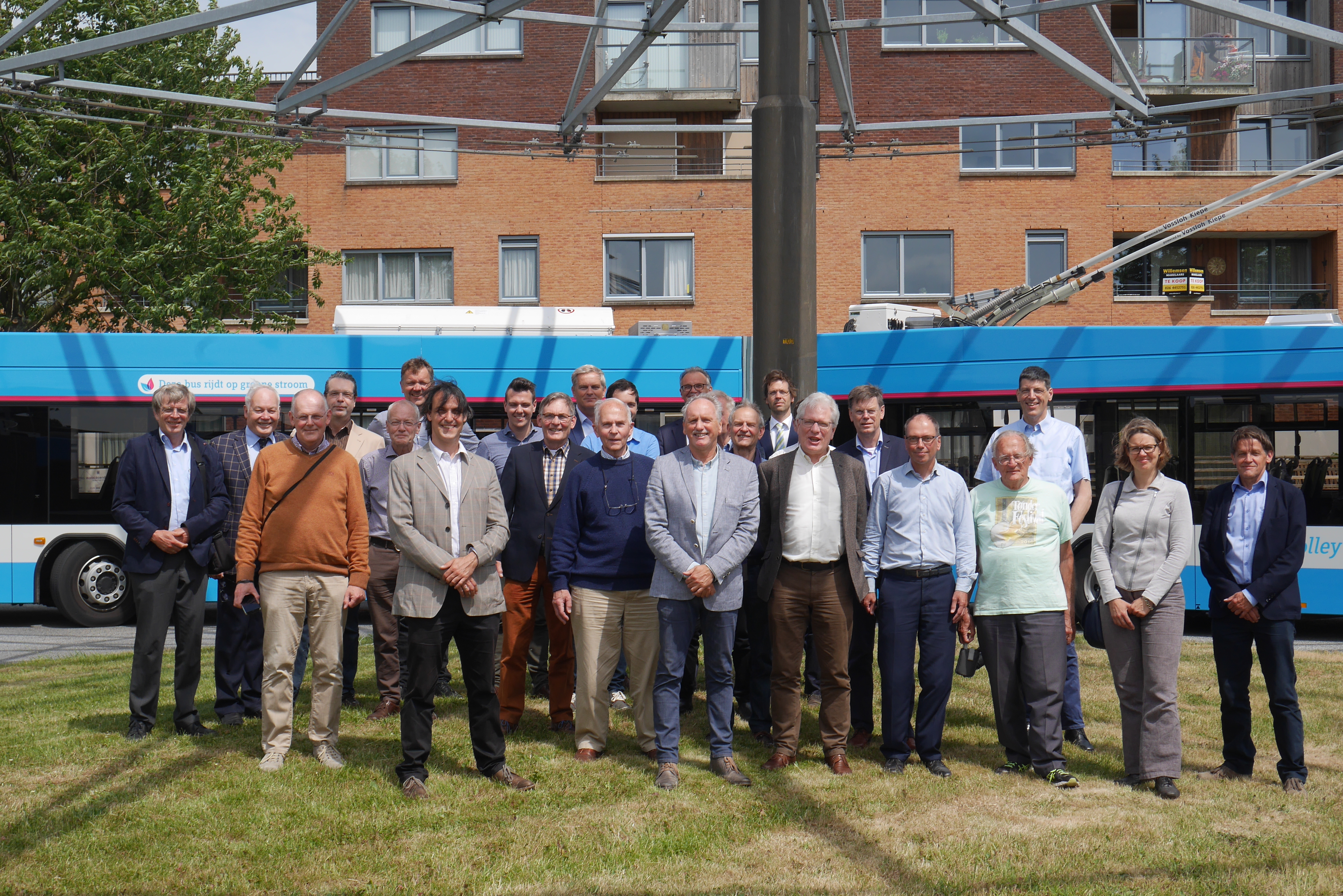
On 8 June, the Traffic and Transport department, with 23 participants, was a guest of Connexxion in Arnhem, to learn about the various aspects of public transport operation with electric buses, with or without overhead wires. After a reception with lunch in the Trolleybus Museum, which is also located in the depot, there followed a demonstration tour along several interesting locations, with explanations by Hans Aldenkamp, Arnhem project manager for trolley infrastructure at Connexxion.
As part of the 'Trolley 2.0' project, Arnhem wants to carry out extensions of trolleybus lines partly 'wirelessly', whereby batteries in the bus will provide traction power on those routes. Charging those batteries will be done 'In motion charging', or driving 'under the wire' on existing routes. Unlike battery buses on line networks without overhead wires, in Arnhem there is therefore no need for separate charging installations to charge the batteries en route using 'Opportunity charging'. Moreover, precisely in the hilly area, power can also be recovered from decelerating trolleybuses. That power can also be used to charge electric cars. In Arnhem, this is being done on a trial basis by means of a charging installation integrated into an overhead line mast at the Schuytgraaf shopping centre. This is a step towards a 'smart grid' where the infrastructure used to power trolleys is used to power other users.
After the 'sun-drenched' demonstration ride, the various aspects were highlighted in more detail by three speakers:
-Herman Wilmer (Herman Wilmer Advies) outlined the possible future development of the Arnhem trolley network;
-Marcel Manheller (Kiepe Electric GmbH) elaborated on some technical and exploitative aspects of the different ways of charging;
-Peter van den Boogaard (province of Gelderland) highlighted the position of the public transport concession provider; in this case, the partnership OV Cluster Oost, in which the provinces of Gelderland, Overijssel and Flevoland have joined forces.
Some high-lights from these presentations:
- The Arnhem trolley network provides an excellent starting point for development towards a partially catenary-free electric bus line network. Extension of bus lines to the outlying area or neighbouring municipalities, where the installation of overhead wires would become too costly or meet a lot of resistance, then becomes feasible. Moreover, for such offshoots, there is no need to maintain separate lines with non-electric buses (running on hydrogen, natural gas or still diesel); partly because of this, the line network can be organised more efficiently.
- If the power supply for the trolleybuses becomes part of a 'smart grid' (see above), however, a contiguous overhead line network is needed. Fragmentation leads to an imbalance in the power supply, which cannot benefit from recovered power.
- As higher speeds and/or heavier vehicles (with more passengers) are driven, energy consumption and hence battery charging time will increase accordingly. With 'In motion charging', the relatively high catenary voltage makes it possible to charge a lot of power in a short time. The necessary 'charging routes' with overhead wires ('Charging roads') are of course widely available in Arnhem. However, these charging routes need not be very long. A 12-metre bus travelling at an average speed of 30 km/h would only have to drive 'under the wire' for 20% of the time.
- The costs of charging installations therefore remain limited, compared to those for 'Opportunity charging'. Since this involves stationary charging, it also involves longer turnaround times and correspondingly higher operating costs.
- In 2012, the Minister of Infrastructure and the Environment signed a 'Green Deal' with, among others, local authorities. This should lead to the inclusion of 'zero emission' as a requirement for buses in all public transport concessions in the period from 2015-2025. The provinces realise that something like this also has 'its price'. For instance, a hydrogen bus is 3.5 times as expensive as a diesel bus; a battery bus 1.8 times as expensive and a trolley bus still 1.2 times as expensive. And because resources will have to come 'length or breadth', costs will have to come down and revenues and efficiency will have to go up. A smart grid can contribute to this.
A lively discussion followed the presentations, which continued for a while during the closing drinks.
Description
The Netherlands is in the midst of an energy transition, from fossil to sustainable green. In the traffic engineering domain, one thing is certain: to meet the set targets on reducing CO2, NOx and particulate matter emissions, electric propulsion is central. In this meeting, we will discuss the changes for public transport in particular bus transport.
E(lektric) buses have the wind in their sails worldwide. In Europe, there are already more than 1,300 in use; both battery buses, plug-in hybrid buses and trolley buses with batteries that can run without overhead wires. Incidentally, these numbers are dwarfed by the 173,000 e-buses in China....
E-buses are also on the rise in the Netherlands. Whereas trolley city Arnhem was the only 'electric bus city' for years, the growth in recent years has been in battery buses. More than 80 of these are now in circulation: on Schiermonnikoog (from 2013), at Schiphol Airport (from 2015) and in Eindhoven (since last November). Soon, after the start of some new concessions, that number will be doubled. In addition, Amsterdam is working on plans to deploy e-buses on a good number of bus lines, especially in the older part of the city.
And finally: Arnhem, as part of 'Trolley 2.0', plans to make extensions of trolleybus lines partly 'wireless', with batteries providing power for the bus on those routes. Especially on the typically Arnhem steep slopes, however, the trolleybus remains at an advantage 'under the wire'. The strong growth in public transport use has meant that the trolley fleet now consists entirely of (44) articulated buses.
The transition to operation with electric buses raises all kinds of fascinating questions. How, where and when should the batteries be recharged? Through 'opportunity charging' - in the depot, at terminus points, or stationary at stops along the way? Or via 'in motion charging', or driving 'under the wire'? What then is the optimal length of the 'wireless' part of the journey, considering the weight of the battery to be carried? What part of the charging equipment is located in the bus or on the shore?
What does this mean for staging and turnaround times? Will the layout of bus stations have to be adapted? What about power supply at charging stations? Is the electricity grid designed for this? What are the technical possibilities and developments, from the industry's point of view? Does it make sense to make choices to 'wait a while longer for the arrival of even more powerful batteries'? Last but not least, what does all this mean for the concession conditions?
These kinds of questions will be addressed in four presentations on 8 June.
The event will start with a tour of one of the Trolley-2.0 demonstration buses, which will also cover infrastructural aspects.
Speaker(s)
Hans Aldenkamp (Connexxion),
Marcel Manheller (Vossloh Kiepe),
Peter van den Boogaard (Province of Gelderland) and
Herman Wilmer (independent consultant).
Location
Remisestraat 4, 6828KZ Arnhem
Organiser
Traffic and Transport
Name and contact details for information
Henk Pauwels 06 2199 4969 henk@pauwels.org