

Hydrogen (UT session)


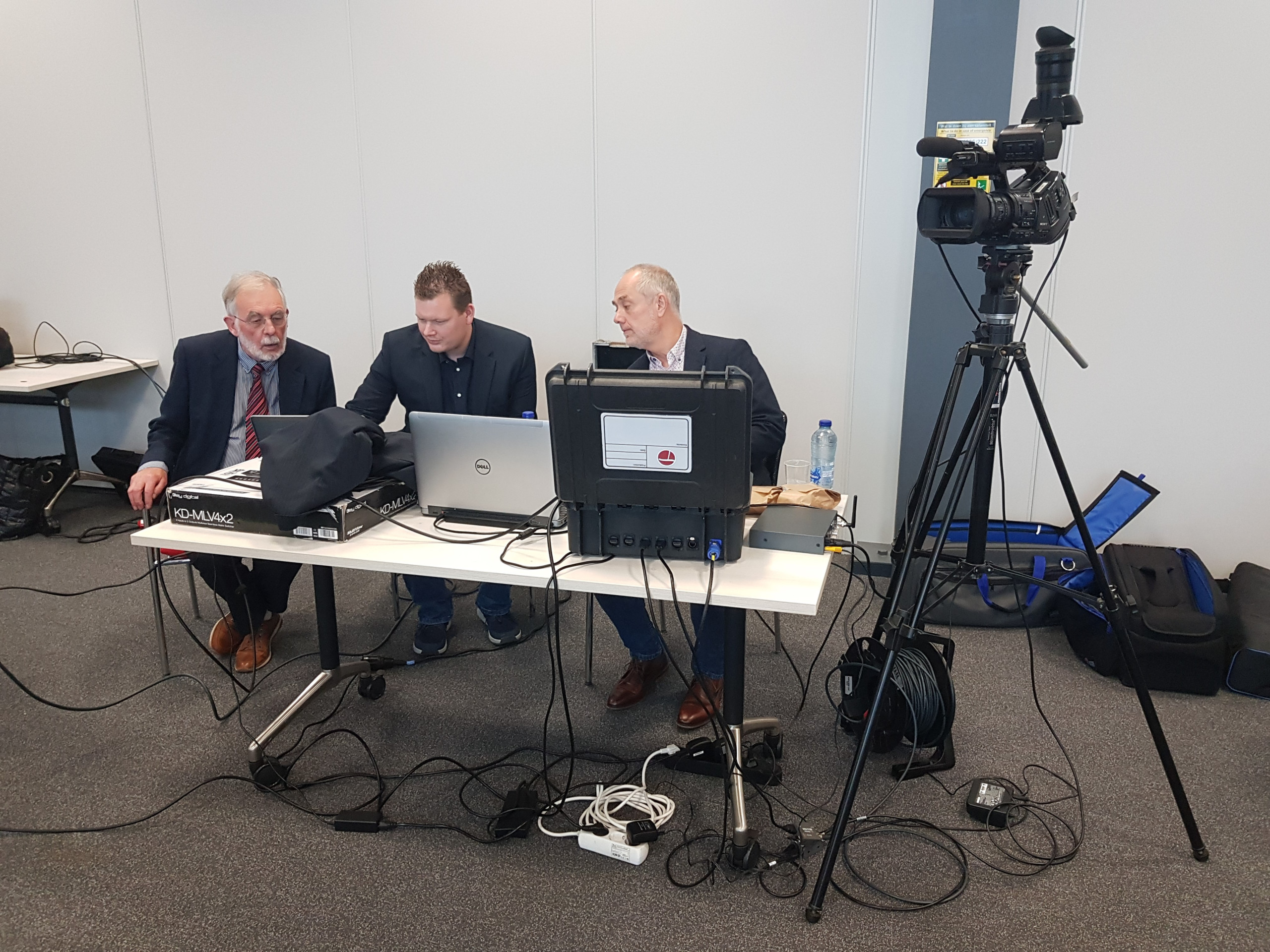

We were delighted that the WATERSTOF seminar of region Gelderland on 30 September 2020 could go ahead after all, with expert speakers from Shell, Alliander, Sweco and MTSA.
We had already made it a hybrid seminar, but at the last minute the number of people allowed in the room was reduced from 50 to 30. Also, due to the tightened rules, 2 speakers unfortunately could not attend. Fortunately, some 20 participants were willing to swap their seats in the hall to participate via livestream and we had up to 184 online viewers.
Participate is the right word because people could ask questions of the speakers at home via Poll Everywhere. One of the questions was why don't we switch to green hydrogen right away. The speaker's answer was simple: we don't have enough green electricity. The price of hydrogen was also discussed. This will start to fall to a level of 3 euros per kilo in the future. The four speakers agreed that without hydrogen, the energy transition will not succeed.
All in all, this was a professionally organised successful seminar in corona time!
Finally, a special thanks to Livestreamoplossingen.nl for supporting the professionalisation of the livestream.
The speakers' presentations can be found under 'Documents' (bottom right).
The presentations can be found under the 'Documents' button (bottom right).
(Fenna van de Watering, Witteveen + Bos was not present due to corona measures)
Hydrogen is indispensable for energy transition
This seminar is organised in cooperation with the Dutch Process Technologists and Arnhem and Nijmegen University of Applied Sciences.
During this seminar, we will present six topics:
Hydrogen production [1] Green hydrogen is expected to play a major role in energy supply. In the short term, blue hydrogen will help develop the hydrogen economy and make great strides in reducingCO2 emissions. The production process of blue hydrogen is a process that generally converts hydrocarbons into hydrogen through a chemical reaction. This method is used, for example, to produce hydrogen as a raw material for fertiliser production (ammonia). It releasesCO2 . Hydrogen can also be obtained by biological hydrogen production in an algae bioreactor, or by using electricity (electrolysis), heat (thermolysis) or an intermediate form (high-temperature electrolysis). These methods are currently not cost-effective for large quantities. Production of hydrogen gas from electricity is currently only interesting if there is a surplus of wind, solar or hydropower. Cheap, mass production with a renewable origin is a requirement for a healthy hydrogen economy.
Transport & storage [2] Transport of hydrogen requires a reliable network. Gasunie can take a huge step in this by using the gas infrastructure that already exists. It is doable to have a base ready for transport and storage of hydrogen to and from the major industrial areas in the Netherlands and towards Hamburg and the Ruhr as early as 2030. By working together, Gasunie can develop a market for hydrogen. Soon, hydrogen will then be as affordable as renewable gas and renewable electricity.
Distribution [3] Network operators can make the current gas distribution network suitable for hydrogen. This is according to a study by Kiwa commissioned by Netbeheer Nederland. Hydrogen can be an alternative to natural gas or green gas in neighbourhoods where heat pumps or a heat network are not a solution. Whether hydrogen really has a future in the Netherlands is still unclear. The grid operators are open to further exploring the possibilities of hydrogen together with other parties.
Hydrogen for energy supply [4] During this seminar, we will limit ourselves to the use of the fuel cell. The most common is the PEM (Proton Exchange Membrane) fuel cell. MTSA builds complete systems using these cells.
Hydrogen as a raw material [5] For industry, becoming more sustainable and thus transitioning to sustainable forms of energy involves large investments. Every factory is different. But the goal of every factory is the same: to produce as efficiently as possible at the lowest possible cost. Until recently, process improvements served mainly to make production as good and cheap as possible. Now the focus is also on process improvements in the context of energy transition.
RELEASE fieldlab Deventer [6] Witteveen+Bos is participating in multi-million research into large-scale energy storage. By 2050, we want to use only renewable clean energy to combat global warming. To reach this international goal, a number of obstacles need to be overcome. The main obstacle is the imbalance between supply and demand of renewable electricity, putting security of supply at risk. To redress the imbalance, energy storage is essential. As a result, there is widespread interest in energy storage in the form of green hydrogen, batteries and other energy carriers. These energy carriers can make an important contribution to making the electricity system more flexible, with the advantage of not emitting carbon dioxide. Besides energy carrier, green hydrogen can also be used as green feedstock of the chemical industry, giving green hydrogen a wider application. It is therefore investing in research and pilot projects into large-scale energy storage, where Witteveen+Bos will develop a field lab for green hydrogen production.
Critical note: www.duurzaamnieuws.nl/gaat-waterstof-het-helemaal-maken/
Programme
13:00 Walk-in with coffee and tea
13:30 Opening and introduction by chairman of the day Arnold Groot
13:45 Presentation [1] Hydrogen production by Ewald Breunesse, Shell
14:15 Presentation [3] Transport,Storage & Distribution by Elbert Huijzer, Alliander
15:00 Presentation [5] Hydrogen as a feedstock by Jasper Paauwe, Sweco
15:30 PAUSE with soft drinks
16:00 Presentation [4] Hydrogen for energy supply by Rob van der Sluis, MTSA
16:30 Presentation [6] RELEASE Fieldlab Deventer by Fenna van de Watering, Witteveen + Bos(not present due to corona measures)
17:00 Start of discussion based on questions
17:30 Final conclusion
18:00 Closing of seminar
INTERACTIVE! During this seminar we will use Poll Everywhere
Government also focuses on renewable gas: