

The story behind lignite mining


Lecture "The Rejected Pearl"
The story behind lignite mining
Completely against mainstream opinion, Anne-Marie Oudejans showed about 20 KIVI members on 6 April at De Raat community centre in Beilen that lignite mining is also just beautiful. If only you want to see it. For the company from the Royal Institute of Engineers, not only all kinds of technical facts were reviewed but also the beautiful lines and amazing colours.
Lignite is currently a mostly maligned and rejected fuel. But what a technique is involved. And that technique and its beauty is what Anne-Marie talked about tonight.
Lignite, like coal, is in the ground and we extract it. And like coal, lignite is made up of carbonised plant material. In Germany, this material is 15-20 million years old and dates from the Miocene era. At this time, sea levels were very high. So high, in fact, that the Netherlands was under water. In addition, large parts of western Europe were swamp forest. In Germany, a subtropical climate prevailed. Large parts of Europe were covered with swamp pine forests Sequioas and yew: the raw material for lignite. Later climate and sea level changes caused these forests to die off and come under sedimentary rock.
During the Miocene, the area around present-day Cologne and Aachen also had these huge bog-needle forests. From this, therefore, the huge Garzweiler lignite deposit was formed and has been mined for more than 200 years. The thickness of the coal seam ranges from 80-100 m, which is as high as the Martini tower. The area of the excavation is 110 km2, which is comparable to 14,600 football fields.
How is lignite mined today? For this, a huge pit is dug. One side is called the "Abbau" and on the other side the overburden rock is backfilled. This is the "Verkippung". Finally, at the bottom, in a relatively small area, the lower "Sohle" extracts the coal. Thus, the whole thing "walks" through the landscape.
All work is done with so-called "Grossgeräte". At the "Abbau" are the diggers or "Bagger". The excavated overburden material the "Abraum" is returned to the other side of the quarry by spreaders or "Absetzers". The largest digger in the world is the B 288 and it works in Garzweiler.
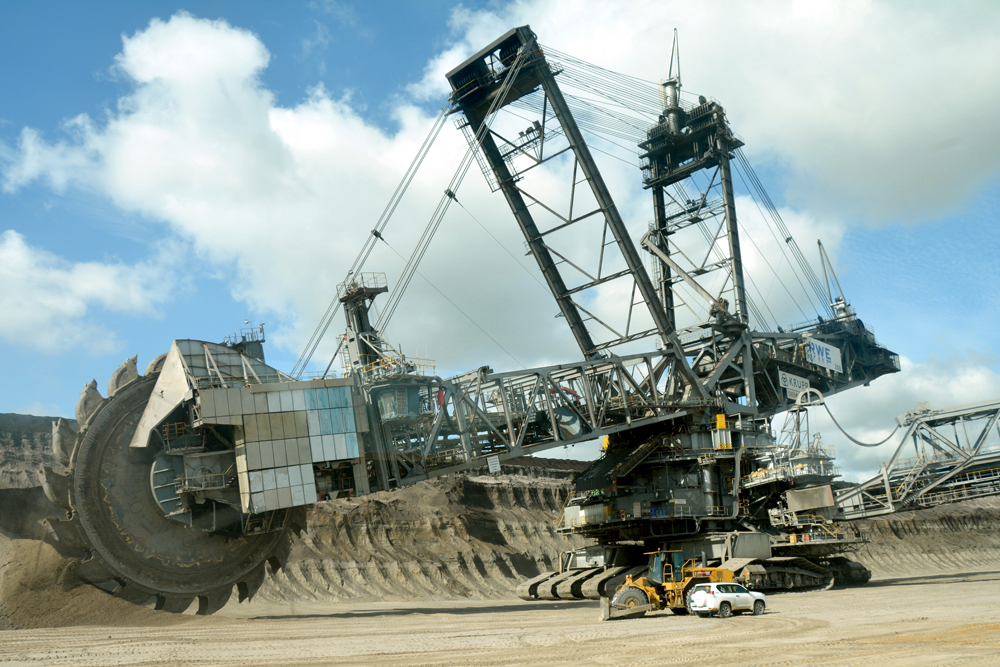
Below is another "Bagger". The whole thing stands and rides on tracks (auf Raupen) and is rotatable (or schwenkbar) as a whole. The designation is number SRs typenr. The first number is the machine number the S is from Schaufelrad the R from Raupen and the small s from schwenkbar. The type number is related to the capacity of the device. It used to be the capacity of a schaufel.
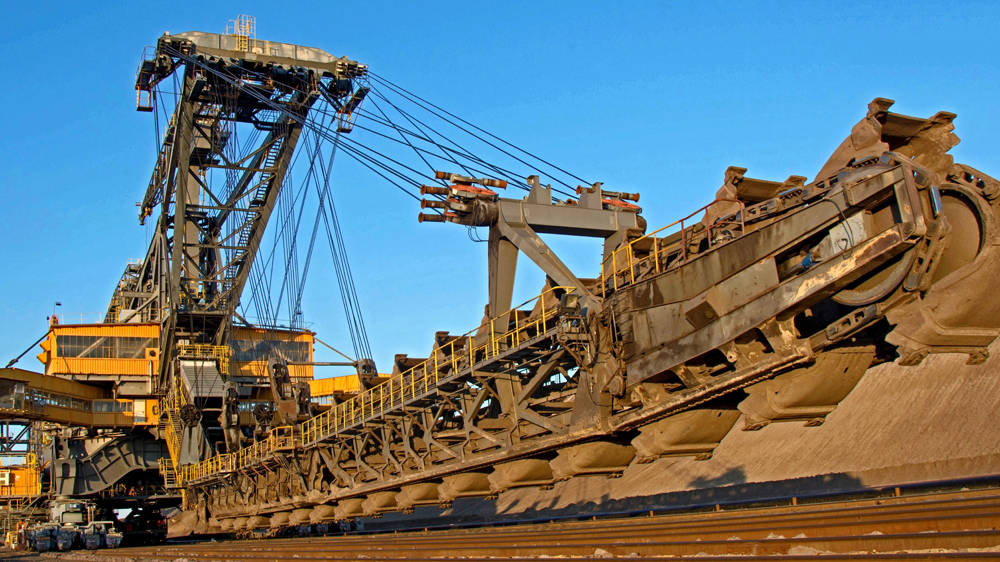
Besides the diggers with one fixed and one movable pilon, there are also, which have size one pilon and where the second pulley block is attached directly to the digging arm itself and right behind the digging wheel. Less material but directly behind that digging wheel is more subject to wear and contamination from drifting sand.
Digging can be done in several ways. Here, it is done in elongated rectangular strips. You can compare the pattern somewhat if you mow your lawn ahead yourself with a brushcutter.
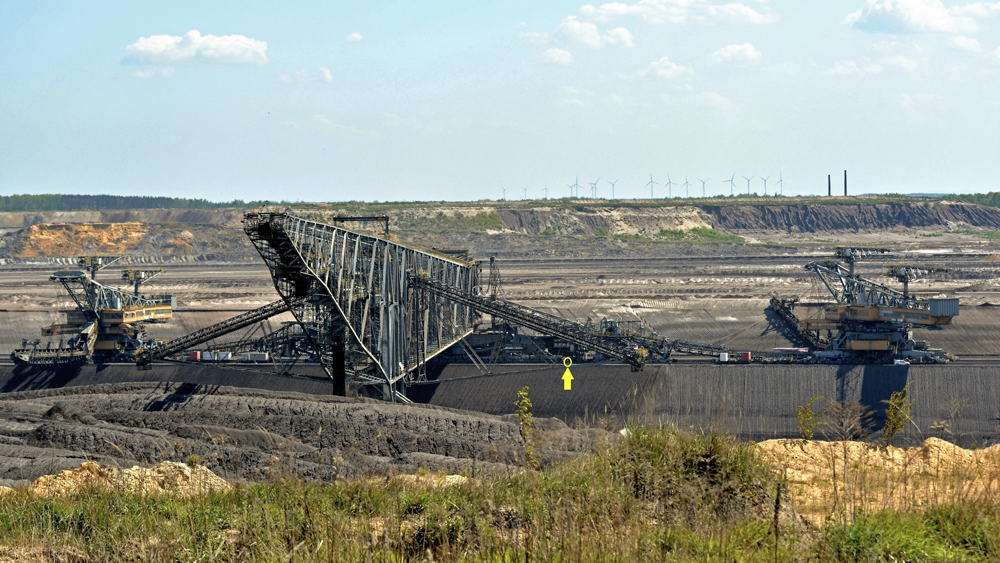
Each "Bagger" is rotatably connected to a so-called "Beladewagen", which dumps the excavated material from the conveyor belt of the dredge onto the central conveyor belt. Through the "Bandsammelstation", the Abraum goes to the Absetzer and the coal goes to the coal storage and finally to the power plant. The flexibility allows the digger to work closer or further away from the central belt. Thus according to Anne-Marie.
From the editor:
"Lignite mining and partly that of Garzweiler is controversial for several reasons:
-
- the local population is opposed because villages have to disappear; - the use of lignite is polluting;
- the groundwater level in the wider area is falling;
- the landscape is being completely destroyed by lignite mining.
The protest found resonance in the media. The original planning area of Garzweiler II was reduced from 68 km² to 48 km² and the relocation of the villages of Wanlo, Venrath, Kaulhausen, Wockerath and Kückhoven was thus shelved."
[Source: https://nl.wikipedia.org/wiki/Garzweiler]
In short, inspired Anne-Marie certainly was. The terms "Schaufelradbaggers", "Selbstfahrende Beladewagens", Absetzers", "Sohlen", "Tagebaugrossgeräte", "Förderbrücke" , "Abbau- und Verkippungsseiten flew from left to right and front to back. It was not only about Garzweiler, but Anne-Marie also showed beautiful pictures of Lichterfelde near Finsterwalde, Tagebau Welzow Süd, open-air museum Ferropolis, Lausitz and Tagebau Hambach. On current controversy and other renewable recourses, that too was briefly discussed. But after seeing so many beautiful images how is lignite to be despised? And do we call this a moonscape or - even worse - an apocalyptic landscape? This introduction and Anne-Marie's shared experiences indicate a completely different picture and beauty of lignite and should be appreciated for that reason alone.
The lecture was scheduled to last until 21:00, but deep reflections were exchanged for a long time over drinks.
Want to learn more about Garzweiler? Join the excursion on 23 June 2017 and register today at https://www.kivi.nl/afdelingen/regio-noord/activiteiten/activiteit/excursie-tagebau-garzweiler.
Got your own ideas for a field trip, lecture or company visit? Contact Mariska van Cronenberg | m.vancronenberg@outlook.com | +31 6 512 02 681
Text: Ir. Mariska van Cronenberg
Description
Just about everything in lignite mining is unrealistically large, breathtaking and impressive, almost verging on imposing. People are dwarfed by the machines. In turn, these gigantic machines are "small" compared to the extraction itself.
To start with, in such an extraction there is an almost already almost immeasurable area of the section that still has to be excavated. Then all those conveyor belts, which looked little more than stripes there from afar but are in reality more than man-high. With its width of 3 metres, such a belt is as wide as the street, on which I live. Somewhere in the distance are then a couple of those giant machines. The distance and effect of the running of the conveyor belts are then so great that the those giant machines looked - somewhat irreverently - more like DinkyToys. And then this was just the part, which was already prepared to be excavated. The area where the excavated overburden rock is deposited back the so-called "Verkipping is many times bigger still...
Inspired, Anne-Marie Oudejans gives you an insight into lignite mining and takes you on a bizarre and extraordinary journey. In it, she tells you about "Schaufelradbaggers", "Selbstfahrende Beladewagens", Absetzers", "Sohlen", "Tagebaugrossgeräte", "Förderbrücke" , "Abbau- und Verkippungsseiten etc. among others. Not only because lignite technology mainly comes from Germany too, but also because she likes the German words too much to translate them, she continues to use them. Oudejans emphasises that she is not and will not become a miner (again). Therefore, do not expect any - to use this word here - in-depth reflections.
Programme
17:00 - 18:30
Possibility of a joint dinner (at own expense) on the Market in Beilen prior to the lecture (express interest via m.vancronenberg@outlook.com)
19:00
Walk-in with coffee/tea and cake
19:15
Lecture "The story behind brown coal mining" by ing. Anne-Marie Oudejans.
20:15 - 21:00
Discussion, drinks and possibility to register for the excursion to Tagebau (Germany)
No matter how big those "holes" are: Relative to the size of the Earth and its crust, they are no more than an elephant's skin flake. Back to our everyday dimensions..
Location
Neighbourhood building the Raat
Reigerlaan 8, 9411 GV, Beilen
Organiser
Region North
Name and contact details for information
Ir. M. van Cronenberg | 06-51202681