
Farmed meat
In the meeting on 28 August, Professor Mark Post presented the state of the art in his research of growing meat. He has succeeded in growing muscle tissue and unsaturated fats from a cow stem cell. Now still to a volume of a hamburger, but the technique has since been further developed to reach about 50 kilograms in the pilot plant. If price, inspection authority and technology are no longer an obstacle in about four years' time, cultured meat could take its place in the food market. A very real expectation! A stable of 150 cows could thus meet the food needs of the Netherlands for years: enormous reduction of methane and CO2 emissions
For the 32 interested parties, Mark Post explained his research with verve in about two hours. His lively way of speaking, his humour and his extreme enthusiasm and expertise on the subject made it a very interesting presentation, which also led to a lively discussion with a flood of questions. By allocating an hour for sandwiches and soup in advance, members and guests were able to meet the speaker in person first, catch up and network with members and easily join in directly from work. A very successful meeting. The power-point basis of the presentation was willingly provided by Mark Post for posting on Region South's page. Download the presentation below.
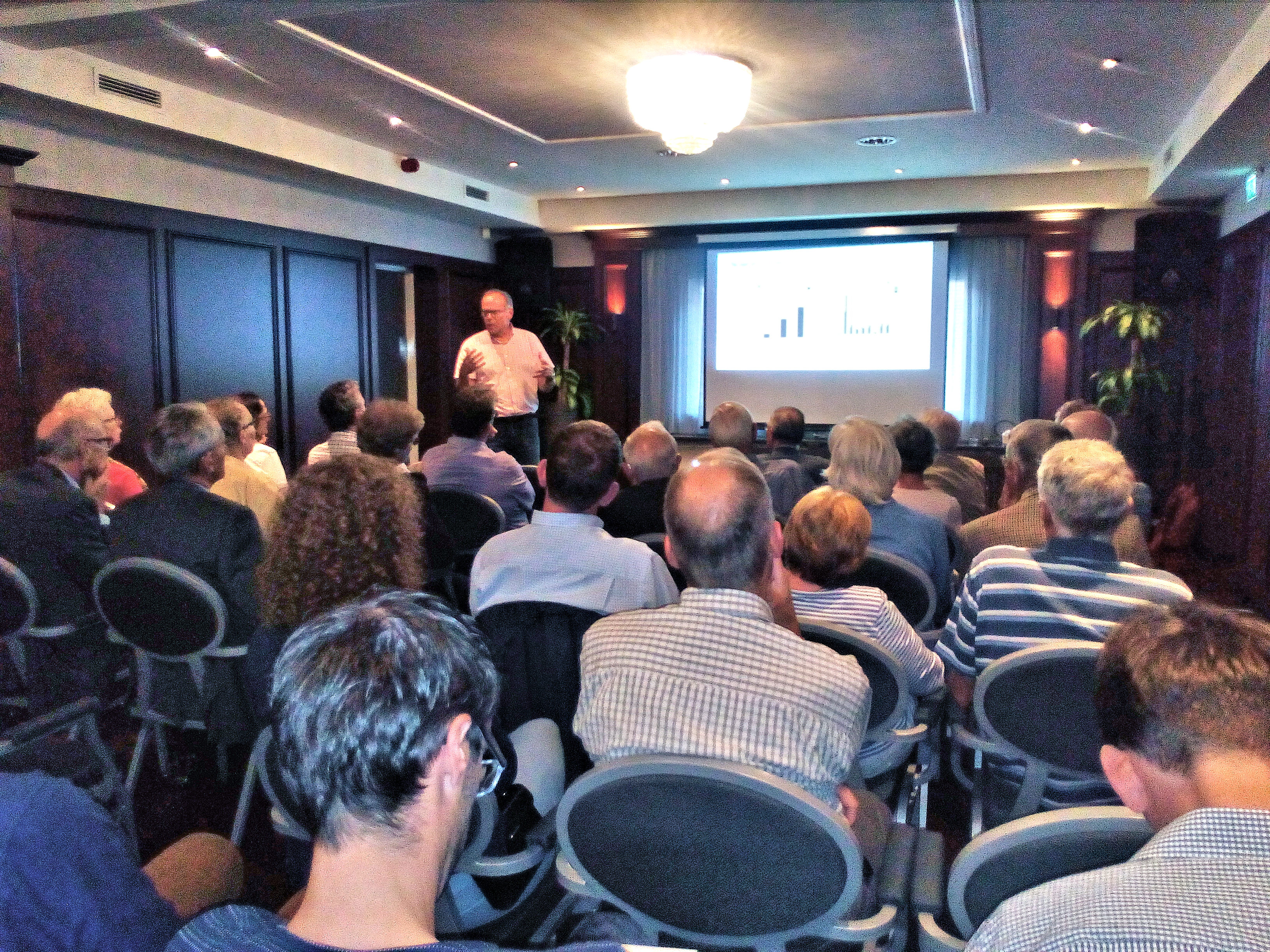
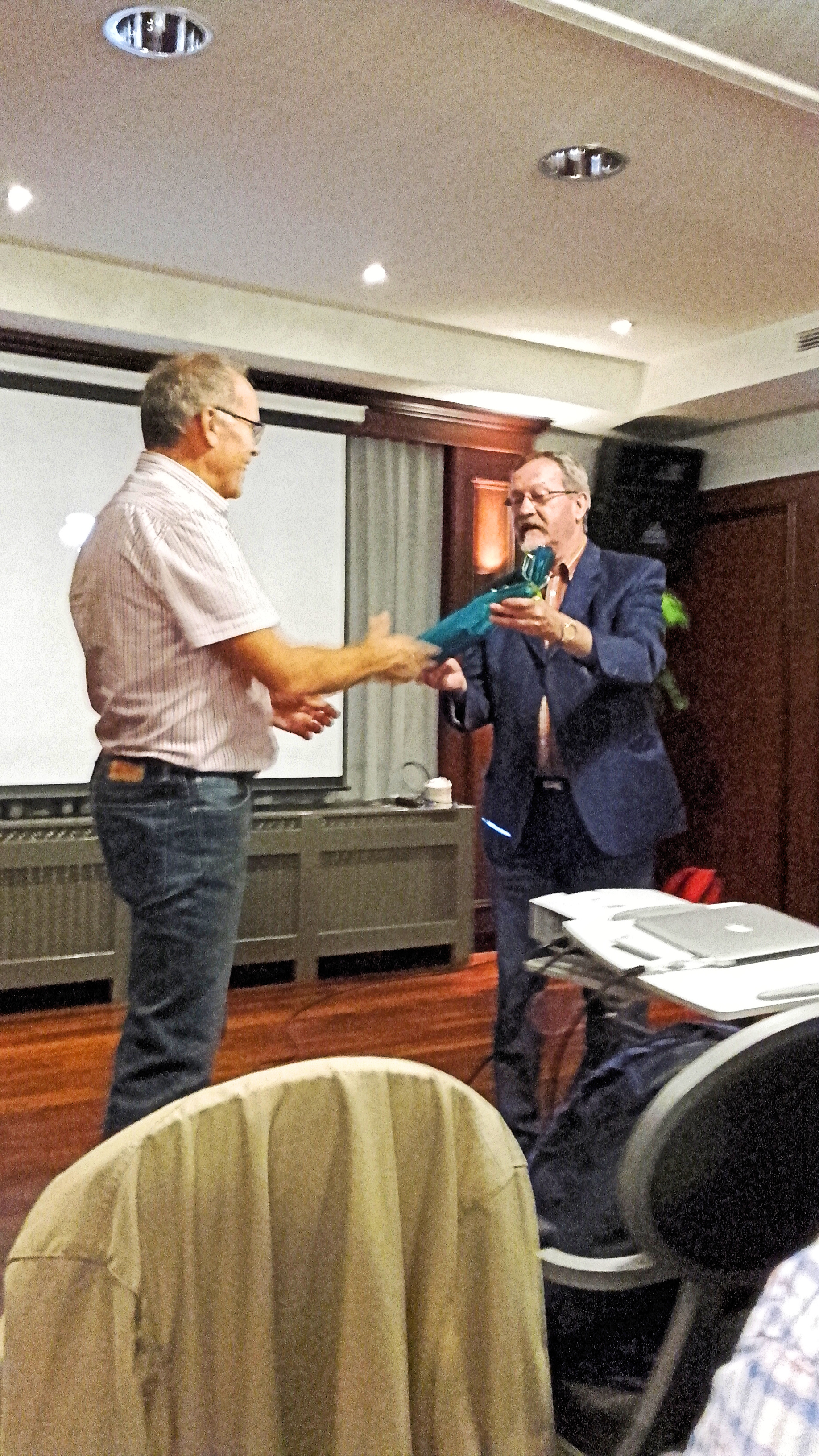
Mark Post giving his presentation. Word of thanks and a bottle of
wine for the speaker.
Description
Thirty-five more years and we are at the deadline for necessary reduced climate change and adequate food - and water supply for humans. As a major consumer of water, arable land for animal feed and a producer of CO2, livestock production for meat consumption needs to be drastically reduced. Will we become vegetarians or is meat production possible in other ways?
In his research, Mark Post has succeeded in growing muscle tissue from the stem cells of slaughter cattle and binding it into 'cultured' meat. So far sufficient for a hamburger, in the future a stable of one hundred and fifty cows may be able to feed the world.
Convince yourself of the desirability of breeding, the health and environmental benefits and the technical feasibility of scaling up.
The meeting starts at 18:00 with a wide walk-in where soup and sandwiches will be available. Once participants are present, the presentation will begin.
Speaker(s)
Mark J. Post MD. PhD. Professor and Chair of Physiology Maastricht University.
Location
Hoofdstraat 43, 5683 AC Best
Organiser
Region South
Name and contact details for information
drs. ing. C.H. van den Bosch