

History of steel construction company De Vries Robbé
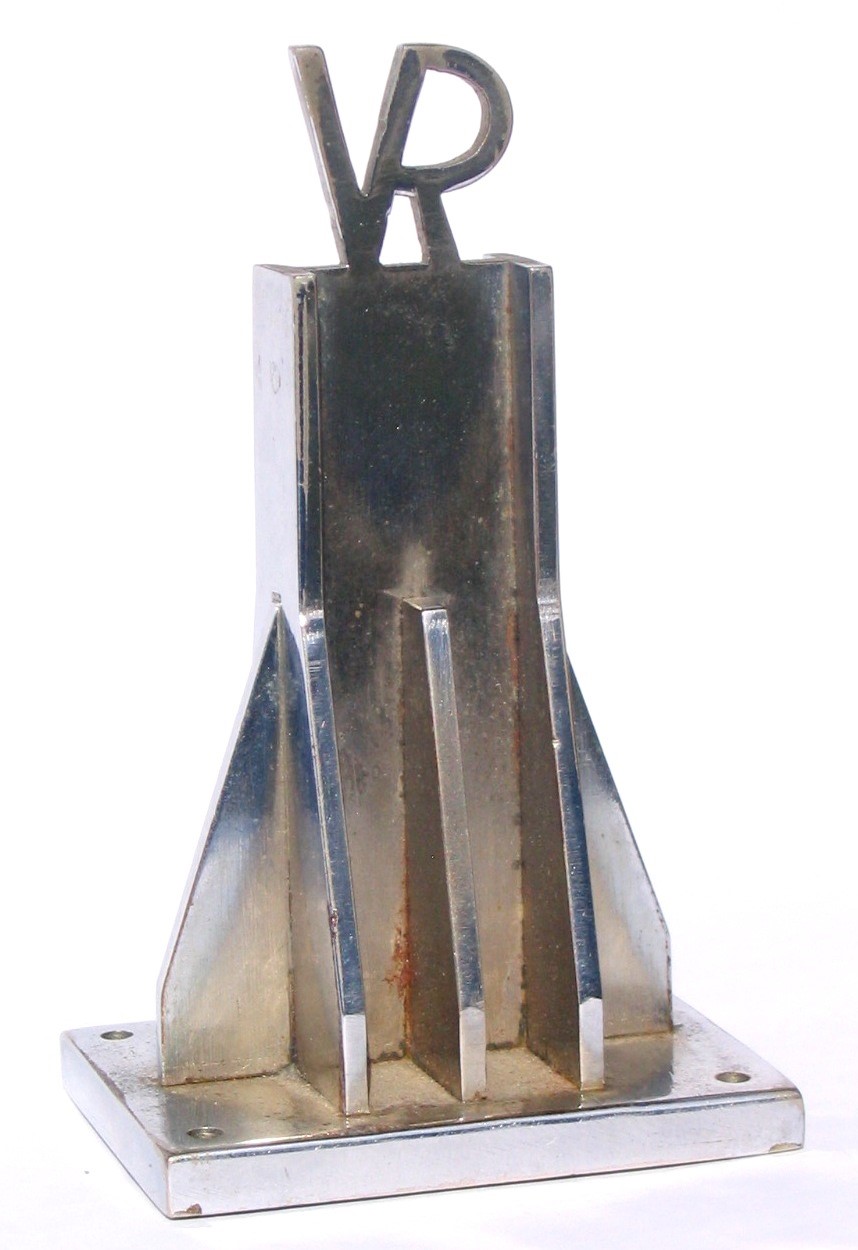
The base of the standard columns executed in silver and 30 cm high
The boards of the KIVI Department of the History of Technology and the Histechnica Association are pleased to invite you to attend a lecture to be given by Prof Dr J.A.A.M. Stoop entitled:
"History of steel construction company De Vries Robbé"
Location: Science Centre, Bouwcampus 26, Van der Burghweg 1, Delft. PLEASE NOTE: The Science Centre has moved!
Programme:
10.30 a.m.: Walk-in with coffee and tea
11:00: Welcome and introduction
11.05:00: Lecture by Prof John Stoop
11:50 a.m.: Break
12:15: Continuation of lecture and concluding discussion
12:45: End of meeting.
Registration is required to attend this lecture :
- KIVI members should register via the KIVI website
- Members of Histechnica should register via the secretary hotzeboonstra@gmail.com
- Interested parties who are not members can also register through the above-mentioned channels. There will then be a cost of Eur 5.00.
The presentation will be broadcast live; you should also register for this through the above-mentioned channels. There is no charge for this. You will receive the link for participation when you register via the website.
Summary of the lecture
A pearl from under the dust
In 1881, Willem De Vries Robbé bought a swampy piece of land outside the ramparts of Gorcum. He and his friends, the Stork brothers, took over a small repair and maintenance business for steam machinery for 6000 guilders. As a stopgap for bad times, a construction workshop for sheds and hoods was added. Little did he know then that this small company would grow into a global concern, a leader in what today would be called sustainable, circular and innovative. Eventually, the concern delivered an integrated product, where design, manufacturing and assembly merged with the modern techniques and materials of the time. For decades, De Vries Robbé products defined the urban and landscape landscape image in the Netherlands: gasholders, railway bridges, high-voltage pylons and iconic buildings such as the KLM head office in The Hague, the National Insurance Bank in Amsterdam, the hangars at Schiphol Airport, the Gerbrandy transmitter mast in Lopik, the Erasmus hospital in Rotterdam, the offices of the Philips concern in Eindhoven. The concern worked with leading architects in the Netherlands such as Roosenburg, Merkelbach and Karsten, and had an established relationship with the Technische Hogeschool in Delft. Together with Philips, De Vries Robbé was involved in setting up the Standardisation Institute. It relied on leading designers and visual artists to market its products. The group occupied a unique position in the niche market of concrete and steel construction. It was a leader in social security provision for its employees.
With the transition of the Netherlands from industrial country to trading nation, the tide also turned for De Vries Robbé after the reconstruction period. It was the first of a series of Dutch global concerns to go under. In 1976, the company went bankrupt and the company site was left to its fate for years. Until a Delft engineer and his wife, who settled in Gorcum with their consultancy firm Kindunos in 1990, rediscovered the beauty and grandeur of the concern and pulled it out from under the dust. They moved the executive office across the Linge and restored it, recognising it as a national monument.
Discussions are currently under way in the city on how to preserve the remaining De Vries Robbé buildings at the site along the ramparts as part of the industrial heritage. But that is a story in itself, so right next to the Unesco World Heritage Site of The New Dutch Waterline. You can see that at www.behouderfgoeddevr.nl
Information about the speaker
John Stoop graduated from TU Delft as an aeronautical engineer and has a PhD in safety issues. He is emeritus professor of 'Forensic Engineering and Safety Investigation'. From his commitment to sustainable innovations and his interest in engineering design, he is interested in industrial heritage developments. To him, the experiences, knowledge and boldness of that past are an inspiration for the future. He also advocates balanced decision-making: the risks and safety of wind farms are vastly underexposed compared to all the alleged benefits. Perhaps it is time for a Safety Impact Report, as his teacher Prof Jan de Kroes said 25 years ago: rather a v.e.r. a boire than an m.e.r. a boire.
Upcoming activities
- saturday 23 April 2022 at 11:00 lecture at Science Centre Delft to be announced
- saturday 28 May 2022 at11:00 lecture Prof Jenny Dankelman: Technology for minimally invasive surgery and interventions at the Science Centre Delft