

Self-driving cars
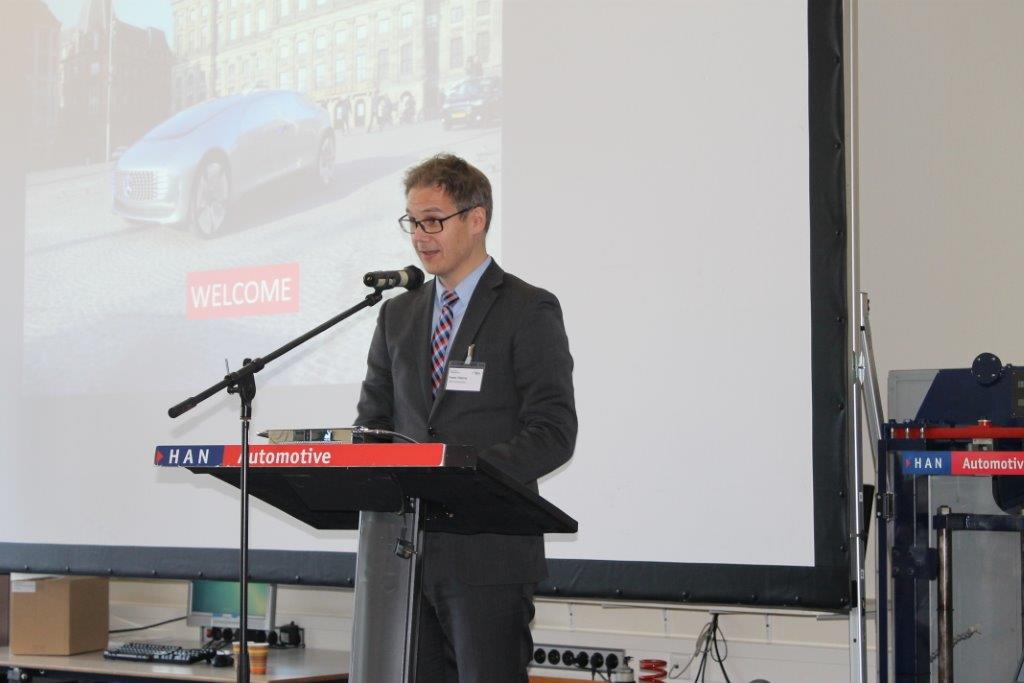

Every year, the KIVI Gelderland division organises a mini seminar, this year the theme was self-driving cars. At an early stage, KIVI contacted Automotive at the Arnhem Nijmegen University of Applied Sciences (HAN) with the question of doing this seminar together. The answer was a resounding yes. This seminar was the busiest seminar so far. Extra chairs had to be added in the hall, and there were already 120. The topics had been chosen together with the HAN: [1] What does the future of self-driving vehicles look like [2] Self-driving trucks [3] The autonomous van between the University of Wageningen and the railway station [4] The legal aspects of self-driving vehicles. It was an ambitious programme with renowned speakers. That is why many students attended.
Frans Tillema, HAN Lecturer in Intelligent Mobility, opened the seminar by outlining Automotive's activities and explained that self-driving cars is one of the spearheads of his lectureship. Actually, it is better to talk about autonomous driving.
Then his brother Taede Tillema, from the KiM Netherlands Institute for Transport Policy Knowledge, spoke. KiM is engaged in a research programme on: Future scenarios for traffic and transport systems with automated driving vehicles. A key issue here is "level of automation". Six levels have been defined by SAE International(www.sae.org): SAE 0 - 5, 0 being no automation and 5 being fully automation. At the highest level, you don't have to do anything yourself. It also looks at vehicle sharing, switching from one transport system to another and using bicycles.
Programme Director EU Truck Platooning Challenge, Dirk-Jan de Bruijn, had to disappoint us, self-driving trucks are not here yet. At the moment, they are rolling out Truck Platooning, in which trucks drive in a kind of train. The one in front is driven and the trucks behind it follow. There is a driver in this vehicle but he does nothing. To manage such a cross-border project, we first looked at what went wrong with the Fyra project. The report of the Fyra Parliamentary Inquiry Committee "The passenger out in the cold" was studied in detail. A key point is to ensure optimal cooperation of the various parties and set goals that are achievable in the relatively short term.
Advantages of Platooning include: [1] Reducing emissions through lower fuel consumption, [2] Safer (most accidents happen due to human error) [3] Increased road capacity and [4] Improving driving and rest times.
How to demonstrate that it can be done, by doing it. All test drives went to Rotterdam. So drove from Gothenburg, Munich, Södertalje and other cities, with positive results. This is only possible because of good cooperation from the parties involved. The aim is to raise the level of Automation from SAE level 1 to level 3 & 4 by 2020.
After the break, the project manager of the WEpod, Jan Willem van der Wiel, spoke. The WEpod is a small van that transports passengers from Ede Wageningen station to the university campus. What immediately stood out in his speech was, the maximum speed of 25 km/hour. This is quite slow among the cars on the Provincialeweg. Therefore, a different route was chosen, namely on roads where the speed difference with other traffic is not too big. There will also be a "driver" along, who can intervene in case of emergency, as the WEpod has no steering wheel, which in practice means stopping. Also, the WEpods are monitored from a control room. From August this year, passenger transport will start. You will have to be a bit patient because it will take three quarters of an hour, but then you will also be driving the world's only automatic van on public roads.
Actually, there are no legal obstacles reported Joost Bindels, lawyer at Dirkzwager advocaten & notarissen. The vehicle will get a type approval before it is allowed on public roads. However, if it is not properly regulated within Europe, it might not be allowed to cross the border. That is why the Declaration of Amsterdam was drawn up in April this year. Also, several experiments with unmanned driving vehicles are already underway. Still, the law is very simple, unmanned vehicles are not allowed. The question, however, is whether in the back seat of your car, you can drive it if it is suitable for that purpose. Another question is who is responsible if you park your car with a "self-parking system". Computer failure is an easy one, as it is similar to the failure of your braking system. Another is that the "presets" of your computer system are wrong, but several car manufacturers have already said they are liable for that.
On behalf of KIVI Region Gelderland,
Gerard Thomas
Description
Taede Tillema, Ministry of Infrastructure and the Environment Knowledge Institute for Mobility Policy:
When we look to the future, we automatically do so from our current perspective. This therefore also applies to means of transport, be it a horse or an 'ordinary' car. We don't know any better or you have to drive a car yourself. Yet this is not as obvious as it seems. The advent of the self-driving car - a car we no longer have to drive ourselves - could radically change our perception of a means of transport. But how does such a self-driving car actually work? Is the technology ready yet? Not to mention, are people actually waiting for self-driving vehicles? Future scenarios. The means of transport of the future depends heavily on questions like these. Therefore, we look at that future from different possible futures: scenarios.
Drik-Jan de Bruijn, Programme Director EU Truck Platooning Challenge:
Truck "platooning" are trucks driving cooperatively at short distances from each other. This is possible by using automated driving technology. Truck platooning is innovative and full of potential for the transport sector. Because the following trucks brake immediately when the one in front brakes, with reaction time zero, platooning is not a road safety issue. In the short term, platooning will mainly lead to cost savings; because the trucks drive close together, at a constant speed, fuel consumption is lower, resulting in fewer CO2 emissions.
Jan Willem van der Wiel, Spring Innovation Management:
Something unique is about to happen in Gelderland. For the first time in the world, self-driving vehicles called WEpods will drive there on public roads in between other traffic. The WEpods will drive between Ede-Wageningen station and Wageningen University and Research centre (WUR) and on the WUR campus. The name 'WEpod': WE stands for Wageningen and Ede and for everyone (we) involved in the project: the province, the FoodValley region, the project group, local residents, users, etc. WE denotes that we are doing it together and that we can be proud of what we are all developing here and pod is a (small) automated vehicle or a shell for precious content.
Joost Bindels, Dirkzwager advocaten & notarissen
It will be clear that autonomous driving vehicles have legal aspects attached to them with regard to the question of liability in case of accidents. Joost Bindels, attorney at Dirkzwager advocaten & notarissen gives his views on this
Speaker(s)
Frans Tillema, Lecturer Intelligent Mobility HAN, host and chairman of the day
Taede Tillema, Ministry of Infrastructure and Environment Knowledge Institute for Mobility Unit
Dirk-Jan de Bruijn, Programme Director EU Truck Platooning Challenge
Jan Willem van der Wiel, Spring Innovation Management
Joost Bindels, Dirkzwager advocaten & notarissen
Location
Arnhem Nijmegen University of Applied Sciences
Ruitenberglaan 29, 6826 CC Arnhem
Organiser
Region Gelderland
Name and contact details for information
Gerard Thomas