Engineer of the Year 2024
Dr Pavlina Nanou

Pavlina Nanou wins tenth Prince Friso Engineer Prize
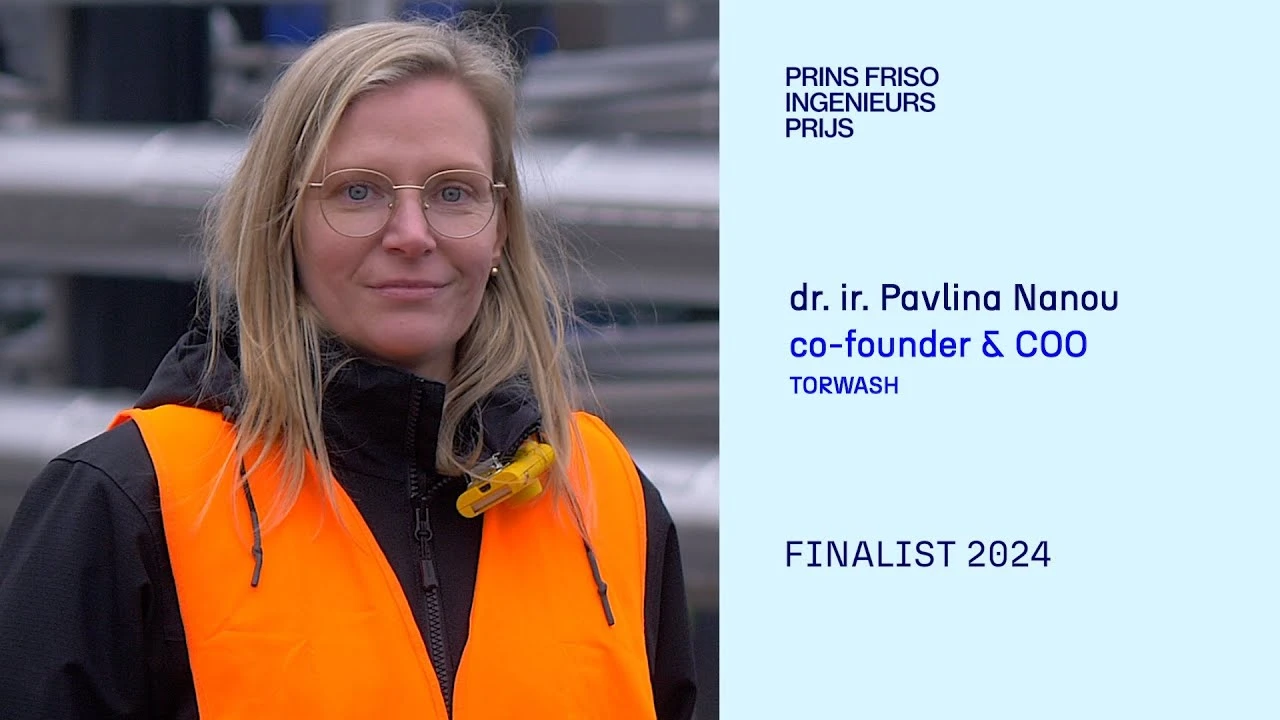
Dr Pavlina Nanou is the winner of the Prins Friso Ingenieursprijs 2024. Princess Mabel presented the prize to her in the presence of Princess Beatrix together with KIVI president Jacolien Eijer-De Jong during a festive gathering on 13 March 2024 at De Haagse Hogeschool. Pavlina may call herself Engineer of the Year for a year.
Innovative technology and inspiring role model
The jury praised chemical technologist Pavlina Nanou from Twente for her "out of the box" approach. Months of stirring in cow manure in search of biogas gave her inspiration to look beyond fossil fuels. From a pilot at TNO, she became co-founder and COO at TORWASH, a startup focused on making various troublesome waste streams circular as a contribution to a better world. Here, Pavlina is mainly concerned with a technology to convert sludge from sewage treatment into biofuel, biogas and fertiliser.
Pavlina's work is not limited to developing and implementing innovative technologies. She also invests heavily in her relationships and collaboration with stakeholders to make good use of these technologies to take significant steps towards a sustainable future. Lacking role models in her career, Pavlina is keen to be visible as an engineer to inspire other women for engineering. She does this by being active through expertise agency women and engineering VHTO and giving guest lectures at primary and secondary schools. The jury sees Pavlina as a great ambassador for engineering.
- From cow manure to sustainable fuel: the story of Pavlina Nanou
Dr Ir Pavlina Nanou has developed an innovative, sustainable treatment for sewage sludge and scaled it up to a demo plant. But it started with stirring in cow manure.
As a schoolgirl, Pavlina was not that into engineering, but when it came to choosing a profile between languages, biology, economics and STEM, she did not have to think long. 'I liked everything and was good at lots of things,' says Pavlina, 'but I like challenges that make me think the most.' In this, her father was an inspiration. 'As a ship's engineer, he had tools with which he could fix everything at home too, whether it was electrical or mechanical. That really captured my imagination
Pavlina was born in Groningen, but lived in Greece from the age of six. There she also went to study oil and natural gas extraction. As an Erasmus student, Pavlina ended up in Emden in Germany. It was there that she first came across the concept of renewable fuels. 'I spent six months there stirring in manure to make biogas. Bizarre, but at the same time a world opened up for me. All my studies I had only learnt about fossil fuels, and suddenly I realised that other fuels were also possible. I knew: this is going to be the future and I want to contribute to it.'
With a Greek college degree in her pocket, Pavlina returned to the Netherlands, where she studied chemical engineering in Twente, followed by a PhD on biomass gasification for methane production. At TNO, she developed Torwash, a technology that allows sewage sludge, currently considered waste, to be converted into green products using patented processing methods. 'We initially wanted to place the technology with a large company to enable upscaling, but when they didn't bite immediately, we continued as a spinoff. It has been in existence for four years now and our first demonstration plant has been running since the end of last year.'
However, to successfully tackle major, societal challenges, innovative technologies are not enough, Pavlina argues. 'Only through collaboration can we make significant steps towards a sustainable future,' she says. 'We also need to develop new value chains, in which we can apply these technologies in a sustainable way. This is only possible through broad-based initiatives where government, companies, universities and research institutes work together.' And, Pavlina immediately adds, in that playing field, the Royal Institute of Engineers and the Engineer of the Year should certainly claim their place. Text: Pancras Dijk, The Engineer


- From Germanic languages to circular plastics: the story of Kim Ragaert
Prof Dr ing. Kim Ragaert works on circular plastics. In doing so, she is not only looking at the technical, but also the social side of things.
'Germanic languages,' Kim Ragaert used to say when asked what she wanted to study. Her parents were mathematicians, it had to be as far away from that as possible. Now she is a professor of circular plastics at Maastricht University, working on the sustainable use and recycling of polymers. 'In the end, I did choose what I found most interesting and ended up in materials science via mathematics, physics and electromechanics.' Mathematics and physics were ultimately too abstract for her, Kim explains. 'As an engineer, you can see in front of you how things work.'
Kim has now been working on making plastics more sustainable for 15 years. 'Although in the beginning nobody was interested in that subject.' First attached to Ghent University, since late 2021 she has been leading her own research group at Maastricht University. There, she is also one of the developers of the circular engineering course. 'What I think is important is that we not only find out what new materials we can make or how it is technically possible to recycle plastic, but also what actually works in industry,' Kim says. 'So then you have to look broadly, also at value chains and legislation, across disciplines.'
Kim sees debunking myths with facts as one of the important social tasks of engineers. There is too much argumentation in politics, the media and society based on feelings, she believes. 'For example, everyone thinks it is better to use bags made of paper than plastic, while paper bags cause more net CO2 emissions. Our job is to point out misconceptions like that to people and to come up with facts and calculations.' And to come up with solutions to problems, of course, she adds. 'But deployable solutions. High-tech developments that end up on the shelf are of no use to anyone.'
Kim wants to fight to preserve the international character of engineering courses. 'An international group of students is great to work with. It gives them a broader perspective, you can see that happen immediately. Besides, there is really no one working at the big multinationals who speaks Dutch.'
And her message to students? 'Go study what you find interesting, but also realise that engineering is really sexy and can have a lot of social impact.' Text: Marlies ter Voorde, The Engineer.
Christoff Heunis third finalist 2024
The third finalist was Dr Christoff Heunis, CEO of Flux Robotics. As a PhD student at the University of Twente, Christoff developed an auxiliary robot for minimally invasive vascular surgery using magnets, which he further developed with the startup Flux Robotics.
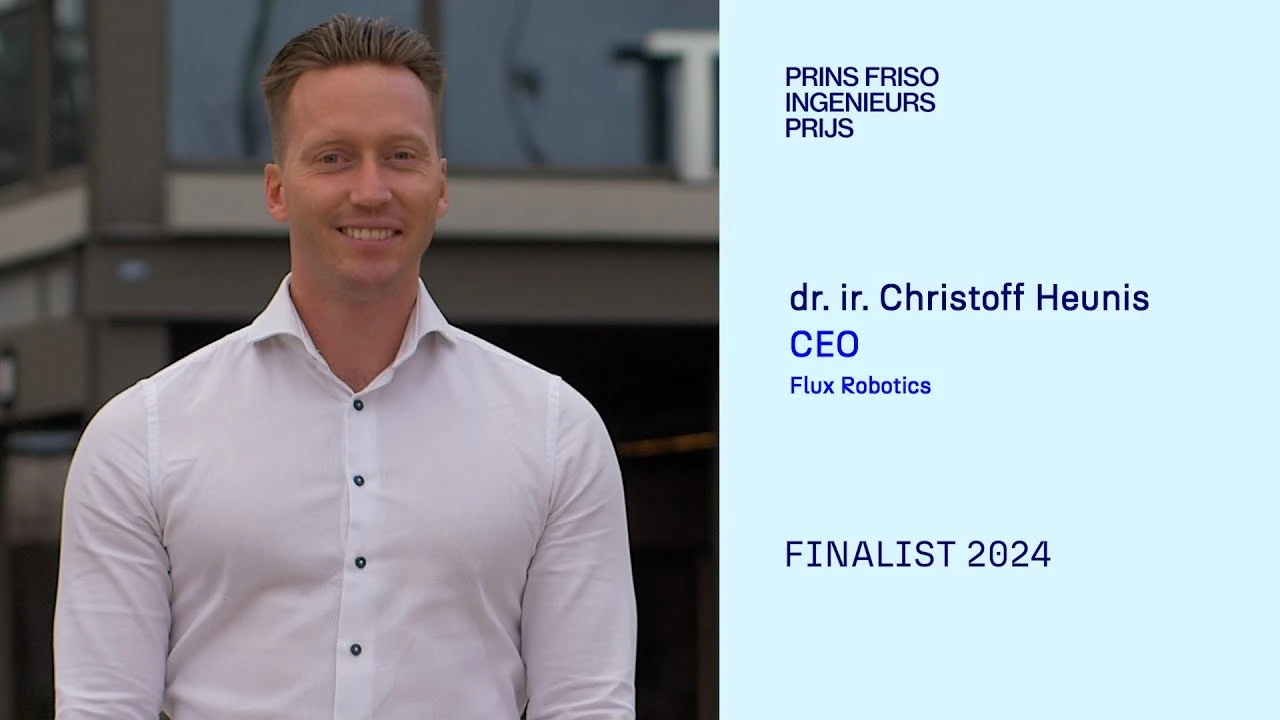
- From South Africa to startup success: the story of Christoff Heunis
Dr Christoff Heunis came to the Netherlands from South Africa seven years ago for a PhD. He has since developed a robot for vascular surgery and runs a startup.
In 2017, Christoff moved to the Netherlands for a PhD at the University of Twente. 'My friends and colleagues declared me crazy. With us, it was not common to do a PhD abroad. But I saw it as an opportunity to explore abroad.'
With Dutch directness, Christof quickly learned to deal with it. 'I see it as transparency, not having a hidden agenda, and just saying what you mean.'
The mechanical engineer developed an ingenious magnetic robot that can help vascular surgeons with operations. To bring that invention to market, he started Flux Robotics. As a mechanical engineer, it was not easy to get to the table with surgeons. 'It took a year, but I had to and would work with those surgeons, because that is where the magic happens. To help healthcare properly with technological solutions, you first have to know what the deep need of the specialist is.'
Christoff considers himself an engineer of the pragmatic kind, a practical person. 'I think I can assess pretty well whether an idea could work in practice ten years from now. I have developed a pretty good sense of whether something is feasible.'
In his native South Africa, he saw that patients in neighbouring countries were far from having access to expensive surgical robots and other high-tech care. 'I want to contribute to bridging that tech gap, by helping spread what we develop here in the Netherlands around the world,' Heunis says.
What does Heunis think of the image that many engineers work in relative isolation from society and are quite invisible in society? 'With that cliché image, I don't quite agree anyway. Engineering has changed quite a lot in the last 30 years. My father, also a mechanical engineer, told me that he used to be responsible only for his own partial task and nothing more. Now an engineer oversees much more and is more broadly trained. In fact, we can no longer afford this narrow view of engineering either. The world is not in the best possible state in terms of sustainability. We need to look at that with the broadest possible team of disciplines.' Text: Jim Heirbaut, The Engineer