Engineer of the Year 2025
Dr Meike Nauta

Meike Nauta wins eleventh Prince Friso Engineer Prize
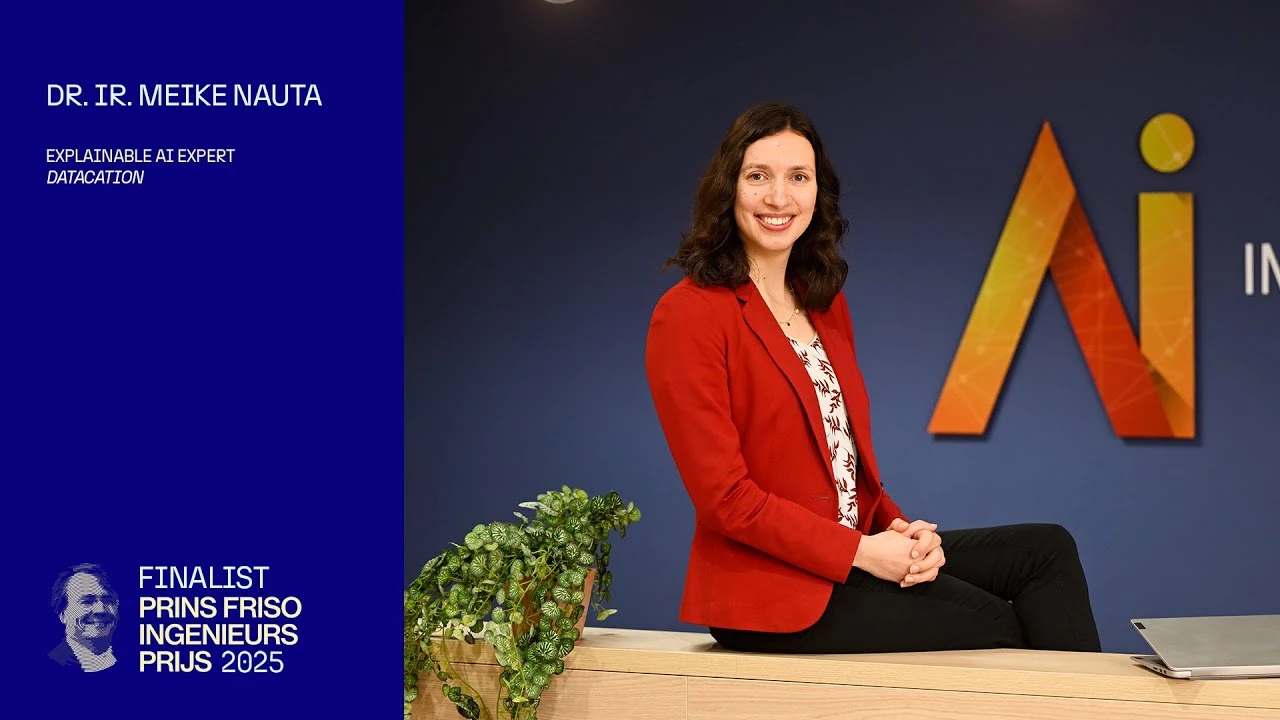
Artificial intelligence expert Dr Meike Nauta wins the eleventh edition of the Prins Friso Ingenieursprijs 2025. Princess Mabel presented her with the award in the presence of Princess Beatrix together with KIVI president Jacolien Eijer-de Jong during a festive gathering on 12 March 2025 at De Haagse Hogeschool. Meike may call herself Engineer of the Year for a year.
The jury particularly praised her empathy and social commitment.
AI premeditated
Nauta, who can now call herself Engineer of the Year for a year, makes the case for understandable artificial intelligence, or in her own words: Premeditated AI. Nauta teaches at the university, but is mainly active as a consultant at Datacation, where she promotes the use of AI among companies and civil society organisations.
Last December, Nauta was already one of 15 great engineering talents under 35, as published by De Ingenieur.
Empathic ability
For the jury, Nauta (30) clearly stood out. "Meike feels a strong responsibility to ensure that her technical applications also reach society and her intrinsic motivation to make AI understandable to everyone is unique," said the jury, chaired by shipbuilder and former businesswoman of the year Thecla Bodewes.
"The jury praises Meike for her empathy and social commitment. She is a paragon of the ambassador for the engineering profession that KIVI is looking for."
- The story of Meike Nauta
Meike Nauta creates understandable and responsible artificial intelligence (AI) that explains why it reaches certain conclusions. Her applications have an eye for the person it ultimately revolves around: the user.
"Surprised and honoured" was Meike Nauta when she heard she was among the finalists for the Prins Friso Ingenieursprijs. Yet this is not the first time the 30-year-old computer scientist and data scientist has won a prize. In 2018, Nauta won the KHMW prize for the Netherlands' best master's thesis on IT; in 2023, she completed the University of Twente's best dissertation of the year. The topic she is working on: understandable and responsible AI.
"Artificial intelligence is often a black box. AI comes up with an answer to a question, without the user knowing the reasoning behind it."
This can be done differently, Nauta thought, and to the surprise of some colleagues, she indeed managed to come up with a different form of AI. "This variant indicates how it arrives at answers, so that it identifies, for example, a bird as a robin because of its red face and short beak. The user can then choose to select on other features or correct AI if the reasoning is incorrect."
Technical nerd
Nauta teaches at the university, but is mainly active as a consultant at Datacation, where she promotes the use of AI at companies and civil society organisations. For example, she is developing AI to distinguish pancreatic cancer from scar tissue on CT scans for the University Medical Centre Utrecht, AI to detect damage to roads on drone images for municipalities and the AI assistant Bookbot that recommends books to young people to promote reading pleasure.
Nauta: "And always responsibly and with an eye for the user. I like to be the technical nerd, thinking up solutions and working them out mathematically and programming them. But what really matters to me is that those solutions then find their way into society."
Explainable AI
Partly for this reason, she gives lectures to interested parties about what AI is and how it works. "About the possibilities as well as the limitations. I want everyone to be able to talk about AI. It is important to start a social dialogue about its use and not a dialogue of a select group of experts."
To students - including working professionals - Nauta teaches how to make AI explainable and accountable. "AI should not be allowed to pull the strings, the power should lie with humans. But that is where AI can be a powerful tool."
Or, as its slogan reads: Power to the people, with the power of AI!
Text: Pancras Dijk, The Engineer
Power to the people, with the power of AI!

Finalists 2025
Finalists Mark Ommert and Johan Paulides may not have won, but their work is at least as impressive.
- The story of finalist Mark Ommert
"We can contribute to cleaner aviation."
He has already worked for and with several Dutch companies developing technology for aircraft. Now Mark Ommert has set his sights on making aviation more sustainable.
Although he has only just turned 28, Mark Ommert has already worked for an educational and a knowledge institution, a manufacturer of electric motors, a manufacturer of aircraft structures and two developers of sustainable aircraft.
Late last year, he joined industry association Netherlands Aerospace Group (NAG). "That I walked through much of the process of developing an aircraft in such a short time is quite unique. Now I can bring this knowledge and expertise to the wider ecosystem."
One notable project Ommert did at InHolland University of Applied Sciences in Delft, where he graduated as an aerospace engineer in 2019. Together with colleagues, he led the conversion of a small homebuilt plane into an electrically powered aircraft. "More than two hundred students and researchers collaborated, together with industry, knowledge institutions and authorities. This project provided not only a test platform for industry, but also new educational material to train engineers for the latest needs from industry."
Collaboration and knowledge sharing
At NAG, Ommert strengthens the ecosystem of Dutch companies in aviation, from startups to large companies and institutions. "Our country can gain a significant position in sustainable aviation. We have enormous innovation power, but then innovations need to be converted into commercially applicable products."
Within the Aviation in Transition Growth Fund project, Ommert focuses on knowledge sharing, cooperation and international positioning. "This contributes to sustainable aviation and more Dutch earning power and employment."
Investing in people
For Ommert, engineering is all about ingenuity and embracing uncertainties. "You have to recognise problems and find solutions," he says
For him, being an engineer goes beyond technology. It also means investing in people and inspiring the next generation of engineers. That is why Ommert is a board member at Young NAG, where he connects young professionals and promotes engineering.
His advice to future engineers: "Get into engineering now, anywhere, and you will have a tremendously cool time. Take that chance, improve yourself 1 per cent every day and before you know it, you too will have made an impact to make the world a little nicer."
Watch Mark's video about his work.
Text: Jim Heirbaut, The Engineer
- The story of finalist Johan Paulides
"Entrepreneurial engineering is so cool."
He is an entrepreneur, an engineer and much more. Why electrical engineering expert Johan Paulides is so active? To "make big dreams come true together with others" - like the electrification of the Netherlands.
Only when a successful innovation has been preceded by at least five failed attempts does Johan experience satisfaction, at least his father says about him. Johan Paulides is co-owner of the Advanced Electromagnetics Group, a nearly 100-year-old family business specialising in electromagnetic design and the production of battery-powered electric drives. Or, in Paulides' own words, "We are working on the electrification of the Netherlands."
Innovating, social entrepreneurship and inspiring are the core values of Paulides' engineering. The range of innovations to his credit is long: from extraordinary electric drives to an energy floor that shows children (and secretly 'big' people too) how much effort it takes to generate energy.
Energy from the waves
Also sensational is the Wavehexapod, which, with three buoys, makes optimal use of the continuous, three-dimensional movement of waves to convert them into electricity via six generators. The innovation is suitable for use in offshore wind farms, for example, where it can significantly increase energy yields. Whether Paulides is proud of it? "For me, pride is not that important, at most I feel satisfaction that we have achieved something together."
Paulides does take pride in all the innovations by engineers he has supervised over time. And there are many. For instance, Paulides has been working with student teams such as the Brunel Solar Team (TU Delft) and Electric Superbike Twente for years. "I like it best when theory and practice come together. Thanks to my entrepreneurial attitude, a lot of electromechanical theory has already become reality. Entrepreneurial engineering is so cool!"
Social media
To convince others of this, the AE Group started the social media company Tikkieland. "With this, we try to get young people excited about engineering and also support companies to build their own community."
Paulides is driven by the ambition to make dreams come true "together with others". In which he falls short? "I don't think enough about how I allocate my time. With the recent death of my wife, that has now become a main, hopefully temporary, question to which I have yet to find an answer. I am in no hurry to see innovations as a product tomorrow, but I always want to take steps. Therefore, when I see an opportunity, I go for it immediately. Business-wise a good trait, personally a sometimes lesser one."
Watch Johan Paulides' video about his work.
Text: Pancras Dijk, The Engineer