

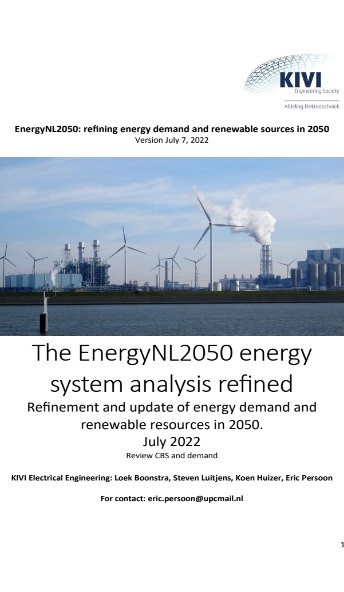
The team of E-engineers, which has been working on the energy plan 2050 ( project EnergyNL2050) has recently completed a document further substantiating the energy plan "The EnergyNL2050 energy system analysis refined" July 2022. The revised version can be downloaded from the kivi.nl/el website under "Energy Plan".
Reason
The team of E-engineers, which has been working on the energy plan 2050 ( project EnergyNL2050) has recently completed a document (July 2022) with the further substantiation of the energy plan "The EnergyNL2050 energy system analysis refined" July 2022.
First version
The first version of the energy plan was published in early 2018. It is based on the information obtained from the extensive lecture series organised in 2016-217 jointly with the USI (Utrecht Sustainability Institute) at the Uithof in Utrecht.
Expert speakers from universities, institutes and industry gave their views on the future energy supply of the Netherlands in 2050 without CO2 emissions.
The first version of the plan contains all the elements needed to provide reliable energy with almost only PV and wind as renewable energy sources.
For instance, there is a need to overcome fluctuations in PV and wind output via batteries. There is also the necessary seasonal storage through hydrogen to cope with the sharp differences in yield in summer and winter. This hydrogen is also necessary for chemical processes and high-temperature heat (in industry) and for heavy road and water transport.
The plan offers a vision of what a CO2-free energy system of the Netherlands could look like in 2050 based on energy production mainly by wind and PV and buffering with batteries and gas storage.
Revised version
However, the fluctuations of weather, energy demand and energy production had limited consideration. A reason for further study.
An improved version will be published in 2020 in which the system will be extensively simulated with data of energy production, energy use and hourly weather from KNMI and TenneT.
Data from three consecutive years (2016-2018) have been used and the energy use and production data have been extrapolated to 2050. The annual cost of such an energy system was then also estimated.
Further substantiation
These results of the current situation were presented among others at the KIVI Annual Conference in December 2020 and at the KIVI Electrical Engineering ALV in 2021, which generated many new questions and comments.
Of much importance, of course, is the starting situation. In the energy plan, the 2015 energy consumption was chosen as the basis. This basis has been further refined in the recent document.
Extensive analysis was done of the 2015 CBS data for different sectors and what the energy consumption was in 2015.
Based on CBS' open data, these have been further refined. Moreover, the extrapolation to 2050 has been reviewed in more detail and described in more detail.
However, the focus has remained on the scenario described earlier in the EnergyNL2050 energy plan.
However, other options with, for example, high energy (hydrogen) imports or the use of nuclear energy have been briefly indicated.
The final results of energy demand and production in 2050 do differ from those of the earlier 2020 calculations, but the differences are relatively small.
This can all be read (in English) in the paper on the KIVI-EL website under the Tab "Energy Plan".
Refined document EnergyNL2050
Title of the document:
The EnergyNL2050 energy system analysis refined July 2022.
Subtitle:
Refinement and update of energy demand and renewable resources in 2050.
July 2022. Download the abstract here Download the full reporthere.


Comments