
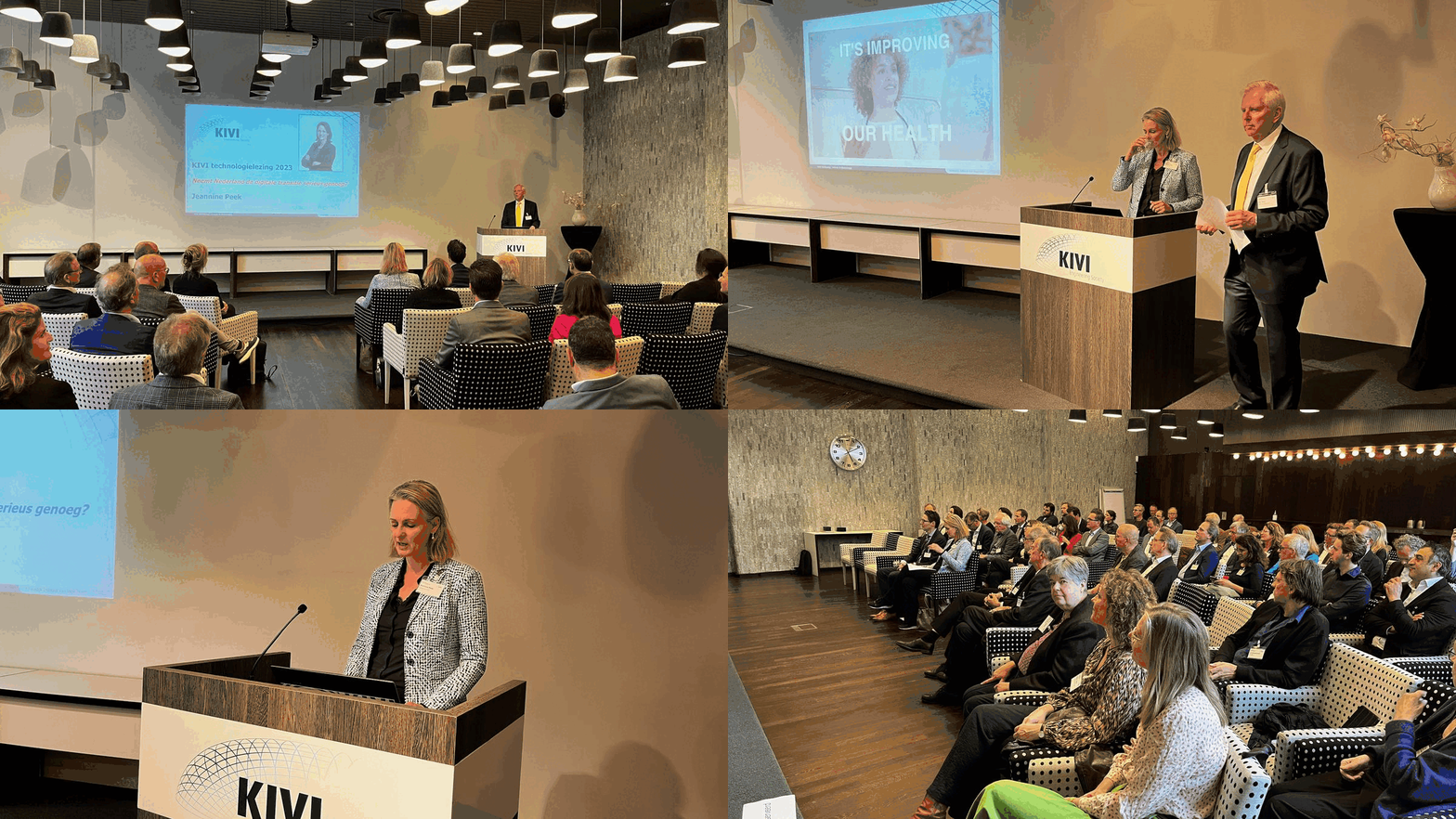
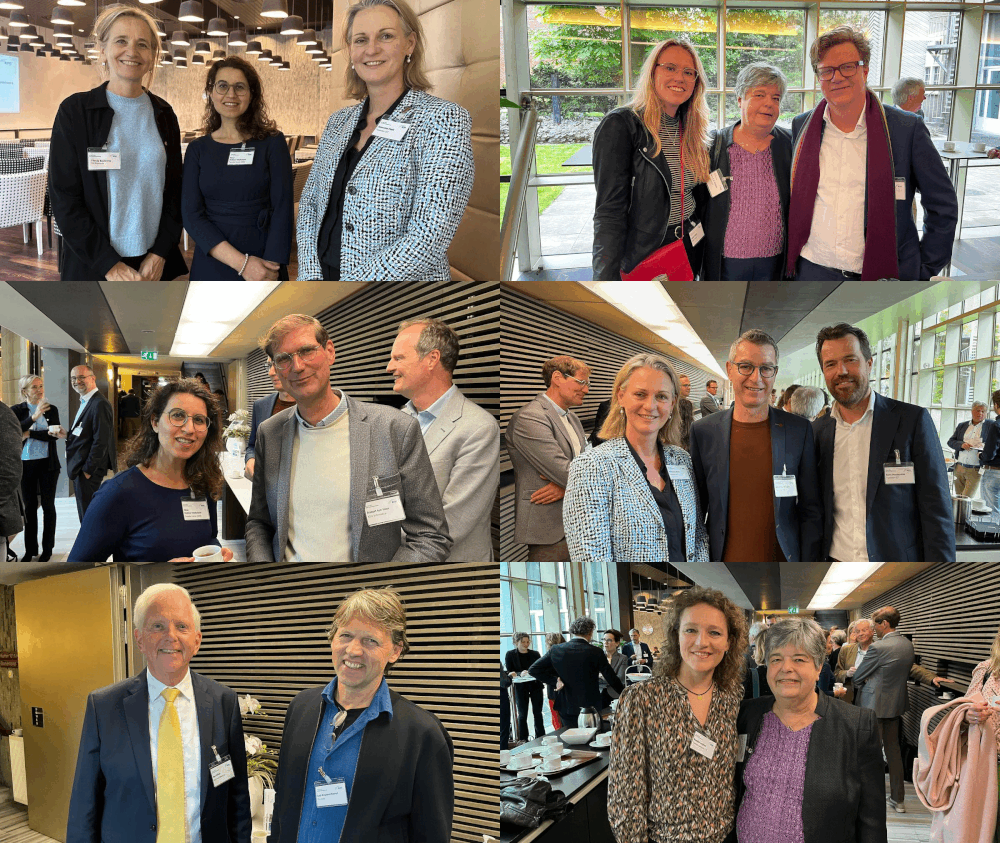
The KIVI technology lecture is given annually by a prominent politician or engineer on the importance of technology in the Netherlands. Jeannine Peek, figurehead of Top Sector ICT, SER member and Managing Director Capgemini Netherlands, delivered the second edition of the technology lecture at KIVI in The Hague on Thursday 11 May.
KIVI technology lecture 2023
By Jeannine Peek
11 May 2023
Download a PDF Watch the video Interview at BNR 
Are we taking the digital transition seriously enough?
Introduction
Great to be here today at KIVI in The Hague.
Yet I will immediately take you on a journey. To the other side of the world. And also some 30 years back in time. We are going to Tokyo, Japan, in the early 1990s. The internet was still in its infancy. And áf you already had a personal computer at home, it looked like a big greyish box.
I had just graduated in IT, from the University of Twente. Not that I knew much about IT beforehand. Apart from a game of pacman, I had hardly any experience with computers. But I was - and still am - fascinated by the new, by innovation. That is why I chose the Information Technology track during my Technical Business Administration studies.
This is how I ended up at my first employer KPN Telecom. And in the early 1990s I was allowed to go on an exchange to Nippon Telegraph and Telephone Corporation, NTT for short, in Japan. A company that breathed innovation. There was, for instance, a house of the future. With a television, on which you could decide what you wanted to watch. And there was a telephone of the future: a square box with which you could also take photos. I didn't understand any of it. Who was waiting for that? On TV, you watched the News at eight o'clock. And surely a phone was for making calls?
In the meantime, we know better. Only people over 50 still watch the news at eight. Our children shrug their shoulders in annoyance. Glued to their phones. On which they watch films, update social media and make phone calls. They rarely make calls on it.
What do we learn from this? That digitisation has radically changed the world in 30 years. And that that change continues as we speak. But much faster. On the one hand, that is nice. Because digitalisation brings us a lot. Videoconferencing software dragged us through the lockdowns of recent years. Measurement systems monitor climate change or our health. Algorithms can predict the composition of materials and chemical compounds. We optimise and make our business processes more sustainable with smart digital tools. And social media put us in touch with everyone. Anytime, anywhere.
But the other side is that we are now completely dependent on digitalisation. That also makes us vulnerable. Cybercriminals can take down our systems. Get hold of our private or company data. Digitalisation can reinforce inequality in society. And how do we still know what is truth and what is fake, now that deepfakes are hardly distinguishable from real? And chatbots can write books and articles? For instance, how do you know whether I wrote this lecture or ChatGPT? And is it bad that you don't know?
Which brings me to my main question. We are in the midst of a digital transition. Do we let that transition wash over us, or do we manage it? In other words, are we taking the digital transition seriously enough? I am already giving you part of the answer. I think we are not taking the digital transition seriously enough. I will first explain why I think that. Then I will look more precisely with you at what the opportunities and threats of the digital transition are. And how we can ensure that we do take digitisation seriously. Finally, I will take a trip into the future with you. But you will see that by then...
Why are we not taking digitisation seriously enough?
First point: why do I think we are not taking digitisation seriously enough? Let me start on a positive note. As I said, from a young age I have been captivated by the new, the unknown. I am therefore proud to have been able to work on innovation at several great companies over the years. On changes that are good for the company and for society. As figurehead of Top Sector ICT, I have a privileged position in a sector that is at the centre of a large number of societal challenges. And can, through digitisation, play a connecting role in them. As KIVI relations, you will undoubtedly know Top Sector ICT well. But for the few who unexpectedly do not know exactly what we do, I will briefly summarise.
During the global financial crisis between 2008 and 2011, the economy was also in bad shape in our country. The government cut spending, companies postponed investments. A lot of innovation came to a standstill. The government then set up the top sectors to restart innovation and investment. Through cooperation between government, business and knowledge institutions.
Anno 2023, there are 10 top sectors: areas in which Dutch companies and research centres excel worldwide. From agri & food, creative industry and energy to logistics, horticulture and ICT. All sectors work on missions in four societal areas: energy supply, agriculture, healthcare and security. By exploiting opportunities in these areas together in the top sectors, we work to solve social issues. And at the same time, we ensure that our industry remains internationally competitive and can remain at the top. Win-win, in other words.
Top Sector ICT is a slightly odd duck in this hat. Because as ICT, we are a sector in itself, but above all we cut across all sectors. After all, no sector or societal challenge can do without ICT anymore. Together with other parties, we look for pioneering innovations to develop societal solutions. Among other things, we do this around key technologies: digital innovations with major impact. Such as Artificial Intelligence, Big Data and Blockchain. Or cybersecurity and a future-proof ICT infrastructure.
Apologies for this summary. It is actually too boring for a lecture. But I still wanted to give you an idea of what we stand for. Because it also allows me to show where the shoe pinches a bit for me. We see digitisation mainly as a means to enable developments and transitions across sectors. Just like Top Sector ICT does. And we do that well, because the Netherlands is one of the most digitised countries in the world. So our starting position is excellent. But we treat digital innovation too little as a transition in itself. That is the first reason why I think we do not take digitalisation seriously enough. Because as a result, this transition rushes over us without us being able to steer it or steer it in the right direction.
The second reason lies in government policy on digitisation. In this cabinet, we have a State Secretary for Digitalisation for the first time. Thirty-four years after the first internet connection was made in our country, the Volkskrant noted a little scornfully when she took office. One might also wonder if it shouldn't have been a minister. But let's approach it positively. Until this cabinet took office, digitalisation was the responsibility of several ministers. One directing State Secretary is a good first step to do something about this fragmentation. The state secretary, Alexandra van Huffelen, puts it as follows on the central government website: "It is high time that we as a cabinet take the lead on digitisation. "
That is a laudable ambition. But parts of the policy on digitisation remain with other departments, such as Economic Affairs and Climate Change and Justice and Security. The state secretary for digitisation himself falls under the Ministry of the Interior and Kingdom Relations. So digitisation is not exclusively vested in one cabinet member. It probably cannot be, because of the intersecting and all-encompassing nature of ICT. But it complicates an integrated approach. The various departments each work from their own perspectives, e.g. economic or legal. As a result, they sometimes still make too little use of each other's expertise and capabilities. With that too, I think we are not taking digitisation seriously enough as a stand-alone transition.
The third reason why I think so is the fact that in our country too little money is spent on digitisation. For 20 years, the EU has set a target for member states to invest 3% of gross domestic product in research and development. The Netherlands has been hovering below 2.5% for decades. With the National Growth Fund, the government is investing 20 billion euros between 2021 and 2025 in projects that will ensure long-term economic growth. This is a good thing. But this does not secure long-term investment. In a recent Rathenau Institute forecast of government spending on Research & Development, thanks to the National Growth Fund, we see an upward trend until 2024. After that, government spending declines again. If you really take digitisation seriously, structural investments in research and development of around that 3% of GDP are needed. That is the basis for remaining a leading and competitive knowledge economy worldwide and in Europe. In addition, there should also be a budget to enable digitalisation as a transition, just like the energy transition.
And then a fourth point. We are rapidly designing the digital world of the future. This involves all kinds of ethical questions. Just think of the Surcharge affair, where algorithms led to discrimination and violation of privacy. We may be aware of this by now. But that is not enough. New technologies continue to develop. We cannot stop that. Nor should we want to. But we then need a broad ethical approach, in which we guarantee, for instance, which social values such developments must comply with. Such an approach is not yet in place. For me, that too shows that we do not feel the urgency to treat digitisation as a mature and stand-alone transition. We let ourselves be steered by it, but we steer too little ourselves.
Finally, I think we are also not taking digitalisation seriously, because after years of lobbying there is still no basic digital skills training in education. And we are still training too few ICT professionals, while at the same time there is a numerus fixus on a large number of ICT courses.
In a nutshell: The Netherlands is digitising fast. But we let it happen to us too much. We see digitisation mainly as a cutting-edge innovation, and too little as a stand-alone transition. There is insufficient guidance, too little money and not enough attention to ethical issues. And we also train too few ICT practitioners.
Opportunities
Is that bad? Yes! On the one hand because we are so inadequately exploiting the enormous opportunities of digitisation. On the other, because we are not good enough at adequately tackling its threats.
First of all, those opportunities. If the organisation or company you work for had stuck with the fax and the floppy disk, it would have long ceased to exist and you would probably not be sitting here. Companies and economies need to be innovative to stay competitive. Digital innovation saves costs, creates new products and services. And for happier customers. It underpins economic growth and sustainable development.
So investing in digitisation is necessary to remain competitive. But also to strengthen our autonomy. The pandemic and the war in Ukraine have led to scarcity of raw materials and related high prices of energy and other products in parts of the world, including Europe.
This painfully shows how dependent we are on countries in sometimes unstable parts of the world. And what undesirable consequences that has. It is not only in terms of raw materials that we are dependent. Almost all our chips also come from countries outside the EU. A lot of data is located elsewhere in the world. Technology comes from the United States or China. And the biggest investments in digitisation also take place outside the EU.
Digitalisation can help strengthen our autonomy in several ways. On the one hand, it can contribute to transparent chains and therefore to a circular economy. If you know where parts and raw materials are in those chains, you can trace them better and recycle them. The more detailed data you have, the easier you can reuse materials and raw materials. And the less dependent you therefore become on other countries.
On the other hand, investing in digitalisation can help make us indispensable in parts of production chains. If we as the Netherlands, or as the EU, have a strategic position on certain high-tech products, that contributes to our autonomy and independence. That takes years of investment. For instance, China and the United States are now fighting over ASML's advanced chip machines. While in 2008, the company was doing so badly that, with the help of benefit agency UWV, it had to avoid laying off too many staff. The current success is the product of years of strategic investment in the ecosystem around Eindhoven. By Philips, by the regional development company and by the government. Investing in the innovation climate, and in innovative companies costs something, but it pays much more. It is necessary to keep us relevant on the world stage and to ensure that other countries also depend on ón us.
But investing in digitisation is not only necessary to stay competitive and strengthen our autonomy. Globally, in the EU and in the Netherlands, we face enormous social issues, which we can only solve through far-reaching digitalisation. I will pick out two of those issues, which are also high on the agenda in the top sector policy: healthcare and energy transition and sustainability. What are the challenges there, and what role can digitisation play in them?
Healthcare first
We are all living longer. That is good news. But with age, health problems often increase. By no means everyone grows old healthily. Fortunately, healthcare in our country is of a high standard. But given the ageing population and the staff shortages that the healthcare sector is already facing, it is clear that we cannot guarantee this high level in the long term. Already, 1 in 6 people work in care. If we do nothing, it will soon have to be 1 in 4. That is unsustainable.
Digital innovation can offer solutions to make care more efficient and improve quality. Starting in 2011, I worked at Dell Technologies for almost 10 years. During that time, I regularly visited the headquarters in Austin, Texas. During one of those visits, we were given a tour of a nearby hospital. Even then, the policy there was to have patients rehabilitate at home as much as possible. So that they had to stay in hospital for as short a time as possible. Not for reasons of economy or efficiency. No, because people like being back home better. Patients were given the technological support they needed at home. For example, sensors that monitored whether and when they took their medication. Or video conferencing with their doctor, which was very unusual at the time. To make this possible, the hospital itself was also completely digitised.
In the Netherlands, this is now also happening more and more. However, we still tend to see objections to robotisation in healthcare. We find it inhuman, or cold. But the patients at the time in Austin where very happy with the possibilities offered to them. Research also shows that people feel better when they rehabilitate at home. And that they recover faster as a result. Digital monitoring makes this possible in many situations after surgery. As a result, elderly people can generally continue to live at home for longer. Moreover, using medical technology takes tasks off caregivers' hands. In fact, they then have more time for their patients. And it can be an answer to the increasing demand for care staff.
More and more hospitals and care providers in the Netherlands are making use of the possibilities of e-health. Take Leiden University Medical Centre's The Box, for example. This is a package of various devices for taking home measurements. Patients can measure their blood pressure at home, take a heart monitor or speak to their treating doctor via a digital consultation. Their data will be sent to the hospital via their smartphone or tablet and analysed via AI. Patients therefore do not need to visit the hospital for all these things. Moreover, measurements are more frequent and reliable. This allows faster intervention if something is wrong.
Digital innovation offers SO many opportunities for better care. Several university hospitals in our country are already using AI to process data faster and better recognise diseases on MRI or CT scans. Digital pill dispensers ensure that patients take their medication on time. Sensors can monitor whether elderly people exercise enough. Provided it is carefully and purposefully deployed, digitisation can help us future-proof our healthcare and keep it of high quality. And even improve it.
Then energy transition and sustainability
Countering climate change while protecting ourselves from its consequences is among the biggest challenges of this century. If we do nothing, our healthcare system will not be sustainable, I just said.
On climate change, this is even more poignantly true. If we do nothing, life on earth will not be sustainable. Here, too, digital innovation is part of the solution.
In Paris and in our national Climate Accord, we agreed to reduce greenhouse gas emissions by 55% by 2030. And that we do not do so at all by 2050. That is why the Netherlands is now moving full speed ahead with energy from solar and wind. But our existing energy system is not designed for that. It is based on large power plants, which deliver energy according to a predictable pattern at the right time to where it is needed. Energy from wind and solar is unpredictable and comes in peaks and troughs. We already notice that our electricity grid cannot keep up with the pace of energy transition.
Extending the grid takes a long time, is expensive and does not provide adequate solutions. Therefore, we need to move towards smart, digitally controlled systems, in which we bring energy supply and demand closer together and coordinate them better. This is already happening in more and more places in our country. For example, at the Hessenpoort industrial estate in Zwolle. A Smart Energy Hub is being developed there: a smart control system that coordinates the generation, storage and use of sustainable energy. With its help, the business park becomes more sustainable and the electricity grid is relieved. Systems like this are crucial to accelerate our country's energy transition.
Digital innovation also offers the opportunity to monitor emissions and pollutant emissions in real time. Smart algorithms can process and organise the resulting data in such a way that users can analyse and act on it. Only when, as a company, you know exactly which substances you emit and when, and in what quantities, can you take targeted measures to reduce those emissions and make them more sustainable.
There are many more examples in this field, too, where digital innovation makes sustainability possible and helps us in the fight against climate change. Of course, we must also ensure that we make digitisation itself sustainable. For instance, by making storage and computers energy-efficient. And reusing raw materials.
Threats
These examples clearly show that we need digital innovation on our way to a sustainable, safe and prosperous future. This is exciting because it also makes us vulnerable. Our future can only be sustainable, secure and prosperous if we also protect ourselves against the threats of digitalisation. That starts with being sufficiently aware of those threats. And of what they can do.
For example, to our privacy. I think you, like me, have long since lost track of exactly what data about you is known where and by whom. How long does information stay online? How far is it distributed? Further digitisation will bring billions of devices online. Sensor networks will measure more and more of everything. From the emission of nitrogen or particulate matter to traffic flow. From the use of public transport chip cards to how often an elderly person gets up from his or her chair. All that data can also be combined again. The more electronics, the more information about our immediate surroundings and about us can be shared. Soon you will know things about your neighbour that you don't need to know. He will know things about you that are not relevant. Or data will end up in the wrong hands. How do we deal with this?
And how do we guarantee our digital security? Viruses can shut down nuclear facilities in Iran. Cyber attacks cause power cuts in Ukraine. While these countries have excellent cyber defences. We can also stay closer to home. Just recently, hundreds of thousands of customers of the NS, among others, were notified of a data breach, where their personal data may have been out on the streets. Every hour, people work themselves into trouble by not recognising phishing emails. Ransomware causes billions of euros worth of damage to companies and institutions every year. Cybercriminals are increasingly penetrating hospital systems. No matter how alert and prepared we are: that we are digitally safe is an illusion.
There is a real risk that the digital world will take us for a ride, instead of the other way around. Not only technological development is going faster and faster, so are applications. We no longer have time to create ethical frameworks within which those applications must fit. Because the moment they are in place, they are already outdated. After all, we were unable to prevent the Tax Administration's algorithms from ethnically profiling allowance parents. Artifical Intelligence offers a wealth of possibilities. But how do we make sure we apply it fairly, equitably and diversely? I am not comfortable with that. Especially where the new digital world is mostly developed by white, Western men. Now I really have nothing against white men, but lack of diversity always leads to too one-sided a perspective. And brings new risks of discrimination and unequal opportunities.
With my examples, I wanted to outline how big and important the opportunities digital innovation offers us are. But also how extensive and real the risks are. So every reason to take the digital transition seriously. More seriously than we have been doing so far. What is needed to achieve this?
Solution directions
First of all, I advocate an integrated approach, led and guided by the central government. I know: there is already a national digitisation strategy, which says that public values and the perspective of users should be central in digital developments. And that the government will take normative action to guard those public values. Meanwhile, that strategy is also accompanied by a Values-Driven Digitisation Work Agenda, with concrete goals and actions. Goals include 'everyone can participate in the digital age'. And 'everyone can trust the digital world' or 'everyone is in control of their own digital lives'. These are very good goals, the importance of which I can only emphasise. But I also emphasise that those goals are still a long way off. And that achieving them requires a concrete, well thought-out and integrated approach. In which technological, legal, economic and social aspects are considered from one and the same perspective. Fragmentation across different departments is not fruitful for that. I therefore call on the cabinet and the State Secretary for Digitalisation to be alert to this and work towards even more coordination and putting all noses in the same direction from the various ministries.
Secondly, I call for the development of an ethical approach, which helps to ensure that technological development safeguards the values that we as a society consider important. As I said, developments and technological applications happen so fast that ethical frameworks are already outdated when the ink is dry. I am therefore not advocating an ethical approach that stipulates that we want one technological application and not another. We should much rather move towards an approach that guides technological development and application. In which we jointly formulate social values that are important to us when applying the development in question.
That may sound abstract. But take ChatGPT, for example. That provokes a lot of discussion: it offers countless possibilities, but it also raises concerns. What if students in schools have their papers written by ChatGPT? What if journalists have their texts produced by it? Who owns the content produced by the programme? Who gets paid for that content or knowledge? The discussion now seems black and white: you are either for or against ChatGPT. But such an approach is not productive. After all, generative AI like ChatGPT is not going away. Much more fruitful is to have a dialogue with relevant stakeholders, such as developers and users, about how to make the best use of this kind of application. How to be a critical user of it. And what preconditions we set for the development of new digital applications. Methods for this are already being designed. One example is the Approach to Guidance Ethics, which allows you and all stakeholders to examine how to guide an application during its introduction in society. So that you can do justice to jointly formulated values. We can build on such an approach.
Then my third point. If we want to steer the digital transition in the right direction, we must also free up sufficient budget for it. In the first place, we must not remain structurally below the target set by the European Union for research and development. The Netherlands leads the way in Europe and worldwide when it comes to digitisation. We are still a leading knowledge economy. Let's strengthen and build on that position. To that end, structurally 3% of our GDP for R&D should surely be an achievable target. In addition, there should also be budget available for implementing digitisation as a stand-alone transition in our society. As is the case for the energy transition. We can hardly overestimate the impact of digitalisation. It is at least as big and far-reaching as that of the energy transition. In my view, it requires corresponding attention and budget.
Finally, I call attention to the shortage of technical staff. Once we were afraid that digitalisation would take over our work and cost us jobs. Now we can be glad that a tomato-picking machine takes work out of the hands of the grower so that he can concentrate on other things. Or that technology can help us start installing all those heat pumps we will need and for which we don't have the people. Digitalisation and innovation offer solutions to labour shortages, in healthcare or education. But people are also needed in ICT. Lots of people. Of government organisations, 79% say they have too few ICT staff. It is no different in the business world. Minister Adriaansens of Economic Affairs and Climate already said last year that the cabinet aims for one million digitally skilled people by 2030, to tackle the shortage of ICT and technical staff. This is necessary. But where should all these people come from? Therein lies a big task for all of us, for instance towards education. How do we ensure that this basic digital literacy training is put in place? How do we remove the barriers that prevent us from training enough ICT professionals? How do we improve the image of engineering and ICT? Too many people still think it's boring and for nerds. And that it is a man's thing. While we all know that is not true.
The first computer programming language was written by a woman: American mathematician and physicist Grace Hopper. The first computer operators in the last century were also all women. Where it went wrong, I don't know exactly. But at some point men advanced and you didn't see many women in ICT anymore. That is a great pity and needs to change. In my own company, I am always trying to get more women interested in ICT. Not only because of all those vacancies that need to be filled. But also for the diversity that is so important in designing the digital world of the future.
Concluding
To conclude. Thirty years ago in Tokyo, I was impressed by a television that could broadcast the News at times other than eight o'clock. And by a phone that could take pictures.
Finally, I will take you on a journey into the future, 30 years ahead. By then - I'll be honest - I will have passed 80. What kind of digital world will we be living in in 2053? Will a robot be delivering the KIVI Technology Lecture then? Will our jobs still exist, or will they have been taken over by Artificial Intelligence? Will technology be able to extend our healthy life years to such an extent that we will still be in the prime of our lives?
I decided to ask ChatGPT. But there I still ran into the limits of technology in practice. 'Predicting the future is always difficult,' replied the chatbot. 'But it's likely that the digitisation of society will continue to accelerate over the next 30 years.'
Well. That just goes to show that technological development can bring us a lot, but above all, we have to keep thinking for ourselves. Like ChatGPT, I find it difficult to predict the future. But I can sketch what the ideal digital world will look like to me by then. Our lives in 2053 will be intertwined with digitalisation. But at the same time, I hope that this will no longer be an issue in any way. That digital innovation, equally distributed around the world, makes people's lives and our planet better. That we make the most of the opportunities and successfully parry the threats. That, as a result, we no longer need a Top Sector ICT. Let alone a figurehead.
An illusion? No. That dream can become reality. If we take the digital transition seriously and work very hard together to steer it in the right direction. Me from my position at Top Sector ICT and all of you from your own positions and responsibilities. Because whatever happens in the world: cooperation will always be the key to success.
I thank KIVI for allowing me to tell you this story today. And thank you all for listening to it. And now: get to work. Because there is a lot of work to do!
About the speaker: ir. W.A.A. (Jeannine) Peek-Vissers is, among other things, Top Sector ICT figurehead, member of the SER and Managing Director Capgemini Netherlands
Questions: Do you have any questions about this lecture? Please contact the chairman of the RWTM: jan.wind@kivi.nl
Disclaimer: This lecture was produced in consultation between the speaker, the Top Sector ICT and the Council Science,Technology and Society (RWTM). This is not an official position of KIVI. The association accepts no liability for anything put forward in this lecture.
Reproduction in whole or in part only by agreement and with acknowledgement of source.
Illustration: Pixabay CC0
Photo speaker: Capgemini


Comments