

Meet the dynamic world of Telecom at KIVI-TC
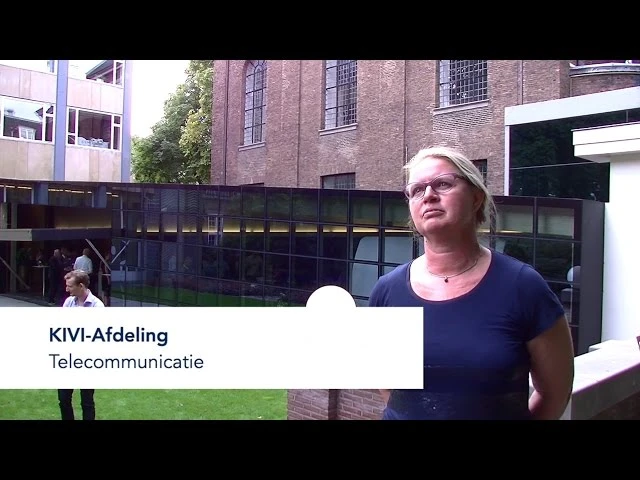
The Telecommunications Department of the Royal Institute of Engineers (KIVI-TC) focuses on disseminating knowledge and experience in the field of telecom networks, services, peripherals and users. The department organises lecture evenings, seminars and excursions to companies and institutions. These activities are open to all KIVI members and interested parties.
Technical and business aspects of products, services, suppliers and manufacturers are discussed. Attention is also paid to marketing and social aspects for business and private end-users.
Benefit from integrated telecom and IT solutions
The dynamic field of activity of the KIVI Telecommunications Division is defined by the rapid developments in Telecom and IT. The distinction between Telecom and IT is blurring. Integrated Telecom and IT solutions are available, using the Internet, e-mail, social media and (live) video links and meeting the growing need for information. Ever-increasing speeds are possible through an advanced transport network, largely based on coaxial, fibre-optic and jet links. Broadband mobile communications are also supported via this "fixed" network. With advanced radio systems, higher and higher transmission speeds are becoming possible. Wireless mobile communication has now surpassed fixed connections worldwide. This results in an unprecedented increase in data and voice traffic. Distance hardly matters in transmission costs (death to distance); internet can be offered over the fixed network at a fixed rate.
Trends: cloud services and software networks
The new possibilities of working with and in the Cloud, software-defined networks (SDN), the further integration of components in chips, the downsizing and cost reduction of sensors and devices are leading to ever newer and more sophisticated applications.
An important trend is the increasing use of communication with and between devices (internet of things, machine-to-machine). New developments in wireless (radio) communication enable addressing and handling of large numbers of devices at low cost. With successive generations of mobile communications like 2G, 3G, 4G and 5G, we see new capabilities, possibilities, and applications every time, resulting in explosive growth.
New business models in a changing landscape
Corporatisation and privatisation of formerly state-owned companies, mergers and acquisitions, and concentration on core tasks (whatever they may be or become) are leading to a very changing telecommunications landscape. The traditional telecom company is under pressure. Telecom services are provided by different operators or suppliers, including over networks they do not own or operate.
The business models best suited to this largely follow the technical possibilities, but are also determined by market demand. Internationalisation, location-independent working of customers, constant mergers and splits of companies require flexible telecom solutions at the lowest possible cost.
Regulations can hardly keep up with technical and social developments. In social discussions on telecommunications, aspects such as privacy and security in addition to fair competition and competition are receiving increasing attention.
Useful contacts and inspiring company visits
The KIVI Telecommunications Division has a lot to offer for those who want to keep up with the latest developments in the field at a level. In addition to presentations, there is also the opportunity to visit interesting telecom companies and locations. Speakers are experts, drawn from companies, governments, education and research.
The meetings are an effective investment of time from which useful and enjoyable contacts emerge.
Added value through collaboration with other organisations
Members of the Telecommunications Division also have easy access to related KIVI departments, such as for KIVI Departments of Computer Science, Electrical Engineering and Defence and Security.
In addition, the KIVI Telecommunications Division has entered into partnerships with related organisations outside KIVI, such as the Platform for Telecom, Media and ICT Pofessionals TSOC, AFCEA and IEEE, allowing KIVI-TC members to participate (sometimes for a fee) in activities of these organisations as well. More information can be found here.
Participation in KIVI Telecommunications Division activities is sometimes free for members or a small fee (for e.g. snacks) is charged; non-KIVI members generally pay a fee. Non-members are made aware of the benefits of KIVI membership.
Benefits of FITCE membership (now terminated)
FITCE is a forum for ICT and Media professionals to exchange and gain insight into new developments and challenges in the technical, regulatory, social and economic aspects of ICT and media technologies and services. FITCE has been in existence for 50 years and has members in 11 European countries.
From 1 January 2015, every member of the Telecommunications Division was also a member of FITCE. At the end of 2016, it was assessed whether FITCE has enough to offer to Telecommunications Division members, relative to the cost and whether this membership will be further renewed.
Termination of FITCE membership after trial period
Since the establishment of FITCE, FITCE Netherlands existed as a subgroup of KIVI Telecommunications (KIVI-TC).
As a result of a reorganisation of FITCE International, the KIVI-TC board dissolved the dedicated group FITCE Netherlands in 2015, at the same time making all KIVI-TC members automatically members of FITCE free of charge. kIVI-TC then instituted a two-year trial period, after which it would determine whether and how we could continue with FITCE.
This was directly related to the now emerging discussion on the value of and interest in FITCE for KIVI-TC members. A survey of members on FITCE yielded a response of about 30 members. The responses showed that interest in FITCE had dropped to almost zero and there were no future expectations either.
After the 2-year trial period set by the board for membership in the Netherlands had expired, the board -in view of the lack of interest in the Netherlands and the stagnation of developments within FITCE itself- decided to terminate membership of FITCE after 54 years with effect from 1 April 2017.
Further information on FITCE can be found at www.fitce.org.